
Driveway Gate Ideas: A Northern California Design Lookbook
A curated lookbook of driveway gate ideas organized by style — Modern, Traditional, Farmhouse, Mediterranean, Craftsman — and by material — Sapele mahogany, white oak, Ipe, metal inlay, and mixed wood-and-iron. Built from real Heartwood Gates projects across the Bay Area, Marin, Napa, and the Sierra foothills.
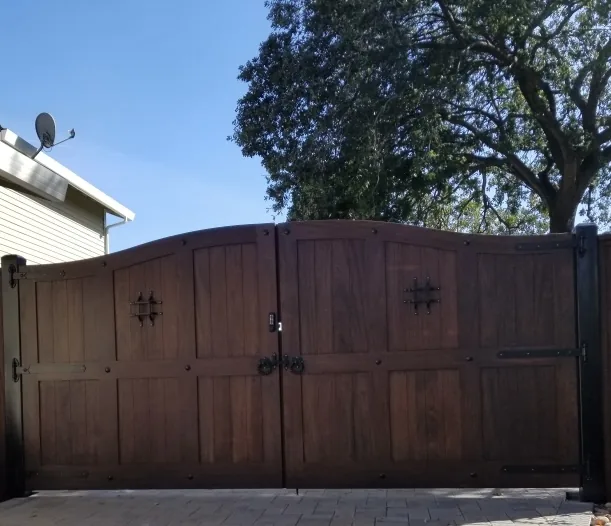
The strongest driveway gate ideas pair an architectural style — Modern slat, Traditional arched, Farmhouse board-and-batten, Mediterranean wood-and-iron, or Craftsman frame-and-panel — with a hardwood matched to the property's microclimate (Sapele for most Bay Area estates, white oak for traditional, Ipe or Teak for extreme exposure). Metal accents work best when they support the wood, not compete with it. The right archetype is the one that reads as native to your home's architecture.
Key takeaways
- Five archetypes cover most Northern California driveways: Modern horizontal slat, Traditional arched, Farmhouse board-and-batten, Mediterranean wood-and-iron, and Craftsman frame-and-panel.
- Sapele mahogany is the workhorse hardwood — stable, beautiful, and 40% the cost of Teak with 85% of the weather resistance.
- Metal inlays read best in three forms: forged grilles, laser-cut steel panels, and minimal strap hinges.
- Match scale to span — a 24-foot opening needs heavier proportions and oversized ironwork than a 12-foot opening.
- Pre-plan automation, lighting, and intercom wiring during design — retrofitting through stone or stucco piers is expensive.
- The right gate reads as inevitable for the house — not transplanted from another climate.
Driveway gate ideas tend to live in two camps: catalog photos from manufacturers thousands of miles away, and Pinterest boards full of gates that look great but won't survive a Northern California summer. This lookbook is the in-between. Every archetype below comes from a real <a href="/services/automatic-driveway-gates">handcrafted luxury driveway gate</a> we've built or specified for clients across the Bay Area, Marin, Napa, and the Sierra foothills — organized by style and by material so you can move from inspiration to a real conversation with your builder. Use it to find the design language that fits your home, then narrow to the wood and ironwork combination that will look right at year one and year twenty-five.
Modern: horizontal slats, clean steel, restrained palette
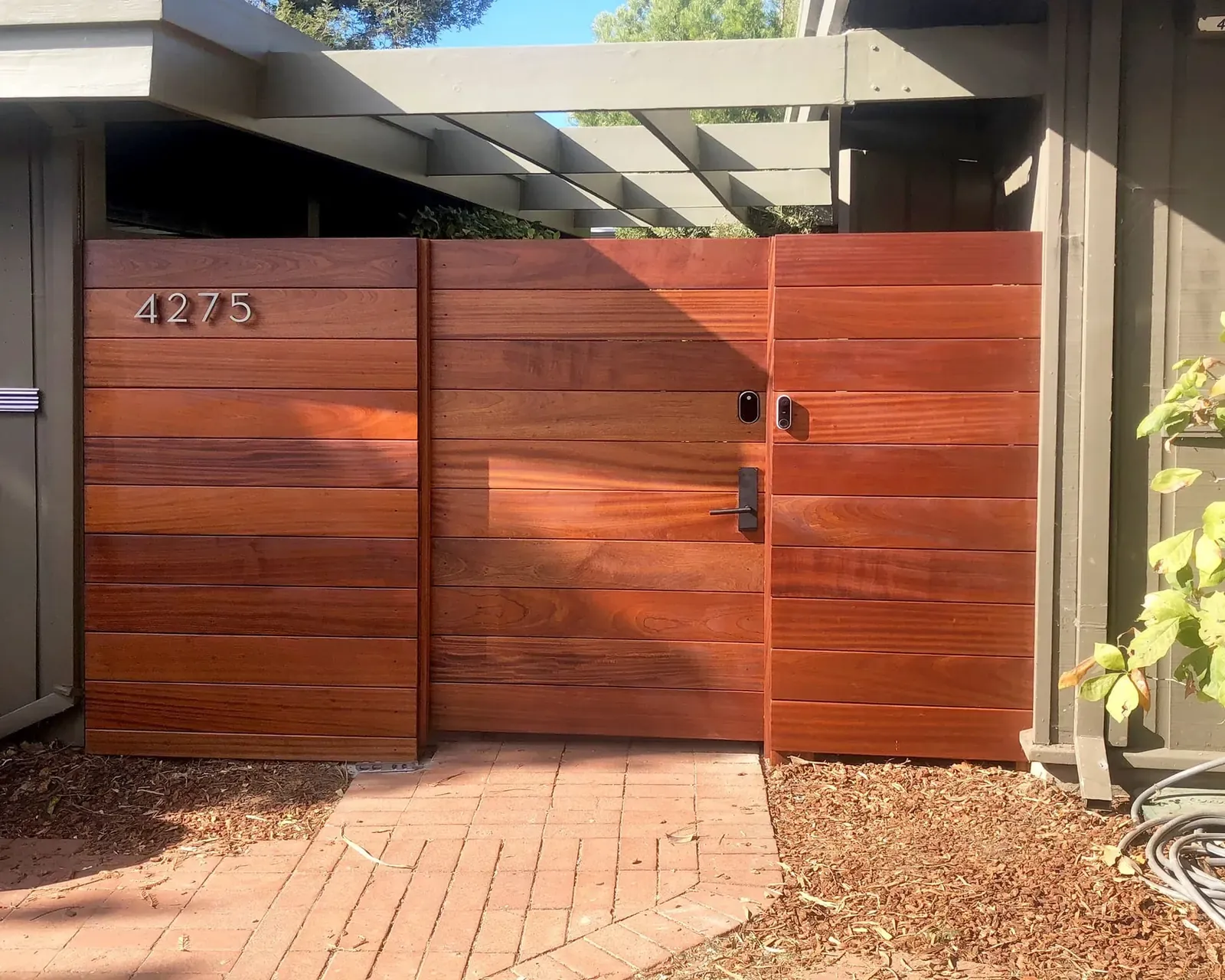
Modern driveway gates rely on rhythm and proportion rather than ornament. The signature move is a horizontal slat field — Sapele or Ipe boards on a hidden steel subframe — broken by negative space, a single accent material, or a recessed mail slot. Done right, it reads as architecture. Done lazily, it looks like fencing.
Our favorite modern execution is a 16- to 20-foot dual-leaf Sapele slat gate with 1.5" boards spaced at 3/4", mounted on a powder-coated steel subframe with concealed hinges. The wood does the talking. A laser-cut steel address panel or a single ribbon of blackened iron is all the ornament it needs. See our deep dive on horizontal slat gates for the engineering behind it.
Where modern goes wrong: oversized hardware on a minimalist field, mixing too many slat widths, or specifying a clear finish that grays unevenly within two years. Pick one accent and let the proportions carry the rest.
Traditional: arched tops, raised panels, forged ironwork
Traditional driveway gates lean into symmetry and craft. Arched or radius tops, raised panels with bevel detail, forged scrollwork or quatrefoil grilles, and clavos or strap hinges with visible joinery. This archetype is at home in front of brick Georgians, stone Tudors, and the older Spanish Colonials of Hillsborough, Atherton, and the East Bay hills.
A representative traditional gate is a 14- to 18-foot arched dual-leaf Sapele swing with bookmatched raised panels, a forged iron grille in the upper arch, hand-forged strap hinges, and a satin marine finish in a custom mahogany stain. The arch should mirror a feature on the house — window head, entry door surround, or roofline. When the arch lines up, the gate reads as original to the property.
For traditional homes near the coast or in deep shade, white oak earns its place — denser, more formal, and accepts the kind of rich stain palette traditional architecture rewards.
Farmhouse: vertical board-and-batten, X-bracing, blackened steel
Farmhouse driveway gates feel honest — a clear nod to barn doors and ranch entries. Vertical board-and-batten, X- or Z-bracing, and blackened steel strap hinges sized for the gate's actual weight. The material story is usually a single hardwood with a hand-rubbed oil finish that ages to a soft silver-gray.
Our typical farmhouse build is a 12- to 16-foot dual-leaf gate in Sapele or western red cedar with 1×6 vertical boards over a steel frame, classic X-brace on each leaf, and oversized forged strap hinges in blackened steel. It belongs in front of restored barns in Sonoma, modern farmhouses in Napa, and the new wave of agrarian-inspired estates around Yountville and Healdsburg.
The fastest way to break farmhouse is to over-design it — chamfered edges, decorative cutouts, or three different finishes. Restraint is the style.
Mediterranean: wood-and-iron, arched grilles, warm stains
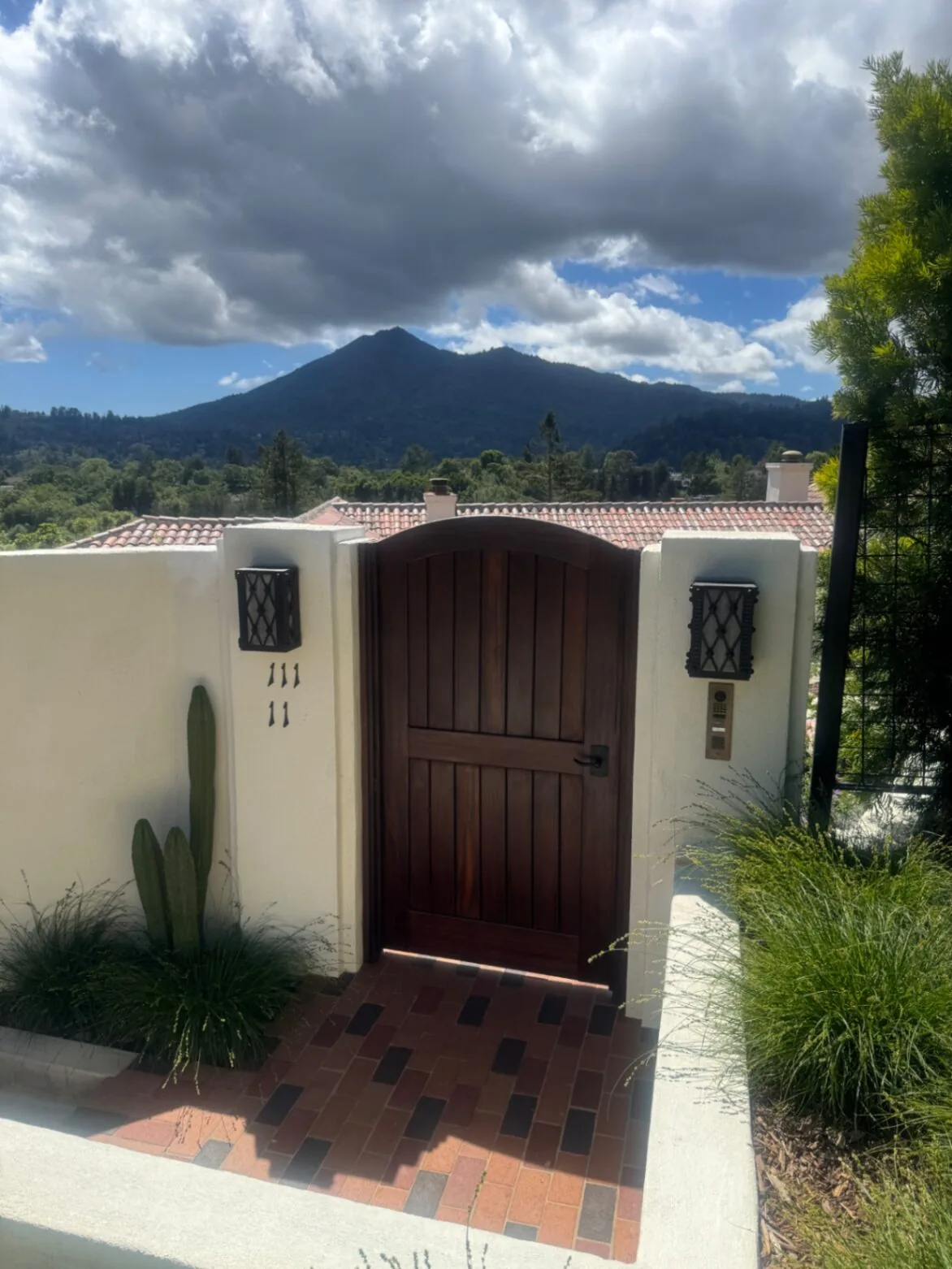
Mediterranean driveway gates pair warm hardwoods with substantial ironwork — arched tops, ornamental grilles, forged spear finials, and the occasional speakeasy panel. This archetype was made for Spanish Colonial Revival, Tuscan, and Andalusian-inspired estates across the Peninsula and Wine Country.
A signature Mediterranean execution: a 16-foot arched dual-leaf Sapele swing with a full-height forged iron grille over the wood field, scrollwork in the upper arch, hand-forged hinges and latch, and a deep mahogany finish. The wood-to-iron ratio is roughly 60/40 — wood reads as the structure, iron reads as the jewelry.
Pair the gate with stone or stucco piers, two warm-light path fixtures, and matching pedestrian hardware. The driveway becomes a sequence, not just an opening.
Craftsman: frame-and-panel, exposed joinery, Greene & Greene details
Craftsman driveway gates celebrate joinery. Visible mortise-and-tenon, through-tenons with pegs, cloud-lift rails, square dowels, and warm tannin-rich finishes. The archetype reads as native to Berkeley brown shingles, Pasadena bungalows, and the Greene & Greene-inspired homes of the East Bay and Sierra foothills.
A favorite Craftsman build is a 14-foot dual-leaf white oak swing with frame-and-panel construction, cloud-lift top rail, square ebony plugs marking each joint, and a hand-rubbed oil finish. Hardware stays modest — bronze strap hinges, a simple thumb latch, and exposed pegs rather than concealed fasteners.
Done right, a Craftsman gate looks like the same shop built the front door, the porch beams, and the gate. That coherence is the goal.
We're booking design consultations 4–6 weeks out. Send us your driveway photos and we'll come back with a sketch, wood spec, and finish system within five business days.
By material: how the hardwood changes the story
Sapele mahogany — the workhorse. Ribbon grain, dimensional stability, and a finish that holds its color in marine climates. Works in every archetype above. Our default recommendation for Bay Area estates.
White oak — denser, more formal, and the right call for traditional and Craftsman gates that need to carry visual weight. Accepts deep stain beautifully.
Ipe — ultra-durable and naturally silvering. Best for modern slat fields and exposed Woodside or coastal ridges where 40-year service life justifies the premium.
Teak — the gold standard for coastal Marin, exposed Wine Country ridges, and properties where minimal maintenance is the priority. Natural oils make it nearly impervious to water.
Western red cedar — lighter, softer, and the right pick for farmhouse gates that are meant to weather to gray. Excellent in dry foothill climates.
For a side-by-side cost and durability comparison, see Sapele mahogany vs Teak in Northern California and our gate microclimate guide.
Wood-and-metal combinations that actually work
Metal inlays elevate a wood gate when they support the design language. They sabotage it when they compete with the wood field for attention. Three combinations earn their place reliably:
Forged iron grilles in the upper third or full-height — traditional, Mediterranean, and arched designs. Hand-forged reads as jewelry; cast iron reads as catalog.
Laser-cut steel panels — modern and contemporary designs. A single accent panel with a custom motif (botanical, geometric, family crest) anchors a slat field without overwhelming it.
Minimal strap hinges and clavos — farmhouse, Craftsman, and Spanish designs. Hardware sized to gate weight reads as honest. Undersized hinges on a heavy gate read as decorative theater.
More on hardware selection: hand-forged iron hardware and decorative iron scrollwork.
From inspiration to your driveway
Once you've found the archetype that fits your home, the next step is a site visit. We measure the opening, photograph the architecture, and walk the property to understand how the gate will be used — daily commute, occasional service access, or estate entrance. From there we sketch in CAD, render the design in context, and walk you through every line item on the quote.
Browse our full project gallery to see these archetypes built out across Northern California, or request a design consultation to start the conversation. For pricing context, our piece on the true cost of a luxury custom driveway gate breaks down what each style typically lands at.
About design
For more answers, see our full FAQ.
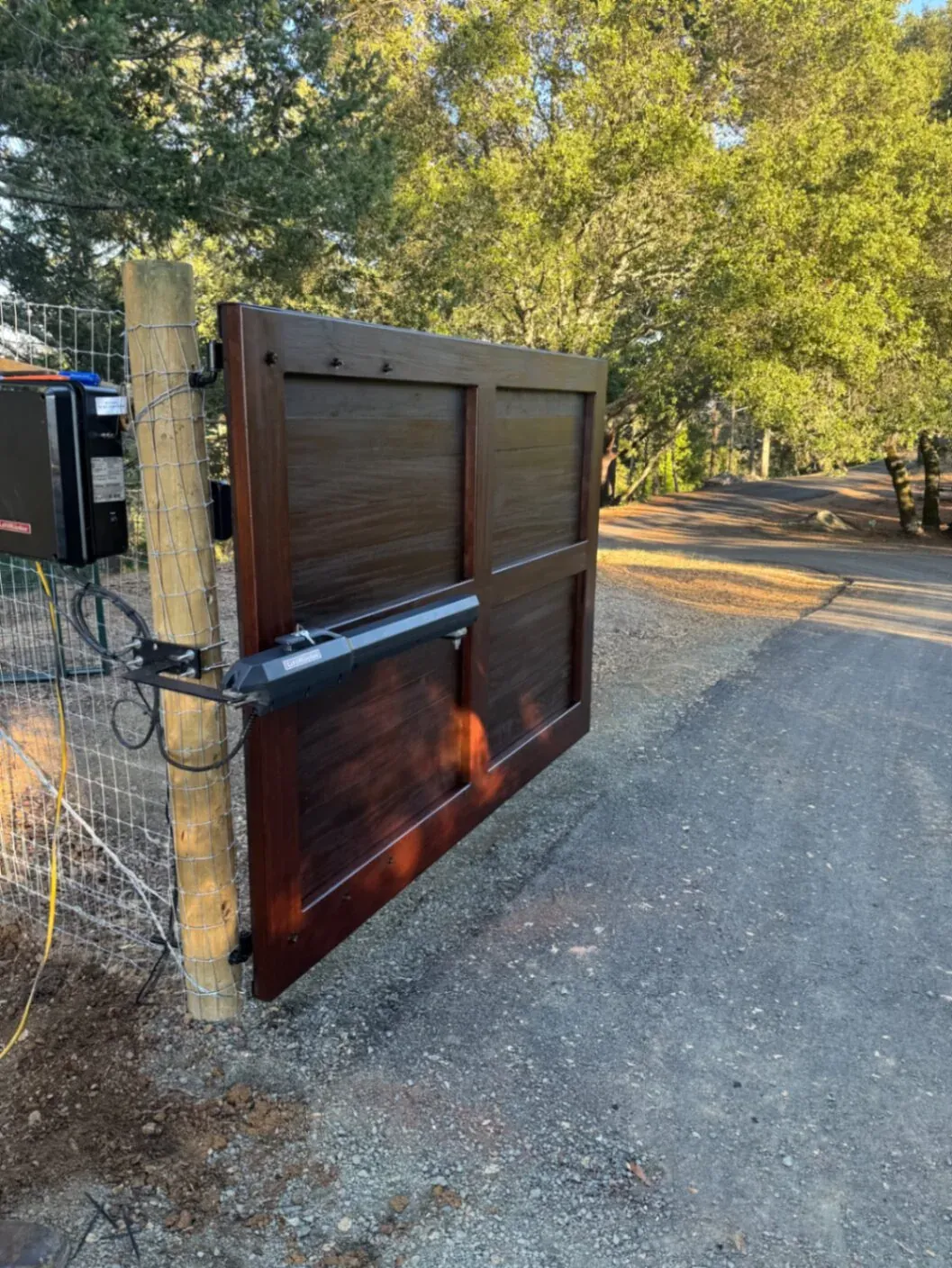
Let's design a gate that belongs to your home.
Tell us about the entrance you want to build. We respond same-day to consultations booked before 2pm, next business day after.