
The Modern Horizontal Slat Gate: A Design Language for Piedmont and the Berkeley Hills
Why horizontal slat hardwood gates have become the default for contemporary remodels in Piedmont, the Berkeley Hills, and modern East Bay architecture — and how we engineer them so they actually last.
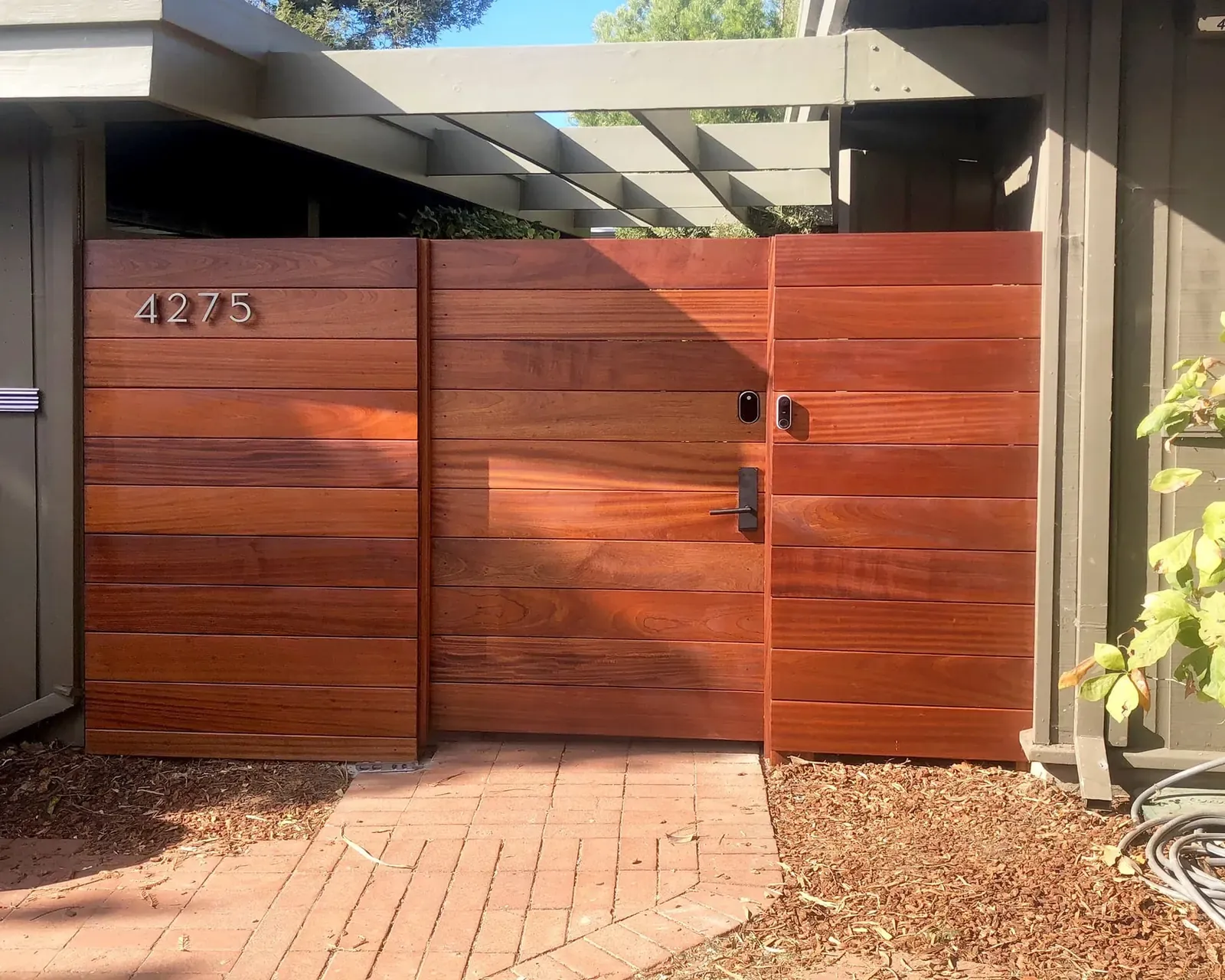
A modern horizontal slat gate is a series of parallel hardwood slats fixed to a concealed steel or hardwood inner frame, presenting as a clean horizontal pattern with consistent shadow gaps. The engineering is concealed: a structural frame carries all load, and the slats are face-attached with engineered movement allowance. Done correctly, the gate is dimensionally stable across decades.
Key takeaways
- A modern horizontal slat gate is a series of parallel hardwood slats fixed to a concealed steel or hardwood inner frame, presenting as a clean horizontal pattern with consistent shadow gaps. The engineering is concealed: a structural frame carries all load, and the slats are face-attached with engineered movement allowance. Done correctly, the gate is dimensionally stable across decades.
- Why horizontal slats took over contemporary residential design: The horizontal slat aesthetic emerged from mid-century Japanese architectural detailing and was widely adopted in Pacific Northwest modern design before becoming a Bay Area staple in the early 2010s.
- What goes wrong on a poorly built horizontal slat gate: The failure mode of an amateur horizontal slat gate is consistent and ugly.
- How we engineer the concealed frame: Every modern slat gate we build has a structural frame entirely concealed behind the slats.
- Slat dimensions, spacing, and proportions: Our default slat dimensions for contemporary gates: 1.5 inch thick by 3.5 inch wide slats, with a 3/8 inch shadow gap between slats, in Sapele or white oak.
- Will a horizontal slat gate provide privacy? By default, no — there are visible shadow gaps between slats. We can add internal privacy panels or use a slat-and-channel profile to achieve full privacy while preserving the visual aesthetic.
Walk through the recent contemporary remodels in Piedmont, the Berkeley Hills, and the modern hillside homes of Orinda and Lafayette, and one gate detail keeps appearing: a horizontal slat hardwood gate, often in Sapele mahogany or white oak, with consistent narrow shadow gaps between slats and a concealed frame. The detail looks simple. It is not. Built incorrectly, a horizontal slat gate twists, sags, and develops uneven gaps within a few seasons. Built correctly, it is one of the most enduring contemporary design moves in residential architecture. This is how we build them.
Why horizontal slats took over contemporary residential design
The horizontal slat aesthetic emerged from mid-century Japanese architectural detailing and was widely adopted in Pacific Northwest modern design before becoming a Bay Area staple in the early 2010s. The reason is the same reason mid-century furniture has endured: the proportions are tight, the visual language is universal, and the detail reads as 'designed' without screaming for attention.
On Bay Area contemporary remodels — particularly in Piedmont, the Berkeley Hills, and the modern hillside neighborhoods of Orinda and Lafayette — the horizontal slat gate matches the prevailing language of the architecture: long horizontal massing, generous overhangs, large planes of glass and warm wood. The gate becomes a continuation of the architectural rhythm rather than an interruption of it.
It is also a flexible detail. The same horizontal slat language can be tuned warm and craft-leaning (wider slats, tighter gaps, white oak) or cool and contemporary (narrower slats, larger gaps, Sapele or stained walnut). The detail is robust enough to fit a wide range of architectural styles.
What goes wrong on a poorly built horizontal slat gate
The failure mode of an amateur horizontal slat gate is consistent and ugly. Slats are screwed directly to a simple rectangular frame with no allowance for seasonal movement. Each slat shrinks and swells across its width independently; the screws prevent the movement; the slats cup, develop end-grain checks, and pull the screws out of the frame.
Within three to five seasons in the East Bay's moisture cycling, the gate has uneven gaps between slats, visible screw heads that have backed out, and a few slats that have twisted out of the plane of the gate. We have refinished this exact failure on gates other shops built across Piedmont and the Berkeley Hills more than once.
The root cause is treating each slat as if it were structural. It is not. The slats are cladding. The frame carries the load. Conflating the two is the design error.
How we engineer the concealed frame
Every modern slat gate we build has a structural frame entirely concealed behind the slats. The frame is either an integral mortise-and-tenon hardwood frame for smaller gates, or — for automatic driveway gates and any leaf wider than 8 feet — a welded steel sub-frame using the method detailed in our piece on steel sub-frame and Sapele cladding.
The slats are face-attached to the frame using concealed stainless steel clip systems that allow each slat to move dimensionally without binding against its neighbors. The clip systems we use are similar in principle to modern rainscreen siding details — the slats are held in plane but not constrained from seasonal expansion and contraction.
Slat ends terminate inside concealed end caps machined into the gate stiles, so the end grain is never exposed to weather and the slats can shift longitudinally within the cap without affecting the gate's appearance. This single detail is what separates a slat gate that looks good for 30 years from one that looks good for 5.
Slat dimensions, spacing, and proportions
Our default slat dimensions for contemporary gates: 1.5 inch thick by 3.5 inch wide slats, with a 3/8 inch shadow gap between slats, in Sapele or white oak. The proportions read clean from 5 feet away and read crafted from 1 foot away — both viewing distances matter for an entry gate.
For tighter modern aesthetics, we can go to 1 inch thick by 2.5 inch wide slats with a 1/4 inch gap. The look is more minimal but requires a denser frame underneath to maintain rigidity. For warmer craftsman-leaning aesthetics, we can go to 2 inch thick by 5 inch wide slats with a 1/2 inch gap.
Slat orientation is always continuous: no aligned vertical seams between slats from leaf to leaf on a bi-parting gate. We rip slats to length to avoid end-to-end joints anywhere within a leaf. End-to-end joints in a slat are a tell that the gate was built from short stock.
Finishing the horizontal slat gate
Modern slat gates accept either a warm clear finish (showing the wood's natural color) or a stained finish (controlling the appearance to match adjacent millwork). Both finish strategies require complete coverage on all six faces of every slat — including the ends, which are inside the end caps and invisible after assembly.
We finish slats individually before face-attachment. Slats are sealed on all six faces with a marine-grade penetrating sealer, then top-coated with two coats of Penofin Verde or comparable. The slats are then installed dry into the frame and clip system. This protects the end grain inside the end caps from any future water intrusion.
Refinishing schedule for a maintained slat gate is a top coat at year three, full strip-and-recoat at year eight, and recoats every six to eight years thereafter. Maintenance is straightforward because each slat is accessible from both faces.
We're booking design consultations 4–6 weeks out. Send us your driveway photos and we'll come back with a sketch, wood spec, and finish system within five business days.
Privacy considerations
A horizontal slat gate with a visible shadow gap between slats is not opaque. From a slight angle you can see through it. For many contemporary clients this is desirable — the gate filters views without blocking them, which is part of the modern design language.
For clients who want full privacy, we offer two solutions. First, an internal opaque panel installed behind the slats, separated by an air gap. The slats remain the visible exterior; the opaque panel handles privacy. Second, a slat-and-channel design where the slats are profiled with a small overlap that blocks line-of-sight while preserving the visible shadow gap appearance.
The privacy decision should be made at design stage, not retrofitted, because it affects frame depth and slat spacing.
Integration with adjacent fencing and millwork
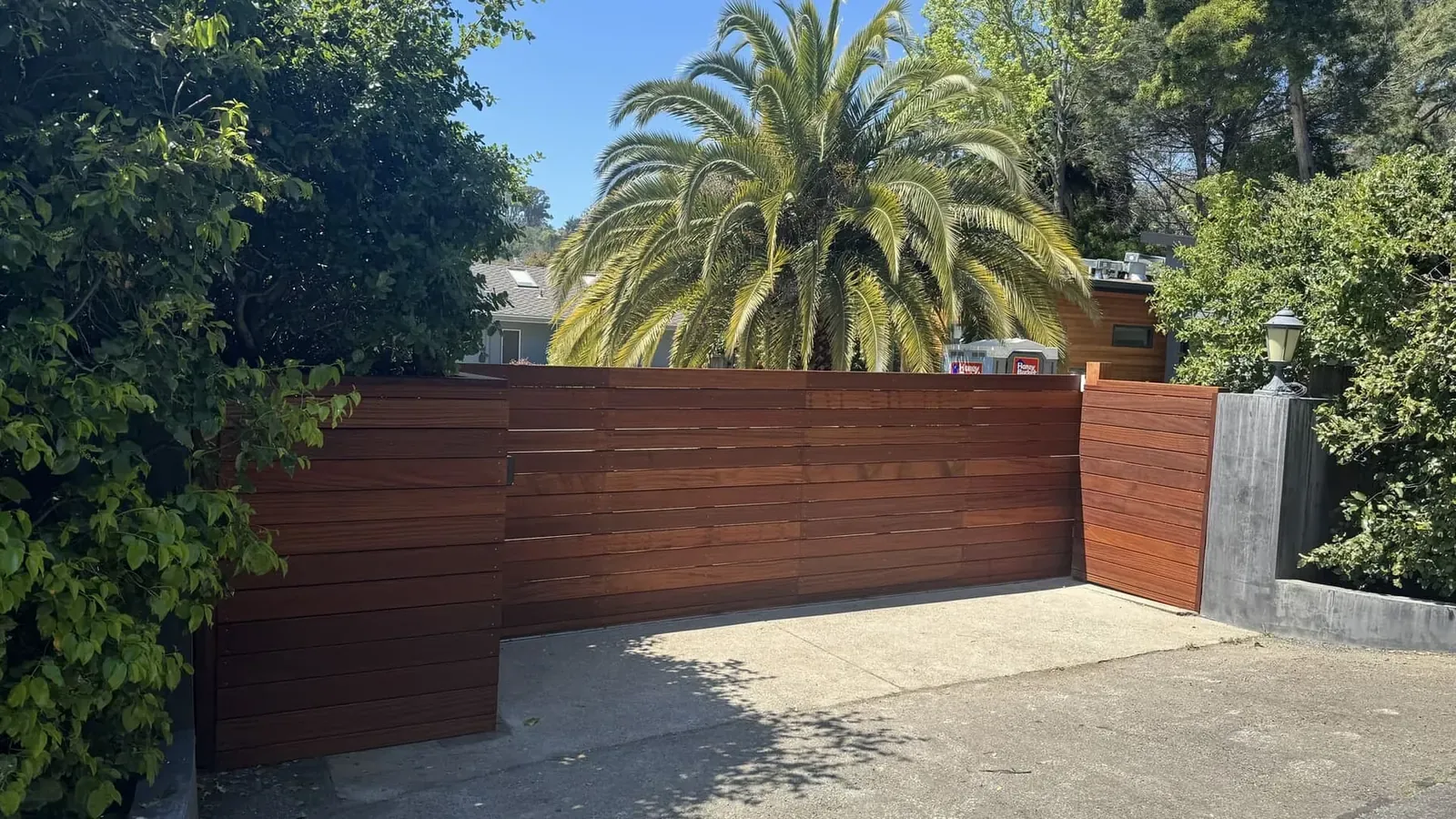
A horizontal slat gate looks best when it reads as part of a longer slat fence, not as a stand-alone object. On well-detailed Piedmont and Berkeley Hills remodels, the gate's slat rhythm continues into the flanking fence panels, with the same slat dimensions, shadow gaps, and finish across the entire run.
We build the matching slat fence panels in the same workshop, using the same materials and detailing. Coordination with the landscape contractor or general contractor is straightforward when the gate and adjacent fencing are part of the same scope.
For projects where existing fencing is being kept, we will match the existing detail as closely as the geometry allows, or recommend re-detailing the gate to acknowledge the existing language rather than fight it.
Why we build these specifically for Piedmont and the East Bay hills
Piedmont, the Berkeley Hills, and the contemporary remodels of Orinda and Lafayette are some of the most demanding contexts for a custom gate. The architecture is sophisticated, the homes are valuable, and the buyers are knowledgeable. Detail mistakes are noticed.
Our shop is 25 minutes from Piedmont, 30 from the Berkeley Hills. We can be on site for design measurements, install, and follow-up service quickly. The horizontal slat language is one we have refined across dozens of projects in these neighborhoods specifically.
If you are planning a contemporary entry gate for a property in Piedmont, the Berkeley Hills, or anywhere across the East Bay, start with our custom gates service overview and the East Bay service areas page. Then request a design consultation and we will walk the site together.
About design
For more answers, see our full FAQ.
Let's design a gate that belongs to your home.
Tell us about the entrance you want to build. We respond same-day to consultations booked before 2pm, next business day after.