
A Microclimate Guide to Gate Design: From the Sacramento Valley to the Sonoma Coast
Why the same gate specification fails in Tiburon and thrives in Roseville — and how Heartwood Gates tailors wood species, finish, and engineering to six distinct Northern California climate zones.
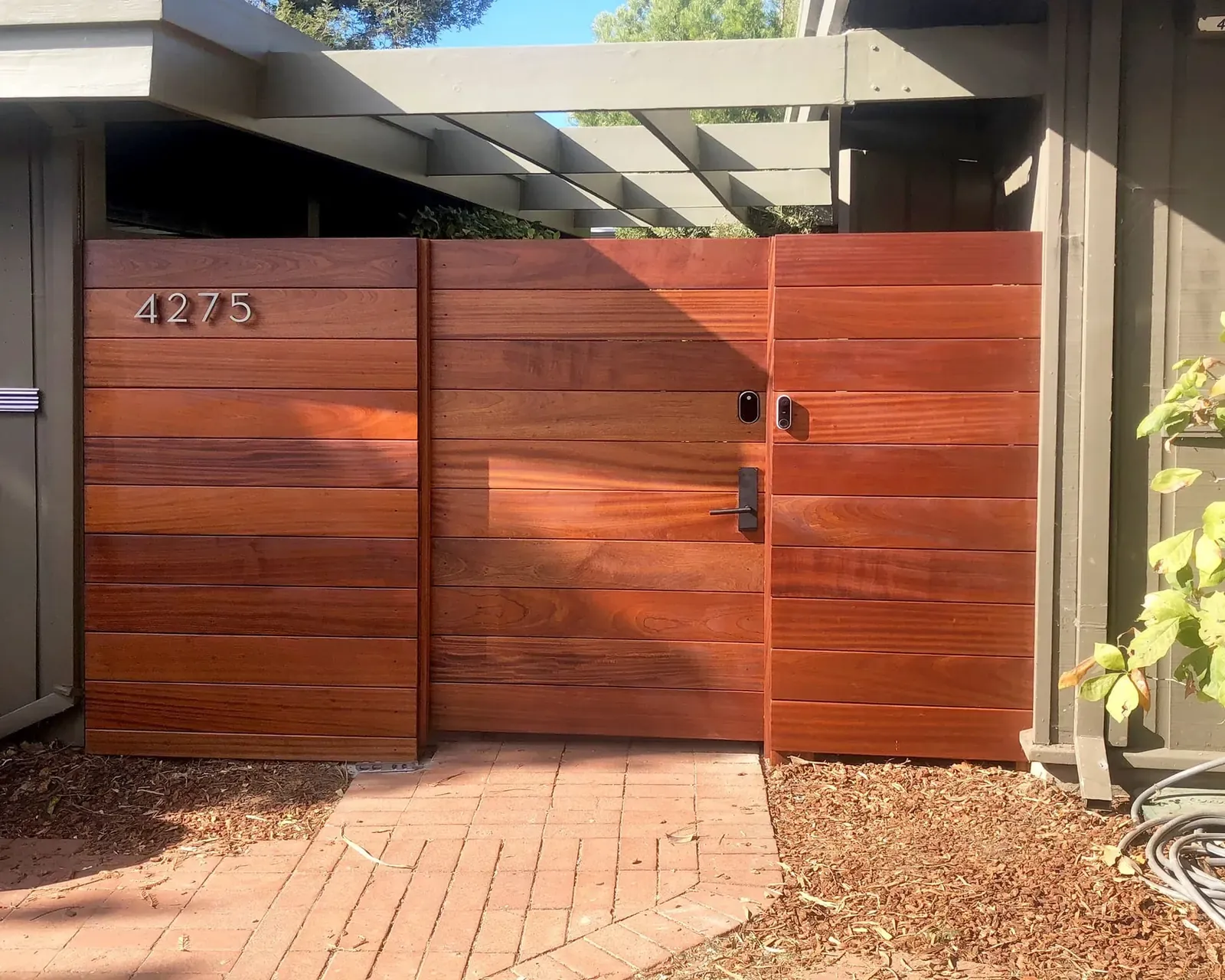
Heartwood Gates tailors every gate specification to the microclimate it will live in. Coastal salt air demands stainless hardware and marine-grade finishes. Inland heat demands UV-stable oils and deeper post footings. Fog-belt humidity favors cedar and Sapele over redwood. Sacramento Valley dryness favors dense hardwoods and aggressive hydration schedules. The right specification doubles service life.
Key takeaways
- Heartwood Gates tailors every gate specification to the microclimate it will live in. Coastal salt air demands stainless hardware and marine-grade finishes. Inland heat demands UV-stable oils and deeper post footings. Fog-belt humidity favors cedar and Sapele over redwood. Sacramento Valley dryness favors dense hardwoods and aggressive hydration schedules. The right specification doubles service life.
- Zone 1: The inland heat basin — Walnut Creek, Concord, Pleasanton, Dublin: The inland East Bay is defined by hot, dry summers and cool, wet winters.
- Zone 2: The fog belt — Mill Valley, Tiburon, Sausalito, coastal Santa Cruz: The coastal fog belt is the most demanding environment for outdoor wood in California.
- Zone 3: The Wine Country valley floor — Napa, Yountville, St. Helena, Sonoma: The Napa and Sonoma valley floors share the inland heat of the East Bay but with less extreme peaks and more consistent morning fog that burns off by mid-morning.
- Zone 4: The Sacramento Valley — Sacramento, Folsom, Roseville, El Dorado Hills: The Sacramento Valley is the hottest and driest region we serve.
- Does the microclimate really matter that much? Yes. We've seen the same gate specification last 30 years in Walnut Creek and need major repair at year 12 in Tiburon. The environment is the single biggest variable in gate longevity after joinery quality.
Northern California is not one climate. It is a patchwork of microclimates — fog belts, river valleys, inland heat basins, coastal salt zones, and foothill transition belts — each with its own humidity cycle, UV load, wind exposure, and salt content. A Sapele gate with our standard premium-oil maintenance schedule will last 30 years in Walnut Creek and need attention at year 15 in Tiburon. A western red cedar gate that thrives in Mill Valley will check and split in El Dorado Hills by year 8. The gate industry treats California as a single market and ships the same specification everywhere. We don't. This guide explains how we adjust wood species, finish systems, steel protection, and joinery details for six distinct climate zones across our service area.
Zone 1: The inland heat basin — Walnut Creek, Concord, Pleasanton, Dublin
The inland East Bay is defined by hot, dry summers and cool, wet winters. Summer temperatures regularly exceed 100°F, humidity drops to 15%, and UV exposure is extreme on unshaded gates. Winter brings 30 to 40 inches of rain concentrated between November and March, with occasional freeze events.
Wood behavior in this zone: rapid surface drying in summer causes checking on softwoods, while winter wetting causes end-grain swelling. The species that perform best are dense hardwoods with low seasonal movement: Sapele, white oak, and ipe. Cedar is too soft for the thermal cycling; redwood is acceptable if all-heart vertical-grain material is specified.
Finish strategy: Penofin Verde Marine Oil (or Cabot Australian Timber Oil for warmer tones) with UV inhibitors, applied in four coats initially, with a wipe-on maintenance coat every 3 years and a full strip-and-recoat at year 8. We do not use film-forming finishes in this zone — the summer heat causes film failure within two seasons.
Hardware: standard zinc-coated or powder-coated steel hinges and latches are adequate. Salt corrosion is not a factor inland. Post footings are 48 inches deep in standard clay soils, with rebar cages.
Zone 2: The fog belt — Mill Valley, Tiburon, Sausalito, coastal Santa Cruz
The coastal fog belt is the most demanding environment for outdoor wood in California. Relative humidity rarely drops below 60% and often sits at 90% for days at a time. Salt air carries corrosive chlorides inland up to a mile from the waterline. UV is moderate because fog provides natural shading, but the constant moisture means wood is never fully dry.
Wood behavior: decay is the primary failure mode, not sun damage. Softwoods with natural rot resistance — western red cedar and old-growth redwood — outperform dense hardwoods in this zone because the hardwoods' density does not help if moisture never leaves the surface. Sapele and white oak still work, but they need more frequent finish maintenance.
Finish strategy: two-part marine epoxy sealer followed by a penetrating oil with mildewcide — typically Messmer's UV Plus or TWP 100. The epoxy creates a moisture barrier that a standard oil does not provide. Maintenance cycle is every 18 to 24 months.
Hardware: all stainless steel — 316 grade within a quarter-mile of the waterline, 304 grade beyond that. Zinc-coated or powder-coated steel will rust through in 3 to 5 years in this zone. Post footings are 48 inches minimum, with drainage gravel at the base to prevent standing water.
Zone 3: The Wine Country valley floor — Napa, Yountville, St. Helena, Sonoma
The Napa and Sonoma valley floors share the inland heat of the East Bay but with less extreme peaks and more consistent morning fog that burns off by mid-morning. Summers are warm and dry, winters are cool and wet, and vineyard dust is a maintenance factor that most gate builders ignore.
Wood behavior: similar to the inland East Bay, but with slightly moderated temperature swings. Sapele is the default species here — it matches the Mediterranean architectural vocabulary, tolerates the heat, and weathers gracefully. White oak works well for contemporary homes. Redwood is acceptable for rustic or ranch-style gates.
Finish strategy: Penofin Verde or Armstrong Clark semi-transparent oil, four coats initially, 3-year wipe-on maintenance cycle, 8-year full recoat. The vineyard dust is abrasive; matte finishes hide dust better than glossy finishes, which is why we specify satin or matte sheens for all Wine Country installations.
Hardware: powder-coated steel is adequate. Salt is not a factor. Post footings are 48 inches in most valley-floor soils, though hillside vineyard sites may require deeper footings in decomposed volcanic rock.
Zone 4: The Sacramento Valley — Sacramento, Folsom, Roseville, El Dorado Hills
The Sacramento Valley is the hottest and driest region we serve. Summer temperatures routinely reach 105°F to 110°F, humidity is negligible for months at a time, and winter rain is modest — 15 to 20 inches annually, concentrated in a few storms. The primary threat to wood is not moisture but desiccation.
Wood behavior: extreme dryness causes rapid moisture loss from the surface, leading to deep checking and surface cracking in softwoods. Dense hardwoods perform better because their lower equilibrium moisture content means they are already closer to the ambient conditions. Ipe and white oak are the best performers in this zone. Sapele is acceptable but benefits from a more aggressive finish schedule.
Finish strategy: Armstrong Clark semi-transparent oil (preferred in this heat zone for its non-drying conditioning oils) or Penofin Verde with additional UV inhibitors, applied in five coats initially to saturate the wood as deeply as possible. Maintenance coats every 2 to 3 years are critical — skipping a cycle in Sacramento heat means the wood is unprotected within a single summer. We also recommend irrigation misters for gates in full sun, which sounds excessive until you've seen what 110°F does to an unfinished hardwood surface.
Hardware: powder-coated steel is fine. The dry climate is gentle on metal. Post footings are deeper — 60 inches — because Sacramento Valley soils are often expansive clay that heaves with winter moisture cycles. We use belled footings or pier-and-grade-beam foundations on known expansive sites.
We're booking design consultations 4–6 weeks out. Send us your driveway photos and we'll come back with a sketch, wood spec, and finish system within five business days.
Zone 5: The coastal transition — Berkeley, Oakland, Piedmont, Ross
The coastal transition zone gets fog some mornings, sun most afternoons, and a mix of inland heat and coastal humidity that changes block by block. A gate in the Berkeley Hills may live in a different microclimate than a gate three blocks away in the flats. This variability makes the transition zone the hardest to specify without a site visit.
Wood behavior: highly variable. A south-facing gate in full sun behaves like Sacramento. A north-facing gate under redwood canopy behaves like Mill Valley. We evaluate every transition-zone project on site, measuring sun exposure, wind patterns, and drainage before specifying species and finish.
Our default for the transition zone is Sapele with the standard Penofin Verde schedule (with Cabot or Armstrong Clark substituted for color or UV reasons). It is forgiving enough to perform adequately across the range of conditions. For sites with high humidity or shade, we substitute white oak or specify a hybrid cedar-clad design. For sites with extreme sun exposure, we step up to ipe or increase the finish coat count.
Zone 6: The Sierra foothills — Lincoln, Loomis, Newcastle, Granite Bay
The Sierra foothills are colder in winter than any other zone we serve, with overnight freezes common from December through February and occasional snow. Summers are hot and dry, similar to Sacramento. The freeze-thaw cycle is the defining stressor for gates in this zone.
Wood behavior: freeze-thaw causes moisture trapped in the wood to expand and contract, leading to checking and joint failure. The best defense is a wood with low moisture absorption — dense hardwoods that do not take on water easily. Ipe is the star performer here, followed by white oak and then Sapele. Cedar and redwood absorb enough winter moisture to be vulnerable to freeze-thaw damage.
Finish strategy: TWP 100 or Messmer's UV Plus with mildewcide additive, five coats initially. The mildewcide matters because the foothills have more winter mold pressure than the valley floor. Maintenance every 3 years.
Hardware: powder-coated steel is adequate, but we avoid zinc-coated hardware because the freeze-thaw cycle accelerates galvanic corrosion at the hinge interfaces. Post footings are 60 inches deep to reach below the frost line, which is 18 to 24 inches in the foothills. We use rebar cages and 3,000-psi concrete.
How we apply this guide to your project
Every Heartwood Gates project begins with a site evaluation that includes climate zone mapping, sun-path analysis, and soil assessment. We don't ship the same gate to Roseville and Tiburon because the environments are fundamentally different. The species, finish, hardware, and foundation specification are all tuned to the site.
If you're in one of the transition zones — Berkeley, Oakland, Piedmont — we strongly recommend an on-site consultation rather than remote specification. The block-by-block variability in those microclimates means a gate that works on one property may struggle on another half a mile away.
For more on specific species, see our companion pieces on Sapele vs. redwood, cedar vs. hardwood, and white oak grain and finish. To start your project, request a design consultation.
About city guide
For more answers, see our full FAQ.
Related articles
Let's design a gate that belongs to your home.
Tell us about the entrance you want to build. We respond same-day to consultations booked before 2pm, next business day after.