
Heartwood GatesHeartwood GatesCalifornia · Est. 2016
Call (925) 570-3688
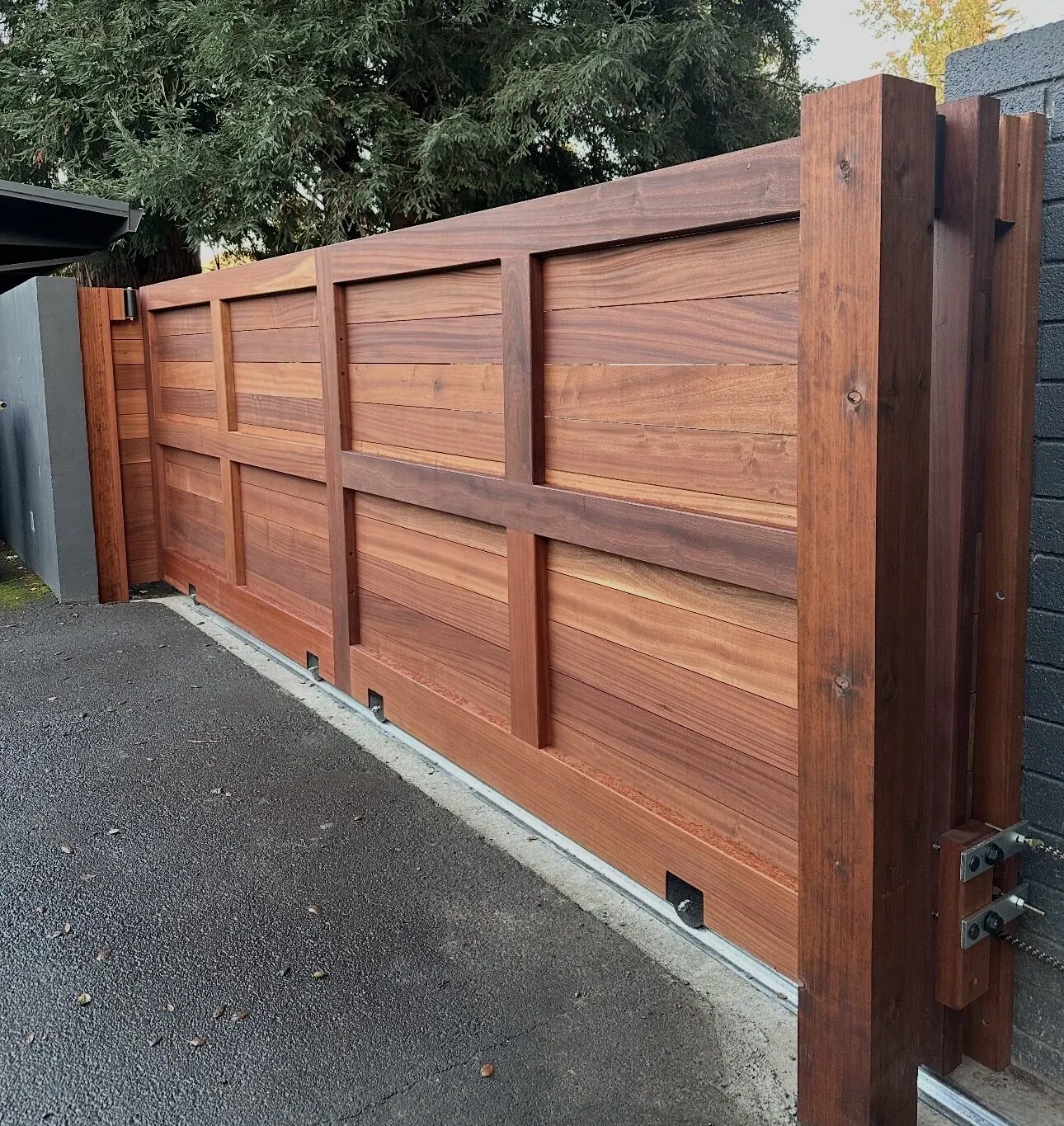
Custom sliding Sapele hardwood driveway gate on precision steel track, automated rack-and-pinion operator, Bay Area hillside estate
Services

Custom Sliding Gates — Space-Efficient & Grade-Friendly for Bay Area Estates

No swing arc needed. No slope limits. One leaf gliding on precision track, built with mortise-and-tenon craftsmanship and automated for effortless entry — from Sapele hardwood estates to modern steel compounds, engineered for tight spaces and steep grades.

What's Included

Every custom sliding gates — space-efficient & grade-friendly for bay area estates commission carries.

  • 01Standard sliding, cantilever (track-free), and bi-parting configurations
  • 02Spans from 8 feet to 40+ feet — single leaf or two-leaf bi-parting
  • 03Sapele hardwood — our signature wood, proven in every Bay Area microclimate
  • 04White Oak, aluminum, steel, wrought iron, Ipe, and Teak available
  • 05We do not build with Redwood or Cedar — softwoods that fail in NorCal climate
  • 06Handles grades up to 10%+ with cantilever — better than any swing format
  • 07Rack-and-pinion, chain-drive, or hydraulic operators sized to leaf weight
  • 08UL 325 photo eyes, edge sensors, manual release, 24–72 hour battery backup
  • 09Smart access: keypad, app, intercom, RFID, biometric, Control4 / Savant
  • 10Embedded steel track in 4,000 PSI concrete trench or cantilever pier engineering
  • 11WUI / Chapter 7A fire-zone compliant configurations with failsafe closure
  • 12Bay Area fabrication, nationwide shipping, 10-year structural / 5-year automation warranty
Request a quote

Quote a custom sliding gates — space-efficient & grade-friendly for bay area estates.

Three fields. We'll call you back today or the next business day.

(925) 570-3688No spam · One business day
Chapter

What a sliding gate is, and why estates choose one

A sliding gate has one leaf that travels horizontally along a track, parallel to your fence or property wall. Push a button. The leaf glides open. You drive through. It closes behind you. No swing arc eating up interior space. No wrestling with a heavy leaf on a hillside. Just smooth linear motion engineered for your specific grade and span. Homeowners choose sliding for space efficiency (no swing arc needed inside the property line — the gate travels parallel to the boundary), grade tolerance (handles steep slopes that make swing gates impractical or impossible), wind resistance (track-mounted design resists wind sail effect better than swing formats), wide spans (single leaf can span 20–40+ feet with proper engineering), security (harder to force open than a swing gate; no hinge post to attack), and automation simplicity (one operator, one leaf, straightforward mechanics). It's the right choice when your driveway is close to the property line, pool, structure, or landscaping; when the slope is over 5%; when the opening is 20+ feet and double-swing leaves would be unwieldy; or when the modern linear aesthetic is the design direction.
Chapter

Sliding vs. swing — when each format wins

A 16-foot double swing gate needs 16 feet of clear swing arc inside the property — 8 feet per leaf plus clearance. A 16-foot sliding gate needs 16 feet of track along the fence line plus 1–2 feet of overhang. If your driveway is 6 feet from the property line, sliding wins. If you have a 40-foot courtyard, double swing wins. On grade: a 6% slope means a swing leaf would rise or fall 3.8 inches across a 60-inch leaf — enough to bind, meet unevenly, and strain the operator. A sliding track follows the grade or is embedded level; the leaf travels true regardless. We recommend swing gates instead when the opening is under 10 feet with ample interior space (double swing is more elegant, often more cost-effective), when the grade is flat with a wide interior (the swing arc isn't a constraint and the symmetrical parting reads as estate), when the architecture is traditional Mediterranean or Craftsman, or when pedestrian wickets are needed for frequent foot traffic. Sliding is for tight spaces, steep grades, wide spans, modern aesthetics, and security-focused properties.
Chapter

Sapele — our signature wood

We build with Sapele as our standard and our signature. For sliding gates, Sapele is ideal — the track-mounted format actually reduces seasonal stress compared to swing gates because the leaf isn't hanging from hinges, fighting gravity and swing momentum; it rests on rollers, travels linear, and stays true. Quartersawn Sapele barely moves seasonally (critical when the leaf must slide freely in a track year after year without binding or jumping the rail), it's dense enough to feel substantial at roughly 40 lb per cubic foot but light enough to keep operator costs reasonable and travel speeds smooth, it takes marine-grade sealers and stains evenly, and its natural rot and insect resistance handles Bay Area fog cycles, inland heat, and coastal moisture. Two decades of Bay Area work has taught us exactly how Sapele behaves in every microclimate. Typical Sapele sliding gate: 2"–2.5" thick, 120–250 lb for a 10–16 ft span, $22,000–$48,000 installed with automation, annual inspection and finish touch-ups, 25–35 year lifespan with basic care. FSC-certified responsibly sourced options available.
Chapter

White Oak — the American Craftsman alternative

For homeowners who want a domestic species with traditional American character, White Oak is our recommendation — not Red Oak. White Oak's closed grain and high tannin make it naturally rot-resistant; Red Oak is essentially interior-grade lumber. White Oak is heavy, strong, dent-resistant, takes pigment beautifully (we can match existing front doors, trim, or interior millwork), and quartersawn White Oak gives the dramatic ray fleck figure that defines Craftsman and Greene & Greene aesthetics. For sliding gates, White Oak adds gravitas — the leaf feels solid at 180–320 lb for 10–16 feet, and the grain reads as established, not trendy. The weight requires heavier-duty operators and more robust track engineering, but the presence is unmistakable. Typical White Oak sliding gate: 2.25"–2.5" thick, $26,000–$55,000 installed with automation, best for Craftsman, Prairie, Arts & Crafts estates, and traditional homes on hillside lots.
Chapter

Metal options — aluminum, steel, and wrought iron

Not every sliding gate should be wood. For coastal corrosion, modern aesthetics, security requirements, or WUI fire-zone compliance, we fabricate sliding gates in aluminum, steel, and wrought iron. Aluminum is light, corrosion-proof, modern — a 16-foot aluminum leaf weighs 80–120 lb, effortless for operators, gentle on track, minimal foundation requirements, marine-grade anodizing or Kynar powder coat handles salt air ($22,000–$42,000 installed with automation). Steel is strong, versatile, cost-effective — fabricated for security-focused designs or mixed-material hybrids, hot-dip galvanized and powder-coated for longevity ($24,000–$48,000 installed with automation). Wrought iron is ornamental, traditional, heavy — hand- or machine-forged, a 16-foot iron leaf can weigh 200–400 lb, requires heavy-duty chain-drive operators and reinforced track ($28,000–$65,000 installed with automation). All three are fully WUI fire-zone compliant as non-combustible materials.
Chapter

Why we don't build with Redwood or Cedar

We get the request often, and we understand the sentiment. But we decline. Modern lumberyard Redwood is mostly sapwood — the pale outer growth that rots almost as fast as pine — and you cannot specify all-heartwood reliably. Both Redwood and Cedar are softwoods with a Janka hardness of 450–600 lbf versus Sapele at 1,500 lbf; a softwood gate dents from landscape equipment, scratches from dog claws, gouges from moving furniture, and looks battered within two years. Northern California's microclimates are brutal on softwoods: coastal fog cycles swell and check the fibers, inland UV and thermal cycling degrade them faster than hardwoods, and Bay Area mixed zones are the worst combination. We've replaced more 5-year-old Redwood gates than we can count. The maintenance trap: $800–$1,500 annual refinishing means a 'cheaper' Redwood gate costs more than a Sapele gate over 15 years and looks worse doing it. On a sliding gate the problem compounds — a softwood leaf swells against the track or bows out of plane, binding the rollers and forcing expensive operator recalibration. Our alternative: Sapele with a custom stain achieves the warm Redwood tone without the structural compromise.
Chapter

Premium hardwood options — Ipe and Teak

For specific properties where standard Sapele isn't enough, we offer two premium tropical hardwoods. These are not our default — they are targeted solutions. Ipe (Brazilian Walnut) is for full coastal sun, WUI fire zones where untreated fire resistance simplifies permitting, or 40+ year minimal-maintenance timelines: nearly twice as dense as Oak, naturally Class A fire-rated, virtually impervious to rot and insects without chemical treatment. Trade-offs: heavier leaf (200–350 lb for 10–16 feet), harder on tools and hardware, specialized fasteners required, heavy-duty operators and reinforced track to carry the weight. Ipe runs roughly 1.5–2× the cost of Sapele — typical sliding gate $32,000–$65,000 installed with automation. Teak is the gold standard for exterior wood. Plantation Teak's natural oils make it virtually impervious to water, it moves less than almost any wood on Earth (a Teak sliding leaf will stay flat in the track season after season with minimal adjustment), and its oils neutralize the corrosion that salt air and metal fasteners usually create. Pair with 316 stainless track hardware and you have a coastal gate that outlives the house. Teak runs 2–3× the cost of Sapele — typical sliding gate $38,000–$75,000 installed with automation. We recommend it for coastal Marin or Malibu properties within sight of salt water, legacy estates, or when the design demands the finest material regardless of budget.
Chapter

Track systems — the foundation of smooth travel

The track is everything. A sliding gate is only as good as the track it rides on. We engineer three configurations. Ground track (embedded) is our default for most residential applications: steel track 3"–6" wide and ½"–¾" thick, hot-dip galvanized, embedded in an 18"–24" deep 4,000 PSI concrete trench with weep holes every 4 feet, a gravel drainage bed, and French drain connection for hillside properties; the track flushes with the driveway for clean aesthetics; can follow grades up to 8% with a stepped foundation. Ground track (surface-mounted) is for retrofits or existing concrete: lower install cost, slightly higher profile, more frequent debris cleaning required. Cantilever (track-free) is our recommendation for snow zones, debris-heavy sites, and high fire hazard areas: the leaf is counterbalanced and extends 40–50% of the opening width behind the track post on a heavy-duty steel frame with nylon or steel rollers. No ground track means no trapped debris, no embers caught in a trench, no standing-water corrosion. Higher install cost, lower lifetime maintenance, and the right answer for WUI properties and grades over 10%.
Chapter

Operators, safety, and access control

Operators are sized to the leaf. Rack-and-pinion is our default for most residential sliding gates: quiet, reliable, precise stopping, 150–600 lb leaves, 10–15 second cycle, $4,500–$8,500 installed. Chain-drive handles heavy gates and commercial duty: maximum pulling power, industrial reliability, 300–1,000+ lb leaves, 12–18 second cycle, $6,500–$12,000 installed. Hydraulic is for very heavy gates, high security, and continuous-duty applications: silent operation, unlimited cycle duty, maximum force, $9,000–$16,000 installed. Every operator we install includes soft start/stop programming (reduces mechanical stress and noise), obstacle detection with auto-reverse, limit switches for precise open/close positioning, manual release for power outages, and 24–72 hour battery backup as standard recommendation. Commissioning to UL 325: through-beam photoelectric sensors, edge sensors on the leading face of the leaf, vehicle loop detectors, warning lights and audible signals. Access control is the same full suite as our automated double swing: 2–4 button rolling-code remotes, standalone or smart-home keypads, video intercom with app routing, RFID for daily drivers and fleet vehicles, Bluetooth auto-open, and Control4 / Savant / Crestron / Lutron Homeworks integration with status, scenes, temporary codes, and video pop-up.
Chapter

Sizing, grade engineering, and California fire-zone compliance

Track length equals gate width plus 1–2 feet of overhang. An 8–10 ft gate needs 9–12 ft of track and side clearance; 10–16 ft needs 12–18 ft; 16–24 ft needs 18–26 ft; 24–40 ft needs 26–42 ft. For limited side clearance, bi-parting distributes the requirement — two 12-foot leaves need only 13–14 ft of track per side. Grade engineering: flat to 3% gets standard embedded track; 3–6% gets stepped foundation or grade-mounted track with the track held level; 6–10% calls for cantilever (no ground track to follow grade — the counterbalance frame handles slope); 10%+ gets cantilever with an engineered pier, possibly helical piles or retaining-wall integration. Foundations: standard track trench is 18"–24" deep, 6"–8" wider than the track, 4,000 PSI concrete with rebar mesh; hillside or soft soil gets engineered piers with expanded footings or helical piles; cantilever posts use 30"–36" diameter × 48"–60" deep concrete piers engineered for the lateral loads of gate travel; all California installs include seismic-rated track mounts and operator reinforcement. Fire-zone compliance: aluminum, steel, and iron satisfy WUI Chapter 7A without treatment; hardwood gates require ignition-resistant treatment or naturally resistant species documentation. Sliding-specific: ground tracks can accumulate leaves and embers — a fire hazard in dry seasons — so we specify debris shields and quarterly maintenance plans in WUI zones, or recommend cantilever where the hazard is high. Operators program failsafe behavior during fire-evacuation scenarios, and battery backup ensures the gate cycles when grid power is cut.
Materials

What we build with.

  • Sapele hardwood — quartersawn, 1,500 Janka, naturally rot-resistant (our signature material)
  • White Oak — domestic, closed-grain, high-tannin, dramatic quartersawn ray fleck
  • Aluminum — marine-grade extrusion, anodized or Kynar 500 fluoropolymer powder coat
  • Steel — hot-rolled, hot-dip galvanized (ASTM A123), epoxy primer plus polyurethane topcoat
  • Wrought iron — hand- or machine-forged, fully non-combustible, WUI-compliant
  • Ipe (premium) — naturally Class A fire-rated, virtually impervious to rot, 1.5–2× Sapele cost
  • Teak (legacy) — plantation, natural oils, coastal gold standard, 2–3× Sapele cost
  • Hidden welded hot-rolled steel sub-frame inside every automated hardwood leaf
  • Hot-dip galvanized steel track, 3"–6" wide, ½"–¾" thick, embedded in 4,000 PSI concrete
  • Cantilever counterbalance frames with nylon or steel rollers — no ground track required
  • LiftMaster CSL/CSW, BFT ARES, FAAC 884, Nice rack-and-pinion, chain-drive, or hydraulic operators
  • UL 325 photo eyes, edge sensors, loop detectors, manual release, 24–72 hour battery backup
  • 316 stainless rollers and hardware within five miles of salt water; hot-dipped galvanized inland
  • Control4, Savant, Crestron, Lutron Homeworks integration; keypad, app, intercom, RFID, biometric
  • We do not build with Redwood or Cedar — softwoods that fail in Northern California's climate
Timeline

How long it takes.

Custom sliding gates ship in 12–18 weeks total: 2–3 weeks for design, grade analysis, and engineering approval, 5–7 weeks fabrication (leaf, sub-frame, and track), 2 weeks finishing and curing, 2–3 weeks track installation and concrete cure, 1–2 weeks gate mounting and automation commissioning. Hillside foundation work, cantilever pier engineering, or fire-zone permitting may extend this. Install is usually 3–4 days on-site, plus a commissioning visit to tune photo eyes, force settings, limit switches, smart-home integration, and battery backup.

Pitfalls

Common mistakes.

  • Specifying a sliding gate without confirming side clearance — discovering at install that the track has nowhere to go.
  • Skipping the hidden welded-steel sub-frame on a hardwood leaf — the leaf bows under operator pull and jumps the rail inside two seasons.
  • Setting a ground track without drainage — first wet winter freezes debris in the trench and the gate stops cycling.
  • Specifying Redwood or Cedar — softwoods that swell against the track, bow out of plane, and bind the rollers.
  • Choosing a ground track in a WUI zone — embers and leaf debris accumulate and create a fire hazard; cantilever is the right answer.
  • Undersizing the operator for the leaf weight — burns out the motor inside 18 months and voids the warranty.
  • Skipping battery backup on a fire-evacuation route — gate fails closed during a power outage when you need it open.
  • Mounting a cantilever counterbalance pier without engineered lateral-load reinforcement — pier fails inside one season.
  • Submitting a Chapter 7A jurisdiction without ignition-resistant material certifications — the permit doesn't move.
Northern California

Where we build sliding gates

Bay Area first: Atherton for estate sliding gates on tight interior lots with strict design review; Woodside for hillside cantilever solutions on steep grades; Hillsborough for traditional estates with grade challenges; Portola Valley for hillside engineering and grade-mounted tracks; Menlo Park and Silicon Valley for modern sliding gates with Control4 and Savant integration; Marin County (Tiburon, Mill Valley, Ross, San Rafael) for coastal cantilever gates with 316 stainless hardware; Walnut Creek, Lafayette, Orinda, and Piedmont for WUI fire-zone compliance with cantilever and debris management; Napa Valley and the wine country for vineyard estates with wide spans and bi-parting solutions. Extended California and nationwide: Sacramento, Folsom, El Dorado Hills, Roseville, Lincoln, Granite Bay, Rocklin, Loomis, Newcastle, and Carmichael; Santa Barbara, Los Angeles, San Diego, Lake Tahoe, and Palm Springs. Fabricated in Concord. Nationwide shipping on custom-built sliding gates; California installation and commissioning; remote areas coordinated with local contractors for track installation and final electrical hookup while we ship the gate, track, and operators.
Compare

Sliding vs. swing — which format for your property

FactorSlidingDouble SwingSingle Swing
Interior space neededTrack length (width + 1–2 ft)Swing arc (width + 2 ft per leaf)Swing arc (full width + 2 ft)
Grade toleranceExcellent — handles steep slopesModerate (3–6% with engineering)Poor (flat to 2% ideal)
Width range8 ft–40+ ft60 in–24+ ftUp to 60 in (5 ft)
Wind resistanceExcellent — track-mountedGood (split sail area)Poor (single sail)
AestheticModern, industrial, securityTraditional, formal, estateSimple, understated
AutomationStandard (one operator)Standard (two operators, sync)Not available — manual only
SecurityExcellent — hard to force openGoodGood
Typical cost range$22k–$85k+$18k–$120k+$6.5k–$23k
Best forTight spaces, steep grades, wide spansEstates, formal entries, daily useWalkways, small drives, simplicity
Case Study
Custom Sliding Gates — Space-Efficient & Grade-Friendly for Bay Area Estates case study by Heartwood Gates — Quartersawn Sapele hardwood with hidden welded-steel sub-frame, cantilever counterbalance frame, 316 stainless rollers, 36" × 60" engineered concrete pier, heavy-duty rack-and-pinion sliding operator, dual through-beam photo eyes, leading-edge sensor, vehicle loop, Control4 integration, 72-hour battery backup.
Plate · A recent commission

A recent custom sliding gates — space-efficient & grade-friendly for bay area estates project.

Problem
A Woodside hillside estate had an 18-foot driveway opening with a 9% grade and only 6 feet of clearance between the driveway and a stone retaining wall on one side. A swing gate was impossible (no arc clearance), a ground-track sliding gate would have trapped oak-leaf debris in a designated WUI fire zone, and the owners wanted full Control4 integration with failsafe-open programming for Red Flag warnings.
Solution
We engineered a Sapele hardwood cantilever sliding gate on a heavy-duty rack-and-pinion operator with a 36" × 60" engineered concrete pier carrying the counterbalance. The leaf has a hidden welded-steel sub-frame, 316 stainless rollers, and a horizontal slat pattern matching the adjacent fencing. Access combined a curbside video intercom (app-routed to the owners' phones), Bluetooth auto-open for the family vehicles, and full Control4 integration with an 'Arrive Home' scene tied to landscape lighting and the alarm system. Battery backup sized for 72 hours, programmed for failsafe-open on extended power loss during Red Flag warnings.
Materials
Quartersawn Sapele hardwood with hidden welded-steel sub-frame, cantilever counterbalance frame, 316 stainless rollers, 36" × 60" engineered concrete pier, heavy-duty rack-and-pinion sliding operator, dual through-beam photo eyes, leading-edge sensor, vehicle loop, Control4 integration, 72-hour battery backup.
Timeline
16 weeks from approved design; 4 days on-site plus a half-day commissioning visit for Control4 scene programming.
Result
Gate cycles smoothly with no ground track to trap debris on a designated WUI evacuation route, opens hands-free for the family vehicles via Bluetooth, and routes delivery and visitor intercom calls to the owners' phones from anywhere. Battery backup tested successfully through a 22-hour PG&E shutoff during last fall's Red Flag warning — gate held open per the failsafe program until power returned. Owners report it's the smoothest piece of automation in the house.
Frequently Asked

About custom sliding gates — space-efficient & grade-friendly for bay area estates.

The track length equals the gate width plus 1–2 feet of overhang. A 16-foot gate needs 17–18 feet of track alongside the fence. For limited side space, bi-parting sliding splits the track requirement — two 8-foot leaves need 9–10 feet of track per side.
Service Areas

Custom Sliding Gates — Space-Efficient & Grade-Friendly for Bay Area Estates across the Bay Area.

We design and install custom sliding gates — space-efficient & grade-friendly for bay area estates throughout Northern California. Browse a dedicated page for your city:

Don't see your city? See our full Bay Area service map — we travel 150 miles from our Concord workshop.

Continue Reading
Begin a commission

Ready to design your custom sliding gates — space-efficient & grade-friendly for bay area estates?

Book a free design consultation. We'll review your site, talk through materials and automation, and follow up with a tailored quote.

Request a design consultation Call (925) 570-3688Mon–Fri
Free design call · No-pressure quote · Bay Area · Napa · Sacramento
CallGet a quote