
Heartwood GatesHeartwood GatesCalifornia · Est. 2016
Call (925) 570-3688
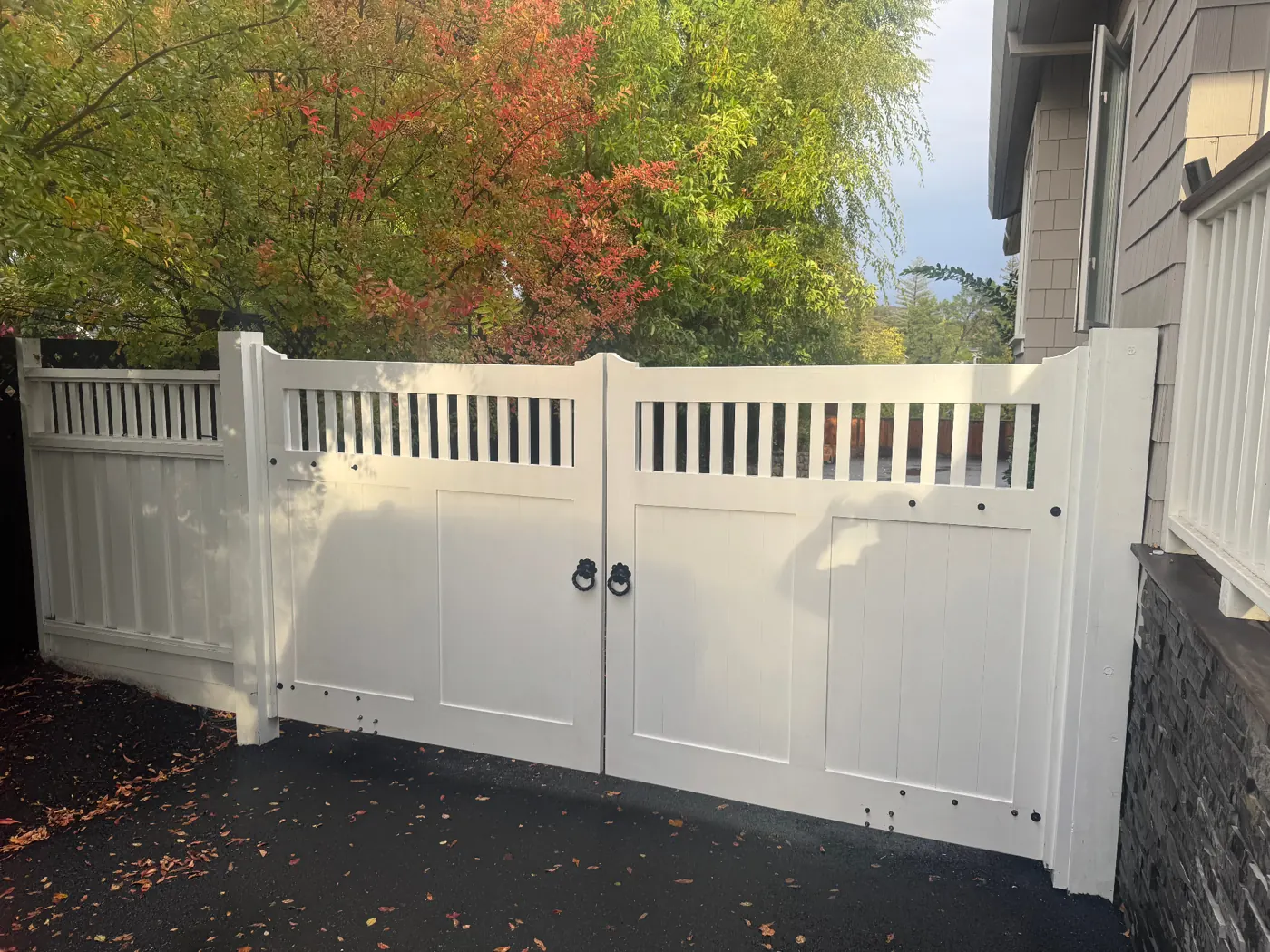
Custom automated double swing Sapele hardwood driveway gate with linear operators, smart access keypad, and safety sensors, Bay Area estate
Services

Custom Automatic Driveway Gates — Engineered for Bay Area Estates & California Homes

Push a button. The leaves part. You drive through. They close behind you. From Sapele hardwood estates to modern aluminum compounds, built with mortise-and-tenon precision and automation engineered for decades of reliable operation.

What's Included

Every custom automatic driveway gates — engineered for bay area estates & california homes commission carries.

  • 01Double swing, sliding, and bi-parting formats — all fully automated
  • 02Span: 60 inches up to 40+ feet depending on format
  • 03Sapele hardwood — our signature wood, proven in every Bay Area microclimate
  • 04White Oak, aluminum, steel, wrought iron, Ipe, and Teak available
  • 05We do not build with Redwood or Cedar — softwoods that fail in NorCal climate
  • 06Linear, articulated, underground, hydraulic, rack-and-pinion, and chain-drive operators
  • 07UL 325 photo eyes, edge sensors, loop detectors, manual release standard
  • 0824–72 hour battery backup for outages and fire-evacuation routes
  • 09Smart access: keypad, app, intercom, RFID, biometric, Bluetooth auto-open
  • 10Control4, Savant, Crestron, Lutron Homeworks integration
  • 11WUI / Chapter 7A fire-zone compliant configurations with failsafe closure
  • 12Bay Area fabrication, nationwide shipping, 10-year structural / 5-year automation warranty
Request a quote

Quote a custom automatic driveway gates — engineered for bay area estates & california homes.

Three fields. We'll call you back today or the next business day.

(925) 570-3688No spam · One business day
Chapter

What an automatic driveway gate is, and why estates choose one

An automatic driveway gate has motorized operators that open and close on command — remote, keypad, app, vehicle sensor, or intercom. The gate becomes part of your daily rhythm: arrive home, press the button, the leaves part, drive through, they close behind you. No getting out of the car. No wrestling with a heavy leaf in the rain. Homeowners choose automation for convenience (never leave the vehicle), security (controlled access, only authorized vehicles and visitors enter), safety (photoelectric sensors, edge sensors, and auto-reverse prevent injury or damage), integration (the gate becomes part of your Control4, Savant, Crestron, or Lutron Homeworks ecosystem), and property value (automated entry is a premium feature that distinguishes estates). Automation is the reason most clients commission a custom gate in the first place.
Chapter

The formats we automate — double swing, sliding, bi-parting

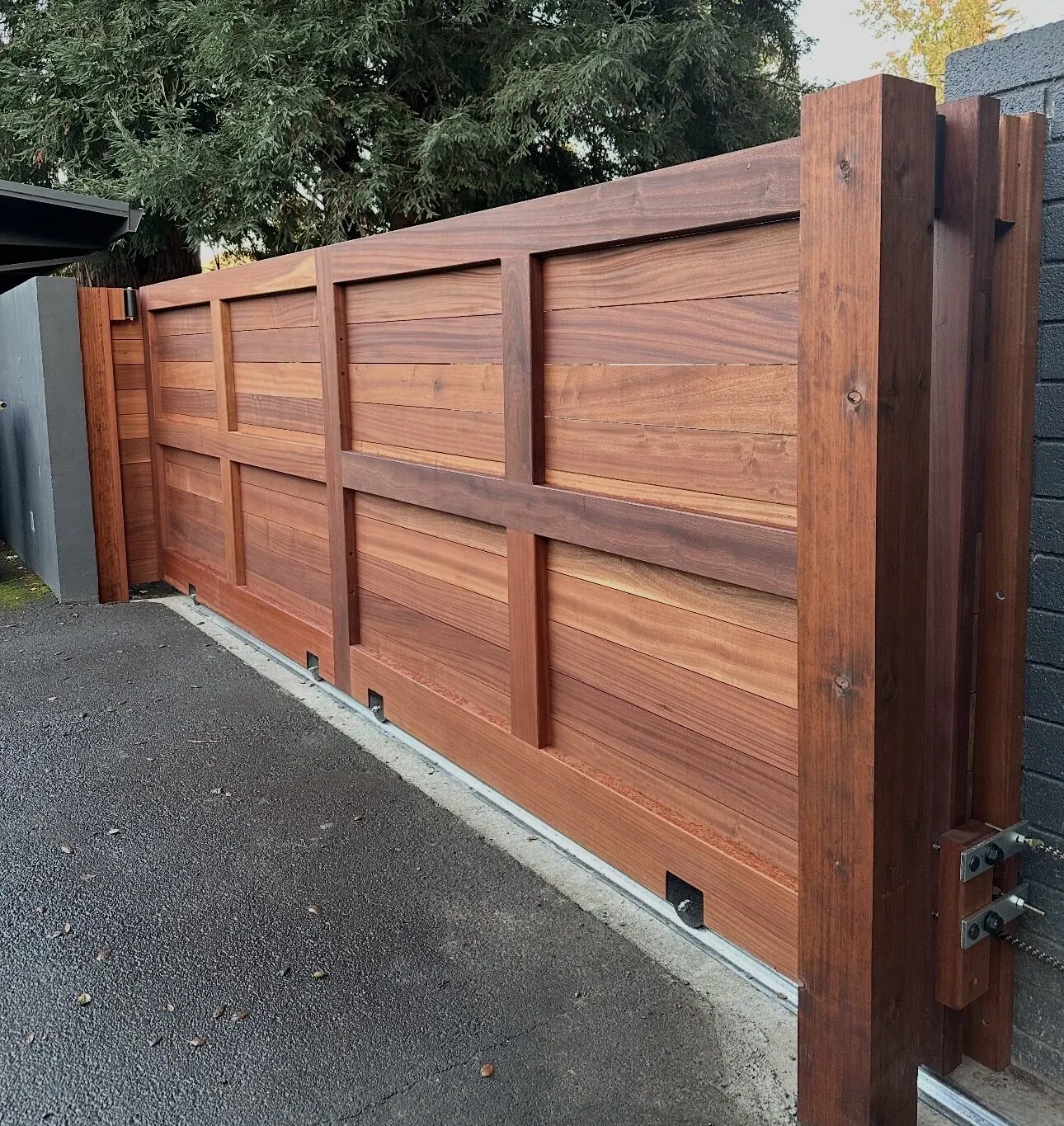
Double swing is our primary automated format: two leaves meeting at center, symmetrical, formal, the estate standard. It handles 60 inches to 24+ feet, wind-resists well because each leaf carries half the sail area, and accepts every operator class from linear arm to underground hydraulic. Cost: $18,000–$120,000+ installed with automation. Sliding gates are our second format: one leaf on a ground-mounted track, no swing arc required, the right choice for tight driveways, steep grades, or any property where interior clearance is scarce. Spans 8–40+ feet and handles slopes that would make swing gates impractical. Cost: $22,000–$85,000+ installed. Bi-parting sliding is our third format: two leaves sliding apart from center on dual tracks, fast cycle (5–8 seconds), clean contemporary aesthetic, ideal for wide openings with limited depth. Spans 10–20+ feet. Cost: $28,000–$95,000+ installed. What we do not automate: single swing gates. They are manual-only by design — a single leaf wide enough to automate becomes too heavy for graceful manual operation, and the operator arm compromises the clean aesthetic. For automated entry, double swing or sliding is the right engineering choice; for openings under 60 inches without automation, our single swing service is built for that.
Chapter

Sapele — the wood we automate with

We build with Sapele as our standard and signature. For automated gates, Sapele is ideal: quartersawn Sapele barely moves seasonally (critical when two leaves must meet precisely at center, cycle after cycle, year after year), it's dense enough to feel substantial at roughly 40 lb per cubic foot but light enough to keep operator costs reasonable and cycle speeds smooth, it takes marine-grade sealers and stains evenly without blotching, and its natural rot and insect resistance handles Bay Area fog cycles, inland heat, and coastal moisture. Two decades of Bay Area work — Atherton, Woodside, Marin, Napa — has taught us exactly how Sapele behaves in every microclimate. For automated double swing gates the dimensional stability is what keeps both leaves matched so they don't bind at center in year ten. Typical Sapele automated gate: 2"–2.5" thick, 80–150 lb per leaf at 8–12 feet, $18,000–$45,000 installed with automation, annual inspection and finish touch-ups, 25–35 year lifespan with basic care. FSC-certified responsibly sourced options available.
Chapter

White Oak — the American Craftsman alternative

For homeowners who want a domestic species with traditional American character, White Oak is our recommendation — not Red Oak. White Oak's closed grain and high tannin make it naturally rot-resistant; Red Oak is essentially interior-grade lumber. White Oak is heavy, strong, dent-resistant, takes pigment beautifully (we can match existing front doors, trim, or interior millwork), and quartersawn White Oak gives the dramatic ray fleck figure that defines Craftsman and Greene & Greene aesthetics. For automated gates, White Oak adds gravitas — each leaf feels solid at 120–200 lb at 8–12 feet, and the grain reads as established, not trendy. The weight requires heavier operators and more robust piers, but the presence is unmistakable. Typical White Oak automated gate: 2.25"–2.5" thick, $22,000–$55,000 installed with automation, best for Craftsman, Prairie, Arts & Crafts estates, and traditional homes.
Chapter

Metal options — aluminum, steel, and wrought iron

Not every automated gate should be wood. For coastal corrosion, modern aesthetics, security requirements, or WUI fire-zone compliance, we fabricate automated gates in aluminum, steel, and wrought iron. Aluminum is light, corrosion-proof, modern — 40–80 lb per leaf at 8–12 feet, effortless for operators, minimal foundation requirements, marine-grade anodizing or Kynar powder coat handles salt air without maintenance ($18,000–$42,000 installed with automation). Steel is strong, versatile, cost-effective — fabricated for security-focused designs or mixed-material hybrids, hot-dip galvanized and powder-coated for longevity ($20,000–$48,000 installed with automation). Wrought iron is ornamental, traditional, heavy — hand- or machine-forged, 150–300 lb per leaf, requires heavy-duty hydraulic operators and robust piers ($24,000–$65,000 installed with automation). All three are fully WUI fire-zone compliant as non-combustible materials.
Chapter

Why we don't build with Redwood or Cedar

We get the request often, and we understand the sentiment. But we decline. Modern lumberyard Redwood is mostly sapwood — the pale outer growth that rots almost as fast as pine — and you cannot specify all-heartwood reliably in today's market. Both Redwood and Cedar are softwoods with a Janka hardness of 450–600 lbf versus Sapele at 1,500 lbf; a softwood gate dents from landscape equipment, scratches from dog claws, gouges from moving furniture, and looks battered within two years. Northern California's microclimates are brutal on softwoods: coastal fog cycles swell and check the fibers, inland UV and thermal cycling degrade them faster than hardwoods, and Bay Area mixed zones are the worst combination. We've replaced more 5-year-old Redwood gates than we can count. The maintenance trap: $800–$1,500 in annual refinishing means over 15 years a 'cheaper' Redwood gate costs more than a Sapele gate and looks worse doing it. On an automated gate the problem compounds — softwood leaves move seasonally, bind at center or against tracks, and force expensive operator recalibration year after year. Our alternative: Sapele with a custom stain achieves the warm Redwood tone without the structural compromise.
Chapter

Premium hardwood options — Ipe and Teak

For specific properties where standard Sapele isn't enough, we offer two premium tropical hardwoods. These are not our default — they are targeted solutions. Ipe (Brazilian Walnut) is for full coastal sun, WUI fire zones where untreated fire resistance simplifies permitting, or 40+ year minimal-maintenance timelines: nearly twice as dense as Oak, naturally Class A fire-rated, virtually impervious to rot and insects without chemical treatment. Trade-offs: heavier leaves (150–250 lb at 8–12 feet), harder on tools and hardware, specialized fasteners required, and heavy-duty operators with beefier piers to carry the weight. Ipe runs roughly 1.5–2× the cost of Sapele — typical automated double swing $28,000–$65,000 installed. Teak is the gold standard for exterior wood and has been for centuries. Plantation Teak's natural oils make it virtually impervious to water, it moves less than almost any wood on Earth (two Teak leaves will meet precisely at center, season after season, with minimal adjustment), and its oils neutralize the corrosion that salt air and metal fasteners usually create. Pair with 316 stainless and you have a coastal gate that outlives the house. Teak runs 2–3× the cost of Sapele — typical automated double swing $35,000–$85,000 installed. We recommend it for coastal Marin or Malibu properties within sight of salt water, legacy estates, or when the design demands the finest material regardless of budget.
Chapter

Operators, safety, and access control

Operator selection drives reliability. Linear arm operators are our default for most double swing projects: visible arm from post to gate, reliable, easy to service, rated for 150–400 lb leaves, $3,500–$7,500 per leaf installed. Articulated arms handle heavier gates and limited post space: compact mount, high torque, 200–600 lb leaves, $4,500–$8,500 per leaf. Underground (submerged) operators are our recommendation for aesthetic-led estates: completely invisible in a buried vault, the gate looks entirely manual when it isn't moving, $7,500–$12,000 per leaf, requires drainage engineering. Hydraulic operators handle very heavy iron or steel gates and high cycle counts ($9,000–$15,000 per leaf). Sliding gates use rack-and-pinion operators (standard, $4,500–$9,500) or chain-drive (heavy-duty, $6,500–$12,000). Every install is commissioned to UL 325: through-beam photoelectric sensors, edge sensors on the leading edge of each leaf, vehicle loop detectors, manual release for power outages, auto-reverse on resistance, warning lights and audible signals. Access control: standalone or smart-home keypads ($350–$750), vehicle loops for hands-free entry ($500–$1,200), audio intercoms ($800–$2,500), video intercoms with app integration ($1,500–$4,500), RFID for fleet vehicles ($600–$1,800), Bluetooth auto-open ($400–$1,200), and biometric for high security ($2,000–$5,000).
Chapter

Smart home integration and power

Your automated gate should talk to your house. We integrate with Control4 (gate status on every touch panel, 'Arrive Home' scene, temporary codes, video pop-up), Savant (similar full integration with custom programming), Crestron (enterprise-grade automation, complex scene logic), Lutron Homeworks (lighting coordination, arrival/departure scenes), and Nice / LiftMaster native apps for standalone control. Capabilities: open/closed/locked status visible on all home screens, 'Arrive Home' scenes that open the gate, turn on landscape lighting, disarm security, and adjust the thermostat; temporary access codes for guests, deliveries, and service providers; intercom feed pop-ups when the gate call button is pressed; and activity logs showing who opened the gate, when, and how. Power: 110V AC dedicated 20A circuit is standard, with 18"–24" deep conduit from the main panel to the gate piers. Solar arrays with battery banks are available for off-grid properties or green-building goals. Battery backup keeps the gate operational 24–72 hours during PG&E outages — critical for fire-evacuation routes, where it's often required by code. Manual release allows physical disengagement of the operator if all power fails.
Chapter

Sizing, engineering, and California fire-zone compliance

Each format has different space requirements. Double swing needs interior swing arc (leaf width + 2 ft per side), handles flat to 6% grade. Sliding needs track length (gate width + 1–2 ft) and handles excellent grade tolerance including steep slopes. Bi-parting sliding needs track length (half width + 1–2 ft per side) and similar grade tolerance. Pier engineering: double swing standard is 24"–30" diameter × 36"–48" deep concrete piers with rebar cages and 4,000 PSI concrete; heavy iron/steel calls for 30"–36" × 48"–60" with engineered seismic lateral reinforcement; sliding gates use continuous reinforced concrete foundation trench 24"–36" deep with embedded track; bi-parting uses dual reinforced foundations with a shared header beam for synchronization. All California installs include seismic-rated hinge mounts, operator reinforcement, and post-earthquake inspection protocols. Fire-zone compliance: aluminum, steel, and iron satisfy WUI Chapter 7A without treatment; hardwood gates require ignition-resistant treatment or naturally resistant species documentation. Automation adds fire-zone considerations: electrical conduit must be rated for exterior exposure and sealed against ember intrusion, operators are programmed to close gates during fire-evacuation scenarios, battery backup ensures function during grid outages, and manual override lets emergency personnel open the gate if automation fails. In Zone 0 (0–5 ft from structure) metal gates are strongly recommended and increasingly required by insurance carriers in VHFHSZ areas.
Materials

What we build with.

  • Sapele hardwood — quartersawn, 1,500 Janka, naturally rot-resistant (our signature material)
  • White Oak — domestic, closed-grain, high-tannin, dramatic quartersawn ray fleck
  • Aluminum — marine-grade extrusion, anodized or Kynar 500 fluoropolymer powder coat
  • Steel — hot-rolled, hot-dip galvanized (ASTM A123), epoxy primer plus polyurethane topcoat
  • Wrought iron — hand- or machine-forged, fully non-combustible, WUI-compliant
  • Ipe (premium) — naturally Class A fire-rated, virtually impervious to rot, 1.5–2× Sapele cost
  • Teak (legacy) — plantation, natural oils, coastal gold standard, 2–3× Sapele cost
  • Hidden welded hot-rolled steel sub-frame inside every automated hardwood gate
  • FAAC, LiftMaster, Nice, BFT operators — linear, articulated, underground, hydraulic, rack-and-pinion, chain-drive
  • UL 325 photo eyes, edge sensors, loop detectors, manual release, 24–72 hour battery backup
  • Stainless or hot-dipped hinges sized 2× actual gate weight; 316 stainless within five miles of salt water
  • Control4, Savant, Crestron, Lutron Homeworks integration; keypad, app, intercom, RFID, biometric
  • Engineered concrete piers and foundations, seismic-rated mounts, 4,000 PSI concrete with rebar cages
  • We do not build with Redwood or Cedar — softwoods that fail in Northern California's climate
Timeline

How long it takes.

Custom automated driveway gates ship in 10–16 weeks total: 2–3 weeks for design and engineering approval, 5–7 weeks fabrication (matched pair for double swing or bi-parting, single leaf for sliding), 2 weeks finishing and curing, 1–2 weeks installation and automation commissioning. Fire-zone permit and Chapter 7A documentation typically adds 2–4 weeks on the front end where required. Install is usually 2–3 days on-site, plus a commissioning visit to tune photo eyes, force settings, synchronization, smart-home integration, and battery backup.

Pitfalls

Common mistakes.

  • Specifying single swing for openings over 60 inches — single swing is manual-only and doesn't scale to automation.
  • Skipping the hidden welded-steel sub-frame on automated hardwood gates — operator torque tears the joinery apart inside two years.
  • Hinges or sliding rollers sized to gate weight rather than 2× weight — sag and bind inside the first wet season.
  • Posts and tracks set in undersized footings — first wet winter heaves them out of plumb and the gate stops cycling.
  • Specifying Redwood or Cedar — softwoods that swell, bind, and force expensive operator recalibration every season.
  • Mounting linear or articulated operators on a gate the manufacturer doesn't rate for that weight or width.
  • Skipping battery backup on a fire-evacuation route — gate fails closed during a power outage when you need it open.
  • Treating bi-parting sliding as 'two slidings' — without precise synchronization control, the leaves meet off-center.
  • Submitting a Chapter 7A jurisdiction without ignition-resistant material certifications — the permit doesn't move.
Northern California

Where we build automated driveway gates

Bay Area first: Atherton and Hillsborough for estate automated gates with strict design review and Control4 integration; Woodside for heavy hardwood, rural access, and equestrian-compatible designs; Portola Valley for hillside engineering and sliding gates on steep grades; Menlo Park and Silicon Valley for modern automated gates with Savant and Crestron integration; Marin County (Tiburon, Mill Valley, Ross, San Rafael) for coastal Sapele or aluminum with 316 stainless hardware; Walnut Creek, Lafayette, Orinda, and Piedmont for WUI fire-zone compliance with failsafe closure; Napa Valley and the wine country for vineyard estate aesthetics; Alamo and Danville for full-automation packages on long private drives. Extended California and nationwide: Sacramento, Folsom, El Dorado Hills, Roseville, Lincoln, Granite Bay, Rocklin, Loomis, Newcastle, and Carmichael; Santa Barbara, Los Angeles, San Diego, Lake Tahoe, and Palm Springs. Fabricated in Concord. Nationwide shipping on custom-built automated gates; California installation and commissioning; remote areas coordinated with local contractors for install and final electrical hookup while we ship the gate and operators.
Compare

Automated gate formats at a glance

FactorDouble SwingSlidingBi-Parting Sliding
Interior space neededSwing arc (width + 2 ft per leaf)Track length (width + 1–2 ft)Track length (half width + 1–2 ft per leaf)
Grade toleranceModerate (3–6% with engineering)Excellent (handles steep grades)Excellent
Wind resistanceGood (split sail area)Excellent (track-mounted)Excellent
SpeedModerate (8–12 sec)Moderate (10–15 sec)Fast (5–8 sec)
AestheticTraditional, formal, estateModern, industrial, securityContemporary, architectural
Width range60 in–24+ ft8 ft–40+ ft10 ft–20+ ft
Operator typeLinear / articulated / underground / hydraulicRack-and-pinion / chain-driveDual rack-and-pinion synchronized
Typical cost (installed w/ automation)$18,000–$120,000+$22,000–$85,000+$28,000–$95,000+
Best forEstates, formal entries, daily useTight spaces, steep grades, wide spansModern homes, fast cycle, wide openings
Case Study
Custom Automatic Driveway Gates — Engineered for Bay Area Estates & California Homes case study by Heartwood Gates — Quartersawn Sapele hardwood with hidden welded-steel sub-frame, heavy-duty rack-and-pinion sliding operator, embedded steel track on continuous reinforced concrete foundation, dual through-beam photo eyes, leading-edge sensor, vehicle loop, Control4 integration, 72-hour battery backup, 316 stainless rollers and hardware.
Plate · A recent commission

A recent custom automatic driveway gates — engineered for bay area estates & california homes project.

Problem
A Portola Valley hillside property had an 18-foot opening with a 7% driveway grade — too steep for a swing gate to clear at full open, and the existing manual cantilever gate had failed structurally after three winters. The owners wanted automation, smart-home integration, and a gate that would close reliably during fire warnings even if PG&E was down.
Solution
We engineered a single-leaf sliding Sapele gate on a heavy-duty rack-and-pinion operator with a continuous reinforced concrete foundation trench, embedded track, and a hidden welded-steel sub-frame inside the hardwood. Access control combined a curbside video intercom (app-routed to the owners' phones), a Bluetooth auto-open for the family vehicles, and full Control4 integration with an 'Arrive Home' scene tied to landscape lighting and the alarm. Battery backup sized for 72 hours, programmed for failsafe-open on extended power loss during Red Flag warnings.
Materials
Quartersawn Sapele hardwood with hidden welded-steel sub-frame, heavy-duty rack-and-pinion sliding operator, embedded steel track on continuous reinforced concrete foundation, dual through-beam photo eyes, leading-edge sensor, vehicle loop, Control4 integration, 72-hour battery backup, 316 stainless rollers and hardware.
Timeline
14 weeks from approved design; 3 days on-site plus a half-day commissioning visit for Control4 scene programming.
Result
Gate cycles smoothly on the steep grade, opens hands-free for the family vehicles via Bluetooth, and routes delivery and visitor intercom calls to the owners' phones from anywhere. Battery backup tested successfully through a 22-hour PG&E shutoff during last fall's Red Flag warning — gate stayed operable and closed cleanly when the power returned. Owners report it's the smoothest piece of automation in the house.
Frequently Asked

About custom automatic driveway gates — engineered for bay area estates & california homes.

Double swing (our primary), sliding, and bi-parting sliding. We do not automate single swing gates — they are manual-only by design. For openings under 60 inches without automation, see our single swing gates service. For everything else, double swing or sliding is the right engineering choice.
Service Areas

Custom Automatic Driveway Gates — Engineered for Bay Area Estates & California Homes across the Bay Area.

We design and install custom automatic driveway gates — engineered for bay area estates & california homes throughout Northern California. Browse a dedicated page for your city:

Don't see your city? See our full Bay Area service map — we travel 150 miles from our Concord workshop.

Continue Reading
Begin a commission

Ready to design your custom automatic driveway gates — engineered for bay area estates & california homes?

Book a free design consultation. We'll review your site, talk through materials and automation, and follow up with a tailored quote.

Request a design consultation Call (925) 570-3688Mon–Fri
Free design call · No-pressure quote · Bay Area · Napa · Sacramento
CallGet a quote