
The True Cost of a Luxury Custom Driveway Gate in Northern California
A transparent breakdown of what a high-end custom hardwood driveway gate actually costs in Atherton, Hillsborough, and Woodside — wood, ironwork, automation, finish, and three real project tear-downs.
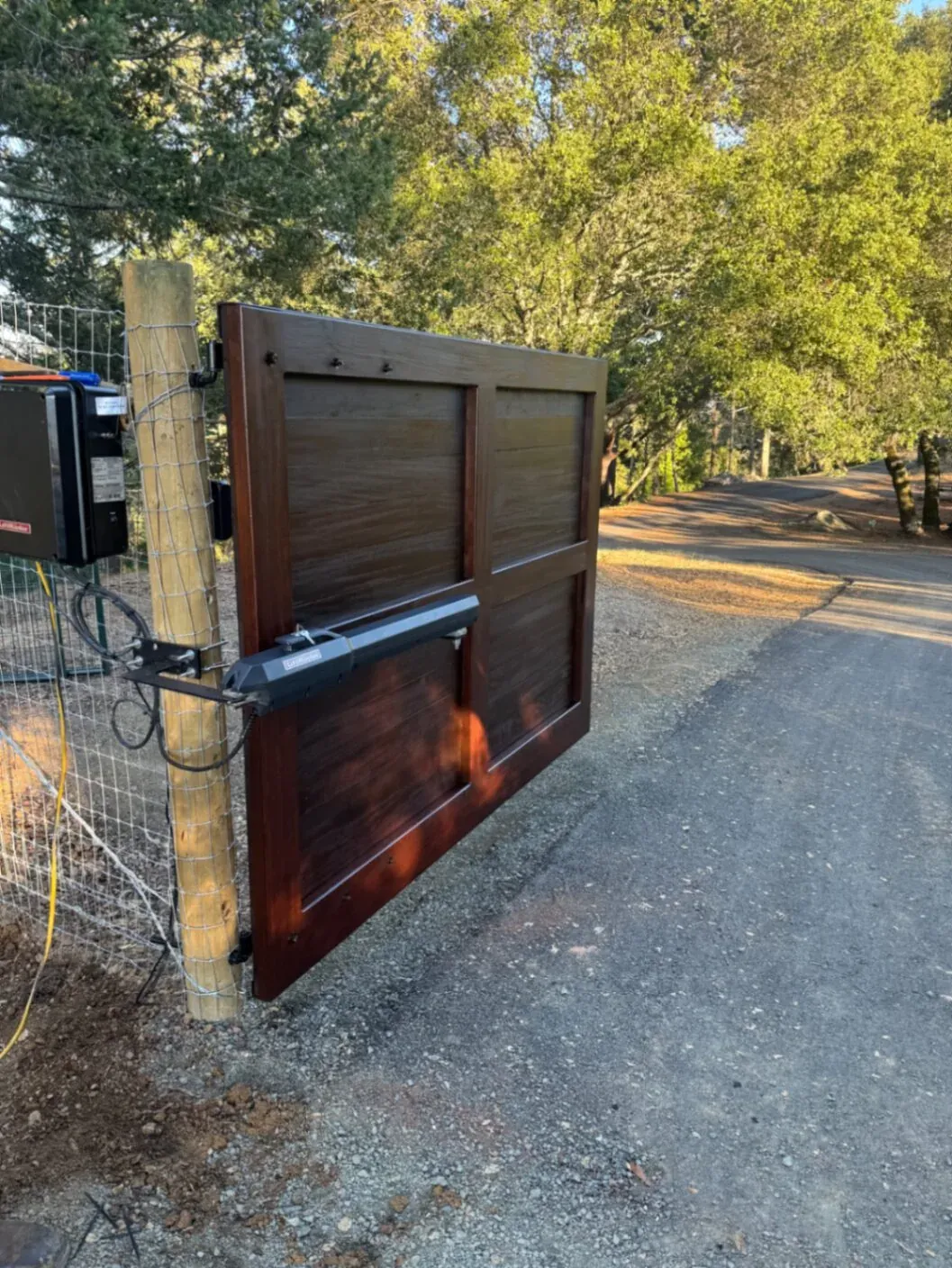
Single swing gates run $6,500–$20,000+ installed. Double swing gates run $8,500–$30,000+ installed, manual or automatic, wood or metal. The price is driven by five components: hardwood species (25–35%), automation and operator (20–30%), ironwork and hardware (15–25%), finish and protection (10–15%), and design, fabrication, and installation (15–20%). Sapele is our default recommendation for Bay Area estates; Teak and Ipe earn their premium in extreme coastal exposure.
Key takeaways
- Single swing gates: $6,500–$20,000+ installed. Double swing gates: $8,500–$30,000+ installed, manual or automatic, wood or metal.
- Five cost components: hardwood (25–35%), automation (20–30%), ironwork (15–25%), finish (10–15%), and design + install (15–20%).
- Sapele's weather resistance, dimensional stability, and ribbon grain make it our signature hardwood for Bay Area estates.
- Maintenance plans start at $600 per year.
- Lead times average 4 to 8 weeks from design to install. Contact us for an exact timeline for your project.
If you're scoping a custom mahogany driveway gate for a Bay Area estate, pricing depends on width, material, hardware, and design detail. Consider the difference between a beautifully crafted 12-foot Sapele swing gate with manual hardware and a fully automated, 24-foot Teak-and-wrought-iron statement piece spanning a Hillsborough driveway with integrated access control, safety sensors, and a decade-long maintenance plan. At Heartwood Gates, we build every gate like a piece of furniture — mortise-and-tenon joinery, sustainably sourced hardwoods, CNC precision for curves and engraved details, and ironwork that complements rather than overwhelms. Before we cut a single board, we walk homeowners through the anatomy of the quote. Because a luxury gate isn't an expense. It's an investment in curb appeal, security, and the first impression your home makes.
The anatomy of a quote: where the money goes
When we quote a custom driveway gate, we break it into five core components. Understanding each one makes the material specification, engineering, and craftsmanship behind the quote clear.
Hardwood and materials account for 25–35% of the total, driven by species, board feet, grain matching, and thickness. Automation and operator come in at 20–30%, sized to gate weight, cycle frequency, and smart-access integration. Ironwork and hardware represent 15–25%, with the spread between and cast, ornamental versus minimal, and the engineering of the hinge system. Finish and protection — marine-grade sealers, UV-stable stains, and maintenance plans — account for 10–15%. Design, fabrication, and installation make up the final 15–20%, covering CNC complexity, site conditions, and electrical trenching.
Wood cost curves: Sapele, white oak, Ipe, and Teak
The hardwood you choose sets the baseline. For a typical 14-foot dual-leaf estate gate (180–220 board feet), here's how the species we work with most often stack up:
Sapele — Our signature wood. Mahogany-like, stable, beautiful ribbon grain. Sustainably sourced. Excellent for Bay Area marine climates.
White oak — Dense, strong, takes stain beautifully. Heavier than Sapele, which affects hardware and operator sizing.
Ipe — Ultra-durable, naturally resistant to rot and insects. Dense and hard on tools, but lasts 40+ years with minimal maintenance.
Teak — The gold standard. Naturally oily, virtually impervious to water. Premium pricing reflects global demand and sustainable harvesting constraints.
Sapele combines weather resistance with dimensional stability and a rich ribbon grain. That's why it's our signature hardwood for Bay Area estates. But if you're building a gate for a coastal Marin property with salt air and no overhang, Teak or Ipe earns its premium.
Operator and safety package: the invisible infrastructure
A luxury gate isn't just beautiful wood. It's a machine that opens and closes reliably, rain or shine, thousands of times a year. For estates in Atherton, Hillsborough, and Woodside, we typically specify heavy-duty linear or articulated arm operators rated for 1,500+ lbs per leaf, photoelectric and edge safety sensors on both leaves, loop detectors for vehicle presence, smart access control (keypad, remote, app-based, or integrated with Control4, Lutron, Ring, or Apple Home), and battery backup for power outages.
Ironwork: details that frame the wood
Wrought iron should complement the hardwood, not compete with it.
Ironwork cost depends on whether the hardware is clean and minimal or the panels and motifs are elaborate. The key is proportion. A heavy iron frame on a delicate Sapele leaf looks institutional. A whisper-thin iron accent on a massive Teak gate looks temporary. Balance is everything — for more on hardware specifically, see our materials guide.
We're booking design consultations 4–6 weeks out. Send us your driveway photos and we'll come back with a sketch, wood spec, and finish system within five business days.
Finish and maintenance: protecting the investment
Bay Area sun, fog, and occasional hard rain are tough on exterior wood. Our standard finish protocol is a penetrating oil or marine-grade sealer (Sikkens, Penofin, or custom-mixed), a UV-stable pigmented topcoat to prevent graying, and an annual inspection and touch-up plan included for two years, then optional.
Finish and initial protection are quoted according to gate size and complexity. Maintenance plans start at $600 per year. A well-maintained Sapele gate will look stunning at year 15. A neglected one will show it by year 5.
Three real project tear-downs
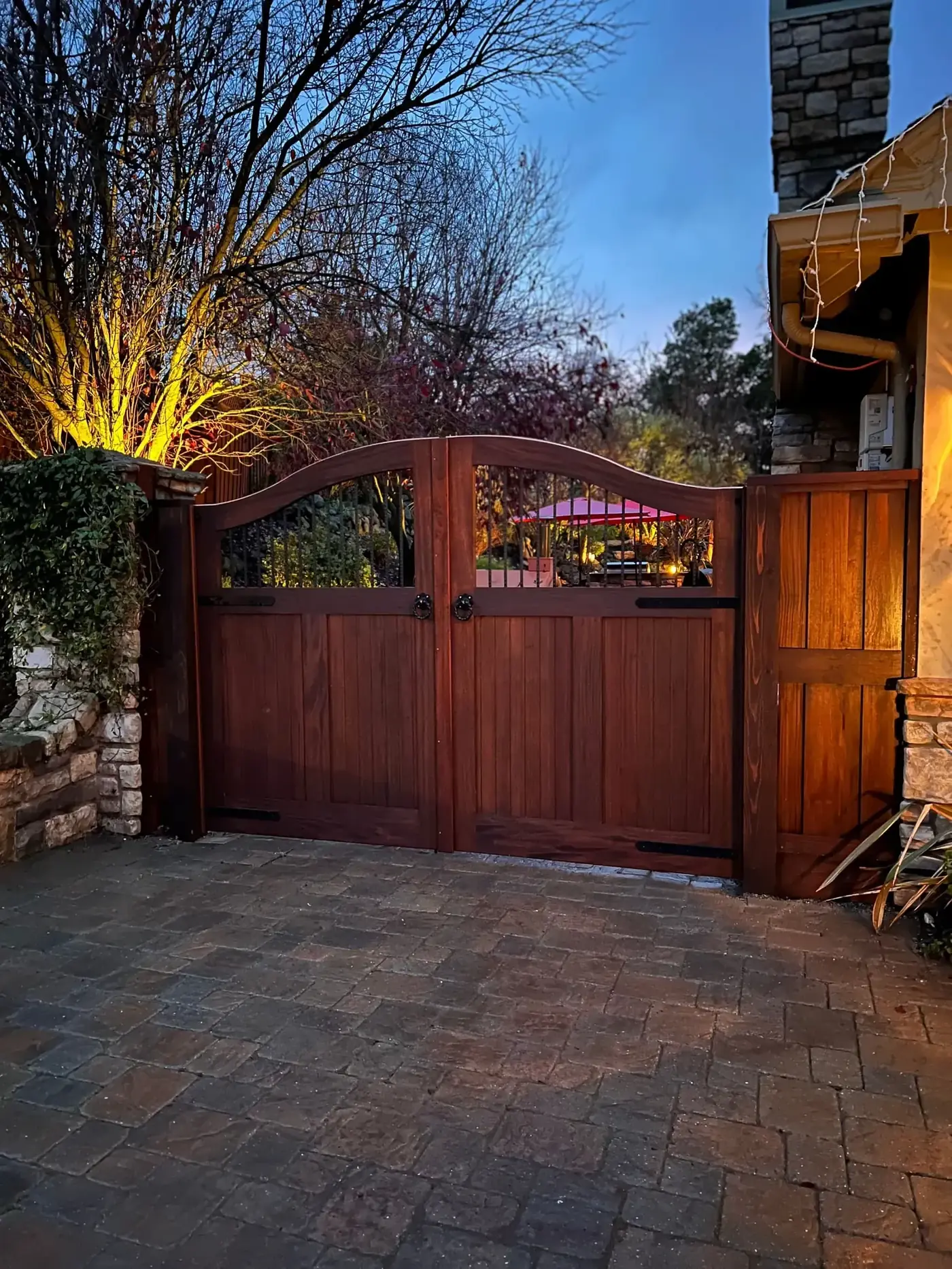
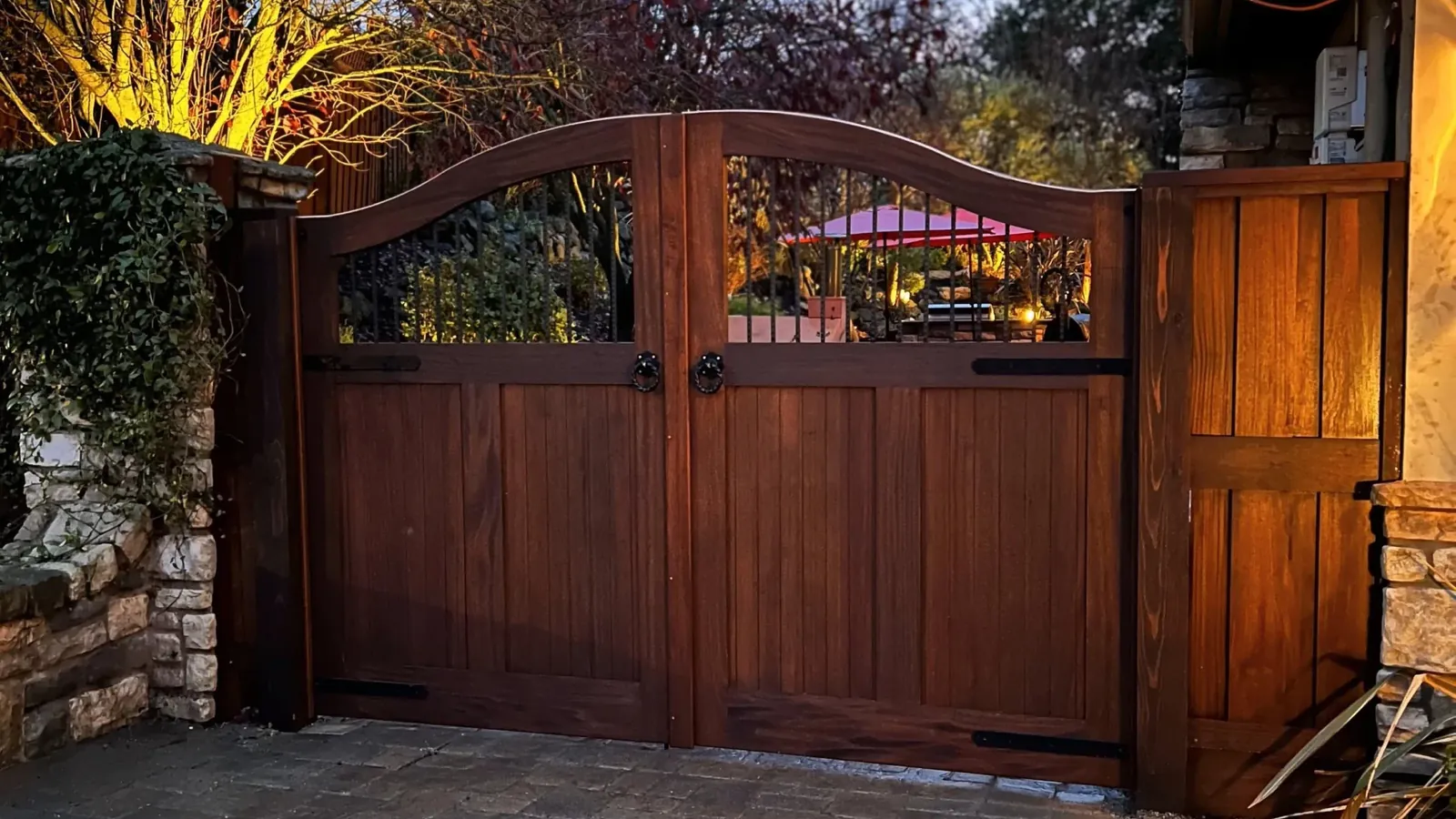
Atherton estate — Sapele swing gate. 14-foot dual-leaf swing, Sapele at 2.25" thick with bookmatched panels, minimal hinges and latch in black powder coat, linear operator with keypad and remote, marine-grade sealer in satin. The homeowner wanted warmth and understatement. The Sapele's ribbon grain does the talking. Clean lines, no scrollwork, just precision joinery and hardware that disappears.
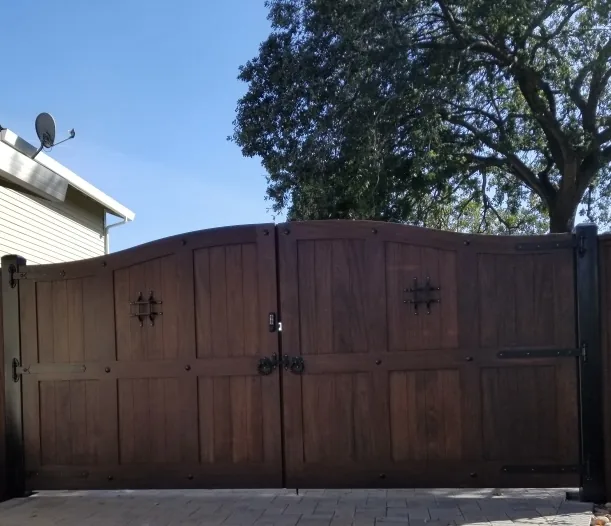
Hillsborough property — white oak and iron statement. 18-foot dual-leaf swing, white oak at 2.5" thick with a custom CNC-engraved family crest, scrollwork top rail and heavy-duty strap hinges with automated latch, articulated arm operator with smart-home integration, battery backup, and loop detector, custom stain to match the front door with UV topcoat. This gate needed to carry visual weight. The white oak's density justified the heavier ironwork, and the CNC-engraved crest turned a functional entry into a family heirloom.
Woodside compound — Teak and wrought iron estate gate. 24-foot dual-leaf swing with custom pier columns, Teak at 3" thick with matched grain across both leaves, full frame with ornamental spears, custom motif, and integrated lighting, dual linear operators with app control, video intercom, solar backup, and full safety suite, natural oil finish with an annual maintenance plan prepaid five years. The Teak will outlive the house. The ironwork was designed to patina gracefully. Every component was oversized for reliability. This is a gate that will still be opening smoothly in 2040.
How to scope a luxury gate budget
Measure your opening — width, height, slope, clearance. Choose your hardwood — Sapele for dimensional stability and ribbon grain, Teak or Ipe for extreme exposure. Decide on automation — manual, basic operator, or full smart integration. Define your ironwork — minimal, functional, or ornamental statement. Factor in site work — electrical trenching, pier columns, landscaping. Plan for maintenance — annual care protects your investment.
Every estate we build for starts with a site visit and a conversation about architecture, landscape, and how the gate will be used. From there we sketch, render in CAD, and walk the client through the full quote with every line item exposed. Visit our handcrafted luxury driveway gates page or request a design consultation to start a project.
The finish system, chosen per project
There is no single best finish for a custom gate — the right system depends on the wood species, microclimate, sun exposure, salt load, and the look you want. Our default is Penofin Verde Marine Oil for Sapele, white oak, and teak (penetrating, low-VOC, UV-stable). For western red cedar and redwood we prefer Armstrong Clark's non-drying conditioning oils. Cabot Australian Timber Oil gives a warmer amber tone on mahogany. Sikkens Cetol is reserved for protected coastal doors. Messmer's UV Plus is our pick for ipe and garapa. TWP 100 handles foothill mildew zones. Every spec is documented in your maintenance binder so any qualified refinisher can match it.
- PenofinPenofin Verde Marine Oil
Best for: Sapele, white oak, teak — most inland & wine-country installs
Penetrating, low-VOC, UV-stable transoxide pigment package. Never peels because there is no film.
- Armstrong ClarkArmstrong Clark Semi-Transparent Oil
Best for: Western red cedar, redwood, sun-exposed inland gates
Non-drying conditioning oils sit deep; drying oils harden at the surface — superior for cedars under intense UV.
- CabotCabot Australian Timber Oil
Best for: Mahogany and dense tropicals when a richer amber tone is preferred
Tung-oil-and-linseed blend that warms hardwood without obscuring grain. Color-matches well for restoration work.
- SikkensSikkens Cetol SRD / Cetol Door & Window
Best for: Coastal salt-spray sites and high-traffic pedestrian doors
Alkyd-modified resin with mildewcide; the only film system we will spec, and only on protected vertical surfaces.
- Messmer'sMessmer's UV Plus for Hardwoods
Best for: Ipe, garapa, and ultra-dense hardwoods that reject most finishes
Specifically engineered for oily tropicals; the trans-oxide pigments hold color on woods where Penofin can be slow to soak.
- TWPTWP 100 Series Total Wood Preservative
Best for: Sierra foothill installs with heavy winter mildew pressure
EPA-registered mildewcide and fungicide package — used when the site has shade and rain together.
About design
01What's the entry point for a custom hardwood driveway gate in the Bay Area?
02Why does custom gate pricing vary?
03Is Sapele really as durable as Teak or Ipe?
04Does automation add a lot to the cost?
05How long does a custom gate take from design to installation?
06What about maintenance costs over time?
For more answers, see our full FAQ.
Related articles
Let's design a gate that belongs to your home.
Tell us about the entrance you want to build. We strive to respond the same day to inquiries received before 2pm.