
Sapele Mahogany vs. Teak in Northern California Microclimates
Teak has been the gold standard for outdoor wood for a century. So why does almost every Heartwood gate get built in Sapele instead? A side-by-side comparison for Bay Area microclimates.
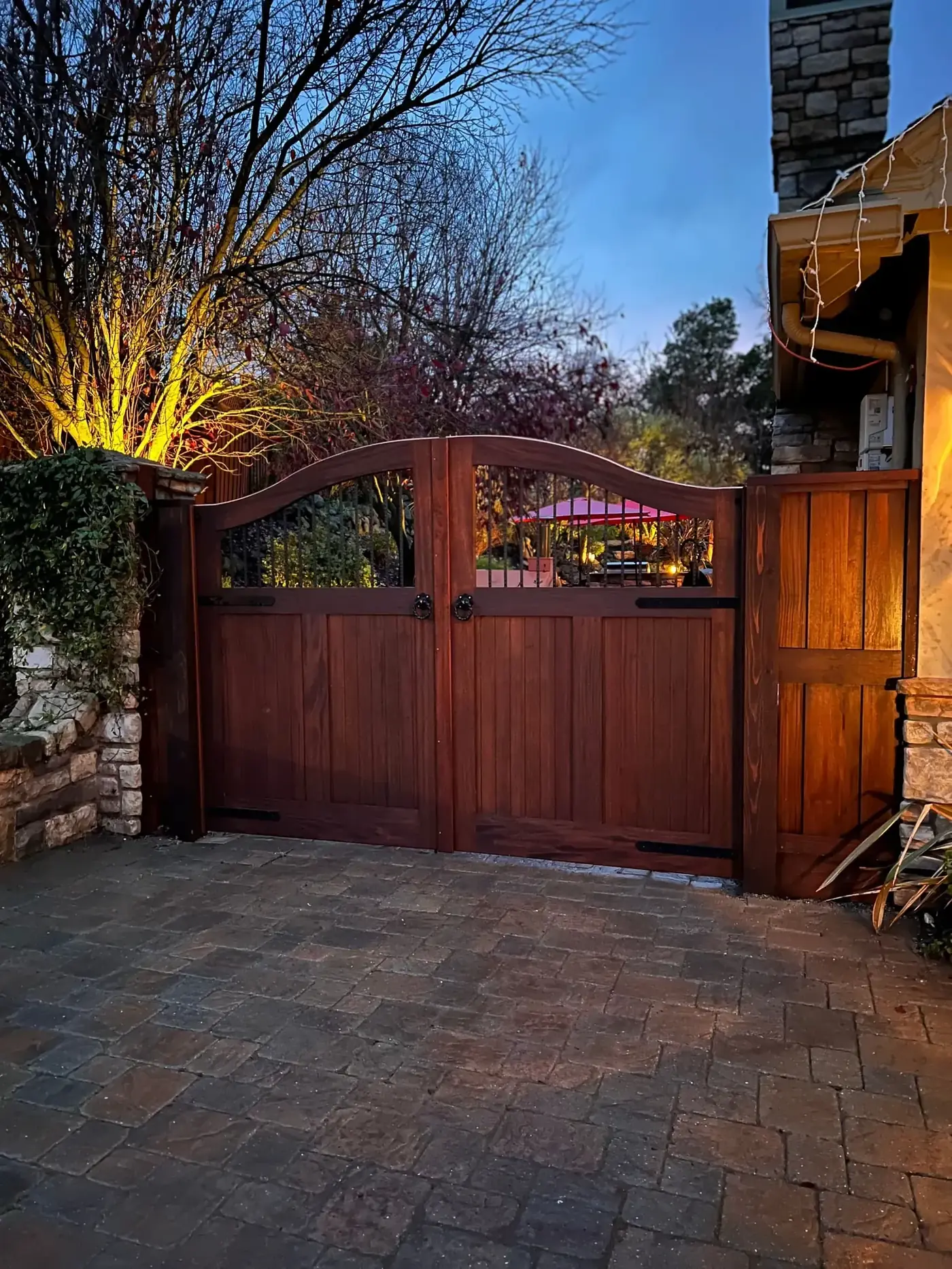
Sapele and teak are both exceptional outdoor hardwoods. Teak is denser, oilier, and more expensive. Sapele is more stable across humidity swings, takes finish more reliably, and costs roughly 35 to 50% less. For Northern California's mediterranean climate with sharp summer–winter humidity changes, Sapele's stability makes it the more predictable long-term choice for a gate.
Key takeaways
- Sapele and teak are both exceptional outdoor hardwoods. Teak is denser, oilier, and more expensive. Sapele is more stable across humidity swings, takes finish more reliably, and costs roughly 35 to 50% less. For Northern California's mediterranean climate with sharp summer–winter humidity changes, Sapele's stability makes it the more predictable long-term choice for a gate.
- What teak does well: Teak is a tropical hardwood from Southeast Asia with one of the highest natural oil contents of any commercial timber.
- Where teak struggles in our climate: Northern California is not a single climate.
- What Sapele does well: Sapele is a true mahogany from West and Central Africa — botanically related to Honduran mahogany but harder, denser, and more readily available from sustainable, FSC-certified sources.
- The cost difference: As of 2026, FSC-certified Sapele runs roughly $14 to $18 per board foot for the 8/4 and 10/4 stock we use for gate frames.
- Is teak better than Sapele? For pure water resistance with no finish, marginally yes. For dimensional stability, finish retention, sustainability, supply reliability, and cost — Sapele is the better material for almost every gate we build in Northern California.
If you ask a yacht builder what wood to use for a deck, they'll say teak without hesitation. If you ask a fine furniture maker what to use for a garden bench in Carmel, same answer. So when a client in Tiburon, Belvedere, or Mill Valley asks us why we build their gate in Sapele mahogany instead of teak, it's a fair question. The honest answer is that teak is excellent. Sapele is also excellent — and for a custom gate in a Northern California microclimate, it is, in our shop's experience, the better material. Here's why.
What teak does well
Teak is a tropical hardwood from Southeast Asia with one of the highest natural oil contents of any commercial timber. The oils make it almost impervious to water, fungi, and marine borers, which is why it's been the dominant boat-decking wood for over a century. A piece of teak left outdoors with no finish will weather to a beautiful silver-gray and last for fifty years untouched.
Teak is also dense — about 41 pounds per cubic foot air-dry — and stiff, which gives a gate built from it a substantial, premium feel. The grain is straight and fine, and it machines cleanly with sharp tools.
For a low-humidity coastal climate where the wood is meant to weather naturally and never see a finish, teak is genuinely hard to beat. We've built a handful of teak gates over the years, mostly for clients who specifically requested it for stylistic reasons.
Where teak struggles in our climate
Northern California is not a single climate. A gate in Tiburon sees salt-laden marine air, regular fog, and humidity that rarely drops below 60%. A gate in Walnut Creek sees 105°F summer afternoons, 38°F winter nights, and humidity that swings from 15% to 95%. A gate in El Dorado Hills sees granite-foothill UV that's punishing eight months a year.
Teak handles the coastal climate beautifully. It struggles, however, with the dramatic humidity cycling we see inland. Its very high oil content makes it difficult to refinish reliably — the oils repel new finish and cause peeling within a season or two if you want the wood to retain its golden color. Most teak gate owners we know give up on finishing and let the wood weather to silver, which is fine if you wanted that look but heartbreaking if you didn't.
Teak also moves more than its reputation suggests when humidity swings exceed 60 percentage points seasonally. The movement isn't enough to destroy a well-built gate, but it can open small gaps at panel joints over years.
What Sapele does well
Sapele is a true mahogany from West and Central Africa — botanically related to Honduran mahogany but harder, denser, and more readily available from sustainable, FSC-certified sources. Janka hardness is about 1,410, marginally harder than teak. Decay resistance is rated moderate to high, with natural extractives that resist insects and fungi.
Where Sapele decisively beats teak for our climate is dimensional stability. It moves less across humidity swings, takes finish reliably and durably, and stains evenly to a deep, warm brown that develops character over years. The grain is interlocked, which gives Sapele its characteristic ribbon figure when quarter-sawn — a finished Sapele gate has visual depth that teak doesn't.
Sapele also accepts the Penofin marine oil finish we use on every gate beautifully. Refinishing is straightforward: clean, light sand, two coats of fresh oil. The wood looks new again.
The cost difference
As of 2026, FSC-certified Sapele runs roughly $14 to $18 per board foot for the 8/4 and 10/4 stock we use for gate frames. Teak in comparable grades runs $30 to $45 per board foot, and supply is constrained.
On a typical 8-foot wide automated driveway gate, the wood cost differential is $1,800 to $3,200 in favor of Sapele. On a single pedestrian gate, it's $400 to $900. The cost difference doesn't make Sapele the right choice on its own — but it does mean we can build a more elaborate Sapele gate with more handwork for the same budget as a simpler teak gate.
Sapele also has dramatically better supply reliability. Teak supply chains have tightened sharply as Burmese exports have been restricted, and lead times for premium teak can stretch to months. Sapele is reliably available in the grades and sizes we need, week to week.
Microclimate matters: choosing by site
For most of our Bay Area service area, Sapele is our default and we don't hesitate to recommend it. The clear exceptions where we'd discuss teak more seriously: properties directly on the Tiburon, Belvedere, or Sausalito waterfront where the gate is subjected to constant salt spray and the client has specifically asked for an unfinished, weathered look.
For Yountville and Napa Valley estates, where summers are dry and gates often live in full sun, Sapele's finish-holding capability is a real advantage — the gate stays the color the client paid for, instead of weathering to a silver that may or may not suit the architecture.
For inland Sacramento-region estates in El Dorado Hills, Granite Bay, and Folsom, Sapele's dimensional stability across the wide summer-winter humidity range is the deciding factor. We've never had a Sapele gate fail in those climates.
We're booking design consultations 4–6 weeks out. Send us your driveway photos and we'll come back with a sketch, wood spec, and finish system within five business days.
Sustainability and sourcing
Both teak and Sapele can be sourced sustainably or not. We source 100% of our Sapele from FSC-certified suppliers with documented chain-of-custody — primarily plantations and managed concessions in Cameroon and Ghana. The FSC certification is verifiable and we provide documentation on request.
Teak sustainability is more complicated. Burmese teak is essentially unavailable in the US through legitimate channels following the 2021 import restrictions. The teak available now is primarily plantation-grown — usually in Central or South America — which is sustainable but tends to be less dense and have shorter heartwood than the legacy old-growth teak it replaced.
If you want plantation teak and a documented supply chain, we'll source it. But the modern plantation teak we'd be specifying is not the same material as the legendary Burmese teak from a half-century ago.
The verdict for a Tiburon client
For a Tiburon waterfront gate where the client wants weathered, untreated wood with maximum salt and moisture resistance — teak. For everything else, including most of Tiburon, Mill Valley, Ross, Belvedere, San Rafael, and the broader Marin and East Bay corridor — Sapele.
We'll happily build in either. Our default recommendation is Sapele because it produces the most predictable long-term result across the widest range of microclimates, and it lets us put more of the project budget into joinery, hardware, and design rather than into raw material cost.
If you'd like to see Sapele and teak samples side by side, we keep both at the workshop. Request a visit through our contact page or read more about our material selection in our materials overview.
How to start a Marin or Tiburon project
We're a 35-minute drive from Tiburon and most of central Marin, and we routinely install across the county. Site visits are free and typically scheduled within two weeks of first contact. See our Bay Area service area for current lead times.
For waterfront properties specifically, we'll evaluate the salt exposure, prevailing wind, and irrigation pattern around the gate location before recommending a wood and finish system. The wrong combination shortens gate life dramatically; the right one extends it past thirty years.
If you'd like to dig deeper, our next-best reads are Sapele vs. redwood and how these woods weather in Marin's salt air.
The finish system, chosen per project
There is no single best finish for a custom gate — the right system depends on the wood species, microclimate, sun exposure, salt load, and the look you want. Our default is Penofin Verde Marine Oil for Sapele, white oak, and teak (penetrating, low-VOC, UV-stable). For western red cedar and redwood we prefer Armstrong Clark's non-drying conditioning oils. Cabot Australian Timber Oil gives a warmer amber tone on mahogany. Sikkens Cetol is reserved for protected coastal doors. Messmer's UV Plus is our pick for ipe and garapa. TWP 100 handles foothill mildew zones. Every spec is documented in your maintenance binder so any qualified refinisher can match it.
- PenofinPenofin Verde Marine Oil
Best for: Sapele, white oak, teak — most inland & wine-country installs
Penetrating, low-VOC, UV-stable transoxide pigment package. Never peels because there is no film.
- Armstrong ClarkArmstrong Clark Semi-Transparent Oil
Best for: Western red cedar, redwood, sun-exposed inland gates
Non-drying conditioning oils sit deep; drying oils harden at the surface — superior for cedars under intense UV.
- CabotCabot Australian Timber Oil
Best for: Mahogany and dense tropicals when a richer amber tone is preferred
Tung-oil-and-linseed blend that warms hardwood without obscuring grain. Color-matches well for restoration work.
- SikkensSikkens Cetol SRD / Cetol Door & Window
Best for: Coastal salt-spray sites and high-traffic pedestrian doors
Alkyd-modified resin with mildewcide; the only film system we will spec, and only on protected vertical surfaces.
- Messmer'sMessmer's UV Plus for Hardwoods
Best for: Ipe, garapa, and ultra-dense hardwoods that reject most finishes
Specifically engineered for oily tropicals; the trans-oxide pigments hold color on woods where Penofin can be slow to soak.
- TWPTWP 100 Series Total Wood Preservative
Best for: Sierra foothill installs with heavy winter mildew pressure
EPA-registered mildewcide and fungicide package — used when the site has shade and rain together.
About materials
For more answers, see our full FAQ.
Let's design a gate that belongs to your home.
Tell us about the entrance you want to build. We respond same-day to consultations booked before 2pm, next business day after.