
Atherton & Woodside Estate Gate Design Guide
Planning codes, setback rules, and four old-money design archetypes for custom estate gates in Atherton, Woodside, and Portola Valley — plus hardwood species by Peninsula microclimate and Control4, Sonos, and intercom integration.
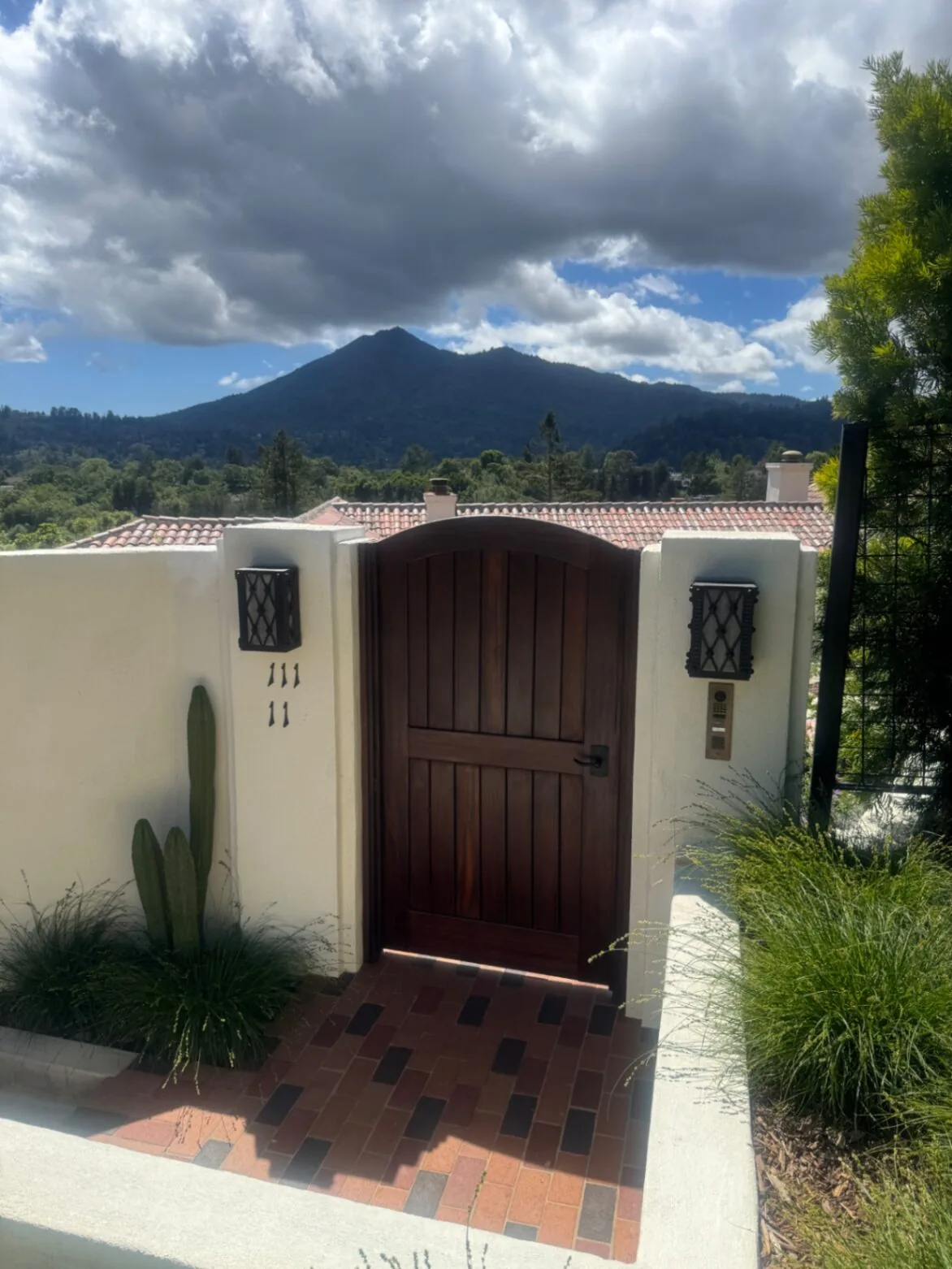
Atherton, Woodside, Portola Valley, and Menlo Park each have distinct planning codes for custom estate gates — typically 6 ft front-yard height limits, 25–50 ft setbacks, and opacity or sight-triangle review for solid gates. Four design archetypes work consistently on the Peninsula: Greene & Greene Craftsman, Mediterranean wood-and-iron, Contemporary horizontal slat, and Japanese-inspired courtyard. Sapele and White Oak are the workhorses; Ipe and Teak earn their premium on exposed Woodside ridges. Plan Control4, intercom, and audio integration during design, not after install.
Key takeaways
- Atherton: 6 ft front-yard height limit, planning review for >50% opacity, sight-triangle clearance on corner lots.
- Woodside: more rural and forgiving but heritage-oak protections require arborist review near root zones.
- Portola Valley: natural materials encouraged; expect engineered footings on sloped lots.
- Four archetypes that read as old money: Greene & Greene Craftsman, Mediterranean wood-and-iron, Contemporary slat, Japanese-inspired courtyard.
- Species by microclimate: Sapele and White Oak for Atherton flats, Ipe or Teak for sunny Woodside ridges.
- Pre-wire piers for DoorBird, Control4, and Sonos during fabrication — retrofitting through stone piers is expensive and ugly.
- Plan 8–12 weeks for design and permitting plus 6–8 weeks for fabrication.
Building a <a href="/services/custom-gates">custom estate gate</a> on the Peninsula means navigating town-specific planning codes, choosing a design language that reads as 'old money,' and integrating modern automation with your home's systems. After twenty years of building gates in Atherton, Woodside, Portola Valley, and Menlo Park, we've learned that the towns that look similar from the freeway are very different from the planning counter. This guide walks through the setback and visibility requirements that actually apply, four design archetypes that feel native to the Peninsula, the best hardwoods for each microclimate, and how to tie a gate into the Control4, Sonos, and intercom ecosystems already running inside the house.
Town code summary: what the Peninsula actually requires
Every town on the Peninsula has its own personality, and that extends to gate regulations. Here's what we navigate on your behalf when designing custom gates in Atherton and the surrounding communities.
Atherton. The planning department prioritizes visibility and neighborhood character. Front-yard gates typically must respect the same setback as the primary structure (often 30–50 feet from street centerline). Decorative gates are generally limited to 6 feet unless integrated with a permitted hedge. Solid gates over 50% opacity may require planning review to ensure they don't create traffic hazards at driveways. Automation is permitted but safety sensors and a manual override are required. Most estate gates clear minor design review; gates over 8 feet or with substantial masonry piers go to the full planning commission. Homeowners searching for driveway gates Hillsborough CA or estate gates Atherton often find that Atherton's code is more prescriptive about materials and opacity than its neighbors.
Woodside. More rural, more relaxed, but not unregulated. Front-yard gates generally follow a 30-foot setback, with more flexibility on 2+ acre parcels. Six feet is standard, with up to 8 feet permitted under design review when topography or security justifies it. Many Woodside properties need dual access for horse trailers and service vehicles — swing radius and approach grade matter. Heritage-oak protections are aggressive: any installation near a protected tree requires arborist review and root-zone protection. A serious Woodside driveway gate builder has to understand rural access, not just curb appeal.
Portola Valley. Atherton's design sensitivity with Woodside's rural sensibility. Setbacks typically run 25–30 feet from street centerline; 6 feet is standard, with design review for taller features. The town actively encourages natural materials that blend with the landscape, which is why solid hardwood gates and wood-and-iron driveway gates are received well at the counter. Sloped lots are common, so piers often need retaining walls or engineered footings.
Menlo Park (adjacent context). Zoning is more varied, but the custom gates Menlo Park luxury market typically aligns with Atherton's standards. Linfield Oaks and Sharon Heights see similar design-review treatment for prominent corner lots.
Four design archetypes that read as 'old money'
After two decades on the Peninsula, we've identified four design languages that feel native to Atherton, Woodside, and Portola Valley. These aren't trends — they're archetypes that age well.
1. The Greene & Greene Craftsman gate. Best for Atherton, Menlo Park, and properties with Arts & Crafts or Prairie-style homes. Horizontal emphasis, exposed mortise-and-tenon joinery, subtle cloud-lift detail, earth-tone stains. Typical build: Sapele or quartersawn White Oak at 2.25" thick, blackened steel strap hinges, concealed linear operator. The Peninsula has a deep Craftsman heritage; this gate reads as considered, not flashy.
2. The Mediterranean estate gate. Best for Woodside, Portola Valley, and properties with Tuscan, Spanish Colonial, or vineyard aesthetics. Massive scale, wrought-iron scrollwork integrated with heavy hardwood panels, arched or segmented top, stone or stucco piers. Typical build: Sapele or Ipe at 2.5–3" thick, forged scrollwork and decorative spears, heavy-duty articulated arm operator with integrated intercom and lighting. Fits Woodside's rural-luxury identity and feels established rather than nouveau.
3. The contemporary horizontal slat gate. Best for Atherton modern rebuilds and Menlo Park contemporary homes. Clean lines, rhythmic spacing, negative space between slats, floating-panel effect. Typical build: Sapele or Teak at 2" thick, 1/2"–1" gaps over a hidden steel subframe, underground operator with smart-home integration. When the house is already a modern statement, a traditional gate fights the architecture — this archetype extends the home's language to the street.
4. The Japanese-inspired courtyard gate. Best for Portola Valley, Woodside hillside properties, and homes with Asian-influenced architecture or zen gardens. Asymmetrical proportions, subtle curve or pitch, natural finish, integration with landscape. Typical build: Sapele or White Oak at 2.25" thick in lighter stains to emphasize grain, minimal blackened steel hardware with a hand-forged texture, bi-parting swing with a quiet operator. Portola Valley's hillside lots and mature landscaping lend themselves to this quieter, more contemplative approach.
Recommended species by Peninsula microclimate
The Bay Area isn't one climate. Atherton's flat lots with fog exposure differ from Woodside's sunny ridges and Portola Valley's oak-shaded valleys. Match the wood to the site, not the brochure.
Atherton flat lots — fog, moderate sun, well-drained soil. Sapele and White Oak shine here. Sapele's dimensional stability handles the moisture cycles; White Oak's density resists dents from landscape traffic.
Woodside ridges — full sun, wind exposure, big temperature swings. Ipe and Teak both laugh at UV and thermal stress. Ipe's cost advantage makes it attractive for large spans; Teak is the premium option when budget allows.
Portola Valley oak shade — dappled sun, higher humidity, clay soils. Sapele's rot resistance handles the humidity; White Oak's natural tannin content resists insect pressure.
Menlo Park near 101 — urban heat island, dust, traffic vibration. Density matters for acoustic dampening and impact resistance; Sapele and Ipe both deliver. This is where Sapele mahogany gates, White Oak driveway gates, Ipe driveway gates, and Teak entry gates stop being marketing language and start being engineering decisions.
Integration with intercom, Sonos, and Control4
A luxury entry gate in 2026 isn't standalone — it's part of the home's ecosystem. The biggest cost mistake we see is treating integration as a phase-two retrofit.
Intercom. We pre-wire gate piers for video intercom during fabrication. Common integrations include DoorBird (hardwired, weather-rated, direct app notification), Control4 DS2 (native Control4 integration), and Ring Elite (PoE for simpler setups). Conduit goes through the pier during construction; running it through 18" of stone or concrete after the fact is expensive and ugly.
Sonos and audio. For properties where the gate anchors an outdoor entertainment zone — pool houses, outdoor kitchens, vineyard tasting areas — we can integrate Sonos outdoor speakers into masonry piers (typically 24"×24" minimum). We design the pier around the audio, not the other way around.
Control4 and home automation. Control4 is the most common ecosystem we integrate with for automatic driveway gates on the Peninsula. Gate status appears on every touch panel; scenes like 'Arrive Home' open the gate, turn on landscape lighting, and disarm security; temporary access codes cover guests and service providers; intercom feed pops up on Control4 screens when the call button is pressed. We also work with Savant, Crestron, and Lutron Homeworks — the key is planning integration during gate design, not retrofitting after install.
We're booking design consultations 4–6 weeks out. Send us your driveway photos and we'll come back with a sketch, wood spec, and finish system within five business days.
Real-world application: an Atherton project
A recent custom gates Atherton project illustrates how these elements come together. Corner lot, Craftsman-style home built in 2014. We chose the Greene & Greene archetype: quartersawn White Oak at 2.5" thick, color-matched to the front door, 16-foot double swing.
Ironwork was blackened steel strap hinges hand-forged by a Bay Area blacksmith. Automation was a concealed linear operator with Control4 integration and battery backup. The intercom is DoorBird with app-based access. Piers are clipped limestone, 30"×30", with integrated landscape lighting. Total investment: $58,000.
The gate reads as original to the house. The automation is invisible. The White Oak will gray gracefully if the homeowner ever stops refinishing it — which is unlikely, given the maintenance plan.
How to start a Peninsula estate gate project
Begin with the architecture, the site, and the town. We do a site visit, sketch options against the home's design language, and produce CAD drawings and renderings before fabrication. From there we handle permit drawings, planning submittals, and any arborist or design-review coordination. For driveways with limited swing clearance or steep grades, sliding driveway gates preserve the full entry width while delivering the same hardwood craftsmanship and automation integration.
Plan on 8–12 weeks for design, documentation, and permit approval in Atherton or Woodside, then another 6–8 weeks for fabrication. Visit our automatic driveway gates page, our Bay Area service areas, or request a design consultation to get started.
About city guide
For more answers, see our full FAQ.
Related articles
Let's design a gate that belongs to your home.
Tell us about the entrance you want to build. We respond same-day to consultations booked before 2pm, next business day after.