
The Premium Finish System We Specify for Every Hardwood Gate in Northern California
Why Heartwood Gates specifies a curated finish system — Penofin, Armstrong Clark, Cabot Australian Timber Oil, Sikkens Cetol, Messmer's UV Plus, or TWP 100 — matched to the wood species, microclimate, and architecture of every gate we build.
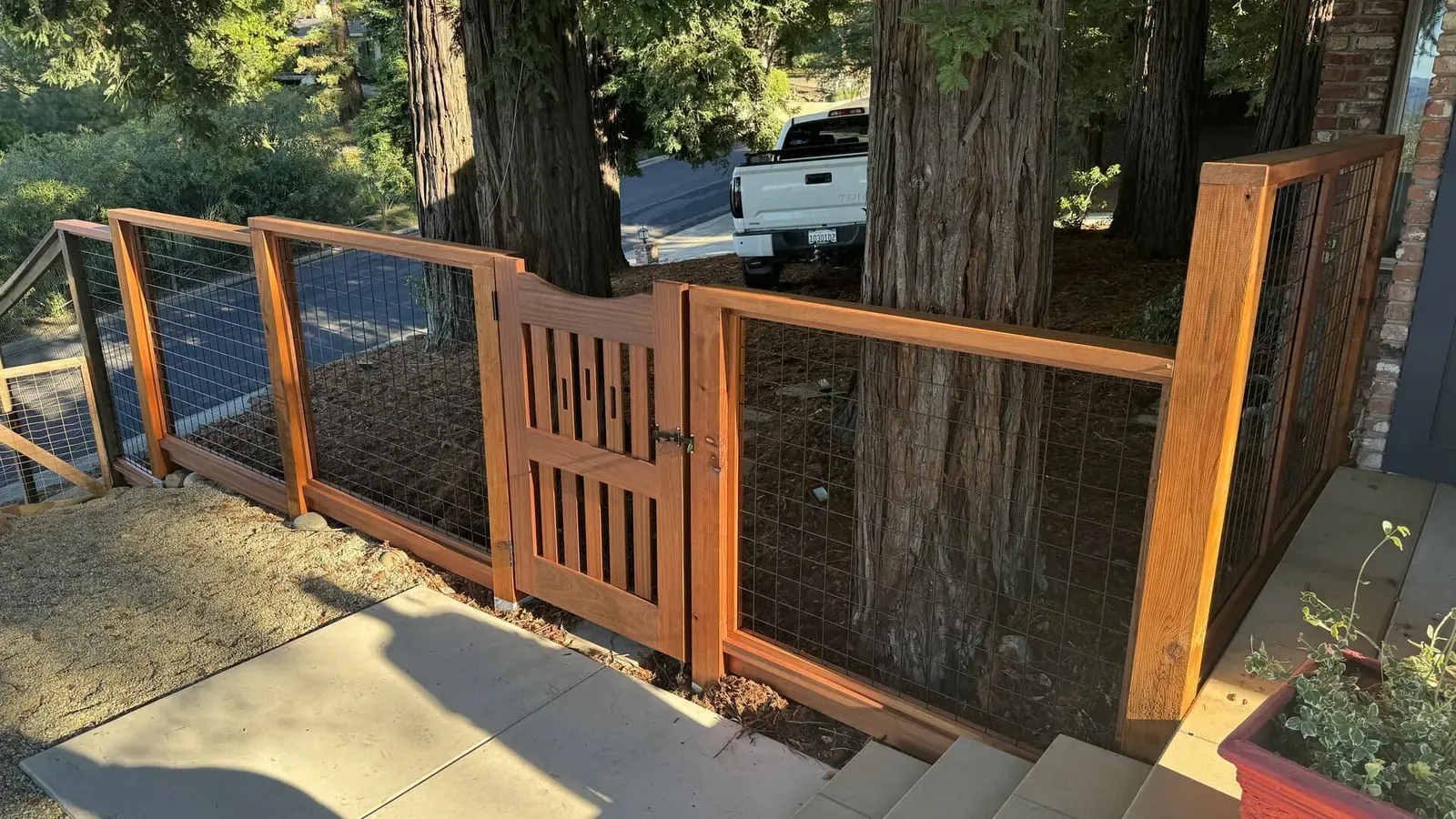
There is no single right finish for every gate. Heartwood Gates specifies Penofin Verde Marine Oil as our most common default, with Armstrong Clark, Cabot Australian Timber Oil, Sikkens Cetol, Messmer's UV Plus, or TWP 100 substituted based on wood species (Sapele, white oak, teak, ipe, cedar), microclimate, and color goals. Every gate ships with four shop-applied coats and a documented maintenance schedule.
Key takeaways
- Heartwood Gates uses six premium finish brands — Penofin, Armstrong Clark, Cabot, Sikkens, Messmer's, TWP — chosen per project, not one-size-fits-all.
- Penofin Verde Marine Oil is our most common default for Sapele in transitional climates.
- Armstrong Clark is preferred for white oak and ipe in high-UV inland sites (Folsom, El Dorado Hills, upper Napa).
- Cabot Australian Timber Oil is specified when a richer amber tone is the design goal.
- Every hardwood gate ships with four shop-applied coats and a documented year-3 / year-8 maintenance schedule.
A hardwood gate is only as durable as its finish. The finest Sapele mortise-and-tenon joinery will silver to gray and check at the joints within five years if the finish package is wrong for the wood species or the microclimate. After more than a decade of side-by-side testing across coastal Healdsburg, Wine Country, the East Bay shade belt, and the inland Sacramento heat basin, we have standardized on a tiered finish system that draws from six premium brands — Penofin, Armstrong Clark, Cabot, Sikkens, Messmer's, and TWP — specified by project rather than by default.
Why penetrating oils, not film finishes
A gate moves. It expands and contracts seasonally as the wood absorbs and sheds moisture, it cycles thermally between cold morning shade and direct afternoon sun, and the joinery flexes microscopically every time the operator drives it open and closed. Hard film finishes — spar varnish, polyurethane, two-part epoxy, big-box deck stains — cannot move with the wood at this scale. They craze, lift at the joints, and require a full sand-down to repair.
Penetrating oil finishes move with the wood because they are in the wood, not on it. When an oil-finished gate weathers, it weathers uniformly — no flaking, no peeling, no isolated failure points at the joinery. Re-finishing is a wipe-on operation, not a sand-and-strip operation. Every finish in our specified system is a penetrating oil or a hybrid oil-alkyd, never a pure film.
Our default: Penofin Verde Marine Oil
Penofin Verde is our most common default — particularly for Sapele mahogany in transitional climates from Walnut Creek to St. Helena. We specify it for two reasons: low-VOC chemistry (better for the shop crew and the property), and a UV-stable transoxide pigment package that resists silvering for years longer than competing brands.
Shop sequence: surface preparation to 180-grit, two flood coats of Penofin Verde Hardwood Formula applied wet-on-wet 30 minutes apart, a 24-hour cure, then two additional top coats with light scuff-sanding between. Maintenance: a wipe-on top coat at year 3, a full strip-and-recoat at year 8, and a strip-and-recoat every 6 to 8 years thereafter.
Armstrong Clark — our pick for high-UV inland sites
For white oak and ipe gates in El Dorado Hills, Folsom, Granite Bay, and the upper Napa Valley, we frequently substitute Armstrong Clark semi-transparent oil stain. Its non-drying conditioning oils stay in the wood longer than Penofin's drying-oil base, which matters in 100°F+ summer heat where standard oils flash off the surface before fully penetrating.
Armstrong Clark is also our preferred finish for clients who want a richer, more saturated color than the Penofin pigment range delivers. It is available in 16 stock tones and we can custom-match to an existing front door, garage door, or fence stain.
Cabot Australian Timber Oil — for warm amber tones
Cabot Australian Timber Oil is the right specification when the design calls for a deep amber, honey, or natural mahogany tone with more chromatic depth than a clear or lightly-pigmented Penofin coat delivers. We use it most often on Sapele and on white oak destined for Mediterranean and Spanish Colonial architecture across Lafayette, Orinda, and Hillsborough.
The maintenance cycle is similar to Penofin — year-3 refresh, year-8 strip-and-recoat — but the color depth means it hides minor surface wear better between maintenance visits.
Sikkens Cetol, Messmer's UV Plus, and TWP 100
Sikkens Cetol SRD (the semi-transparent oil, not the film-forming variants) is our specification for cedar-clad hybrid gates and for situations where the client has an existing Sikkens-stained fence or trim package to match. We do not specify Sikkens Cetol 1, 23, or DEK on a custom hardwood gate — those are film products and will fail.
Messmer's UV Plus is our cold-weather and shade-belt specification. It has the highest UV inhibitor loading of any of our six brands and performs exceptionally well on north-facing gates and on Berkeley Hills and Oakland Hills sites under permanent oak canopy.
TWP (Total Wood Preservative) 100 series is our specification for sites with documented insect or mildew pressure — wooded foothill properties, vineyards near standing water, and any site where the prior fence stain has shown mildew bloom. The mildewcide and insecticide additives are integrated into the oil rather than applied as a separate treatment.
We're booking design consultations 4–6 weeks out. Send us your driveway photos and we'll come back with a sketch, wood spec, and finish system within five business days.
The shop application standard, regardless of brand
Every gate we build receives a four-coat shop finish before it leaves Concord for installation. Surface prep, coat schedule, and cure times are documented per brand. Application is done under controlled shop conditions — 65 to 75°F, 40 to 60 percent relative humidity. We will not finish on a site visit; the variables are too uncontrolled.
The fourth coat is applied with the gate hung in the upright orientation so excess oil drains off the joinery rather than pooling in the corners. This is a detail most installers skip; it is the difference between a gate that looks new at year 10 and a gate with dark oil-pool stains at every mortise.
The maintenance schedule we leave with every client
Year 3: A single wipe-on top coat of the original product. This is a 90-minute job for a service tech and refreshes the color and UV protection. Cost is modest.
Year 8: A full strip-and-recoat. The gate is dismounted or sanded in place, all weathered finish is removed back to clean wood, and the full four-coat sequence is reapplied. This is the most significant maintenance event in the gate's life.
Every 6 to 8 years thereafter: Repeat the strip-and-recoat. With this schedule, a Sapele gate looks essentially new through three decades of service.
We offer this maintenance as a service contract to every client across our East Bay, North Bay, and Sacramento service areas. Clients who self-maintain receive the documented schedule, the exact product specification, and a written application guide.
What we will not specify
We will not specify big-box deck stains (Sherwin-Williams Deckscapes, Behr Premium, Olympic Maximum, Thompson's Water Seal) on a custom hardwood gate. These products are formulated for vertical deck rails and horizontal decking, not for the high-flex, high-UV environment of a gate. They fail in 18 to 30 months and the failure mode is film-finish craze that requires a full sand-down to repair.
We also will not specify any clear finish without UV pigment. A clear finish on outdoor hardwood is a one-season finish; the wood will silver below the film within months.
The finish system, chosen per project
There is no single best finish for a custom gate — the right system depends on the wood species, microclimate, sun exposure, salt load, and the look you want. Our default is Penofin Verde Marine Oil for Sapele, white oak, and teak (penetrating, low-VOC, UV-stable). For western red cedar and redwood we prefer Armstrong Clark's non-drying conditioning oils. Cabot Australian Timber Oil gives a warmer amber tone on mahogany. Sikkens Cetol is reserved for protected coastal doors. Messmer's UV Plus is our pick for ipe and garapa. TWP 100 handles foothill mildew zones. Every spec is documented in your maintenance binder so any qualified refinisher can match it.
- PenofinPenofin Verde Marine Oil
Best for: Sapele, white oak, teak — most inland & wine-country installs
Penetrating, low-VOC, UV-stable transoxide pigment package. Never peels because there is no film.
- Armstrong ClarkArmstrong Clark Semi-Transparent Oil
Best for: Western red cedar, redwood, sun-exposed inland gates
Non-drying conditioning oils sit deep; drying oils harden at the surface — superior for cedars under intense UV.
- CabotCabot Australian Timber Oil
Best for: Mahogany and dense tropicals when a richer amber tone is preferred
Tung-oil-and-linseed blend that warms hardwood without obscuring grain. Color-matches well for restoration work.
- SikkensSikkens Cetol SRD / Cetol Door & Window
Best for: Coastal salt-spray sites and high-traffic pedestrian doors
Alkyd-modified resin with mildewcide; the only film system we will spec, and only on protected vertical surfaces.
- Messmer'sMessmer's UV Plus for Hardwoods
Best for: Ipe, garapa, and ultra-dense hardwoods that reject most finishes
Specifically engineered for oily tropicals; the trans-oxide pigments hold color on woods where Penofin can be slow to soak.
- TWPTWP 100 Series Total Wood Preservative
Best for: Sierra foothill installs with heavy winter mildew pressure
EPA-registered mildewcide and fungicide package — used when the site has shade and rain together.
About materials
For more answers, see our full FAQ.
Let's design a gate that belongs to your home.
Tell us about the entrance you want to build. We respond same-day to consultations booked before 2pm, next business day after.