
Wood vs Metal Gates: Choosing the Right Material for a Northern California Estate
A frank comparison of hardwood, steel, aluminum, and wrought-iron gates — what each does well, what each fails at, and which is right for your home in Walnut Creek, Piedmont, or St. Helena.
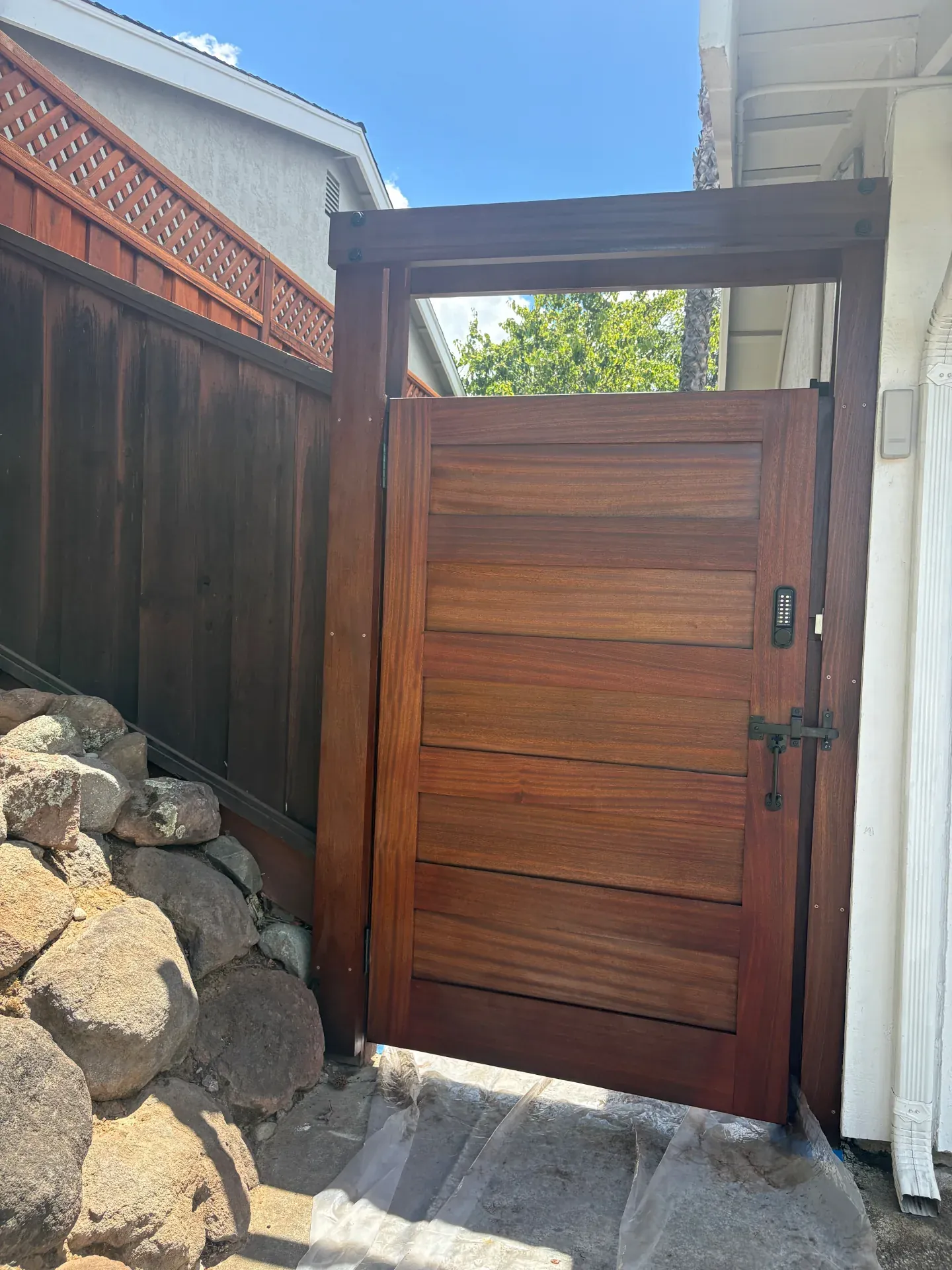
Hardwood gates offer the warmest aesthetic, best acoustic privacy, and longest-lived joinery when built correctly. Steel and wrought iron offer maximum security and the longest absolute service life but read cold and require periodic refinishing. Hybrid gates — steel sub-frame with hardwood cladding — combine the best of both for wide automatic driveway gates.
Key takeaways
- Hardwood gates offer the warmest aesthetic, best acoustic privacy, and longest-lived joinery when built correctly. Steel and wrought iron offer maximum security and the longest absolute service life but read cold and require periodic refinishing. Hybrid gates — steel sub-frame with hardwood cladding — combine the best of both for wide automatic driveway gates.
- What a hardwood gate does best: A well-built hardwood gate is the warmest object in the entry sequence of a home.
- What a steel or wrought iron gate does best: Steel is unmatched for security.
- Aluminum: where it fits and where it doesn't: Aluminum gates have a real place in the market: lightweight, corrosion-immune, and considerably cheaper than steel or hardwood.
- Hybrid construction: the right answer for most wide automatic gates: For automatic driveway gates wider than 14 feet — which describes most estate driveways in Walnut Creek's Northgate area, the Berkeley Hills, Piedmont, and the Napa Valley estates — hybrid construction is the engineering answer.
- Do you build pure wrought iron gates? We design them and project-manage the build in collaboration with two East Bay forges. The hardwood frame, hardware integration, and automation are all done in our shop.
Almost every client who walks into a custom gate conversation in the Bay Area starts in the same place: wood, metal, or both. The answer matters for cost, service life, maintenance, aesthetics, security, and the way the gate will age against the rest of the home. This is the comparison we walk through at the start of every design consultation in Walnut Creek, Piedmont, St. Helena, and beyond.
What a hardwood gate does best
A well-built hardwood gate is the warmest object in the entry sequence of a home. The grain has depth that no painted finish can match. The acoustics are softer — wood absorbs and damps sound rather than reflecting it the way steel does. The gate ages with character, not corrosion.
From a structural standpoint, Sapele mahogany, white oak, and teak built with mortise-and-tenon joinery will outlast the original hardware before the wood fails. We have refinished 30-year-old Heartwood-built hardwood gates that needed only a new top coat and a hinge lubrication to be ready for another decade.
The trade-offs are real. Hardwood is heavier per linear foot than aluminum, requires periodic refinishing, and has a span limit before steel reinforcement becomes necessary. The right hardwood, designed and built correctly, manages all three issues across the range of gates most clients are commissioning.
What a steel or wrought iron gate does best
Steel is unmatched for security. A welded steel gate with proper picket spacing is genuinely difficult to defeat without tools. It is also the longest-lived material if maintained: a properly finished steel gate in inland Walnut Creek or St. Helena will easily see 50 years before significant refinishing is needed.
Wrought iron specifically — true hand-forged wrought, not bent steel sold as 'wrought' — has an aesthetic that no other material reproduces. The slight irregularity of a forged element reads as craft in a way that machine-bent metal cannot. We collaborate with two East Bay forges for clients who want this look on estates in Piedmont, Berkeley Hills, and the Napa wine corridor.
Trade-offs: steel reads cold relative to wood, costs more in materials, requires welding access for any future modification, and is acoustically harsh. Coastal salt air corrodes unfinished steel quickly — a North Bay or coastal Marin steel gate needs proactive maintenance.
Aluminum: where it fits and where it doesn't
Aluminum gates have a real place in the market: lightweight, corrosion-immune, and considerably cheaper than steel or hardwood. For a budget-conscious project, a powder-coated aluminum gate from a reputable fabricator is a reasonable choice.
What aluminum cannot do is read as a high-end custom gate. The hollow tubular sections, the visible welds, the slightly hollow sound when struck — all are tells. On a multi-million-dollar property in Piedmont or St. Helena, an aluminum gate will undersell the rest of the architecture.
We do not build in aluminum, but we will tell a client honestly when aluminum is the right answer for their project — usually when the gate is a back-of-house side yard gate that needs to function but not perform aesthetically.
Hybrid construction: the right answer for most wide automatic gates
For automatic driveway gates wider than 14 feet — which describes most estate driveways in Walnut Creek's Northgate area, the Berkeley Hills, Piedmont, and the Napa Valley estates — hybrid construction is the engineering answer. A fully welded steel sub-frame carries the operator load and resists cyclic racking; a hardwood cladding provides the appearance and weather face.
The full method is detailed in our piece on the steel sub-frame and Sapele cladding method. The short version: from the street, the gate reads as solid Sapele. From an engineering standpoint, it reads as a steel-framed vehicle gate with the durability that implies.
Hybrid gates also let us combine wrought iron decorative elements with hardwood cladding. A forged iron medallion, picket fan, or family crest inset into a Sapele frame is a classic detail for Mediterranean and Tuscan estates in the Napa wine country.
Cost comparison: what each material runs in 2026 dollars
Approximate installed pricing for a comparable 12-foot single-leaf gate in our service area, in 2026 dollars: pure hardwood mortise-and-tenon gate, $14,000 to $22,000 depending on species and detail level. Pure welded steel gate, $11,000 to $18,000 plus paint maintenance. Hand-forged wrought iron gate, $22,000 to $40,000 depending on the forge work. Hybrid steel-and-hardwood gate, $18,000 to $28,000.
Aluminum, for comparison, runs $5,000 to $9,000 installed from a typical fabricator. That price point is real and reflects the material's strengths — it is not directly comparable to the above because it is a different category of product.
These numbers exclude automation. Add roughly $4,500 to $9,000 for a complete automation package: operator, control board, safety sensors, access control, and battery backup. Wider gates and dual-leaf configurations scale up from there.
We're booking design consultations 4–6 weeks out. Send us your driveway photos and we'll come back with a sketch, wood spec, and finish system within five business days.
Service life expectations
Realistic service-life numbers from our field experience: pure hardwood with mortise-and-tenon joinery and a maintained finish schedule — 30 to 50 years before structural rebuild. Steel with maintained paint — 40 to 60 years before significant refinishing. Wrought iron — comparable to steel, often longer because the material is more corrosion-tolerant. Hybrid — 30 to 50 years for the cladding, 50+ for the steel frame underneath.
Aluminum — 25 to 40 years, with the limiting factor being hardware and welds rather than the aluminum itself.
These numbers assume proper installation on properly engineered posts and foundations. A poorly installed gate of any material is a 10-year product. Foundation depth, hinge sizing, and operator selection matter as much as the gate material.
Aesthetic considerations by architecture style
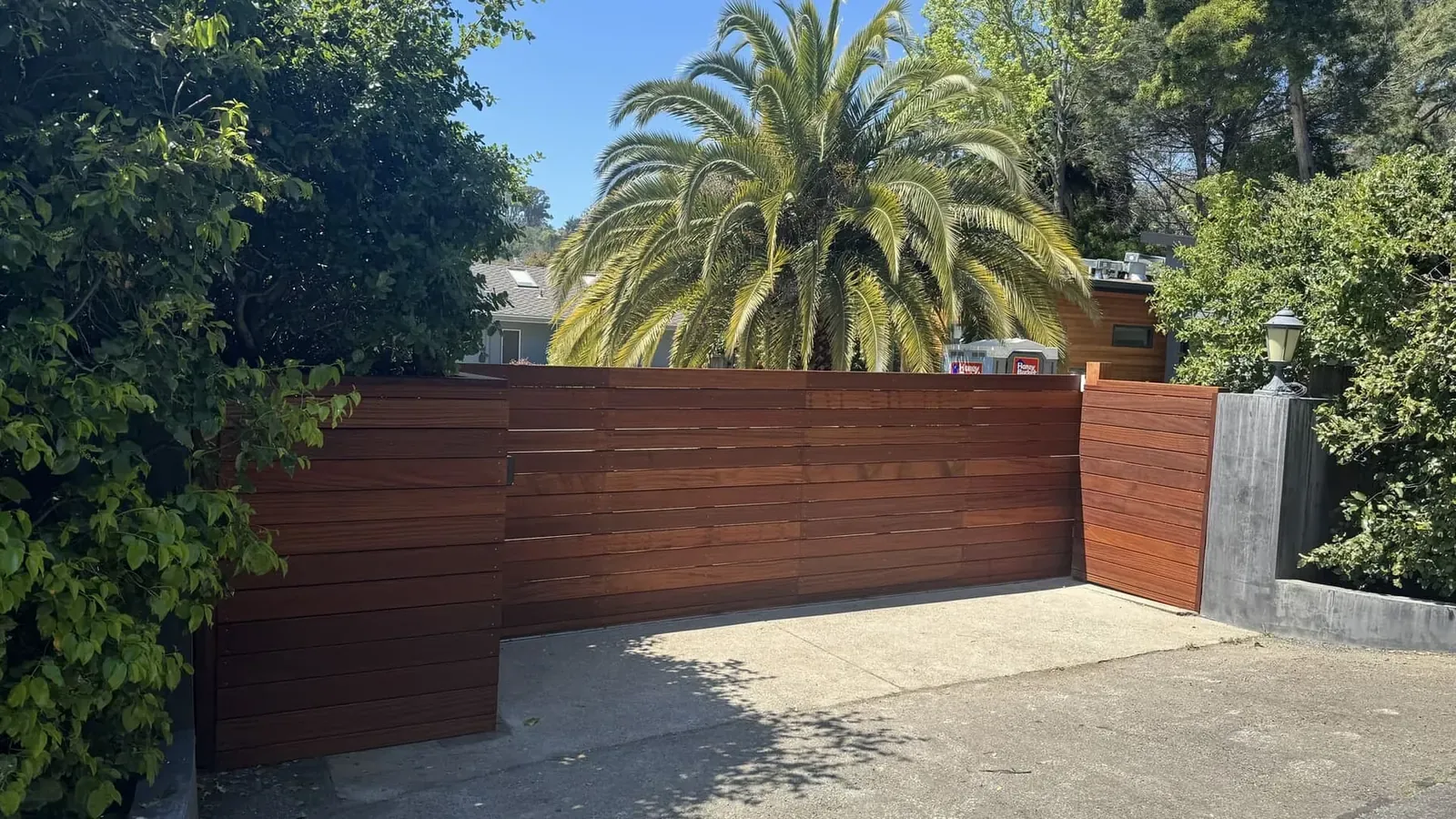
Modern and contemporary homes — typically read best with hardwood horizontal slats, either pure wood or hybrid construction. We see this often in Berkeley Hills, Piedmont contemporary remodels, and modern Walnut Creek hillside homes.
Mediterranean and Tuscan villas — wrought iron with hardwood gates, or a combination panel. Common in the Napa wine country, the Lafayette and Alamo Mediterranean estates, and Piedmont's older Spanish revival blocks.
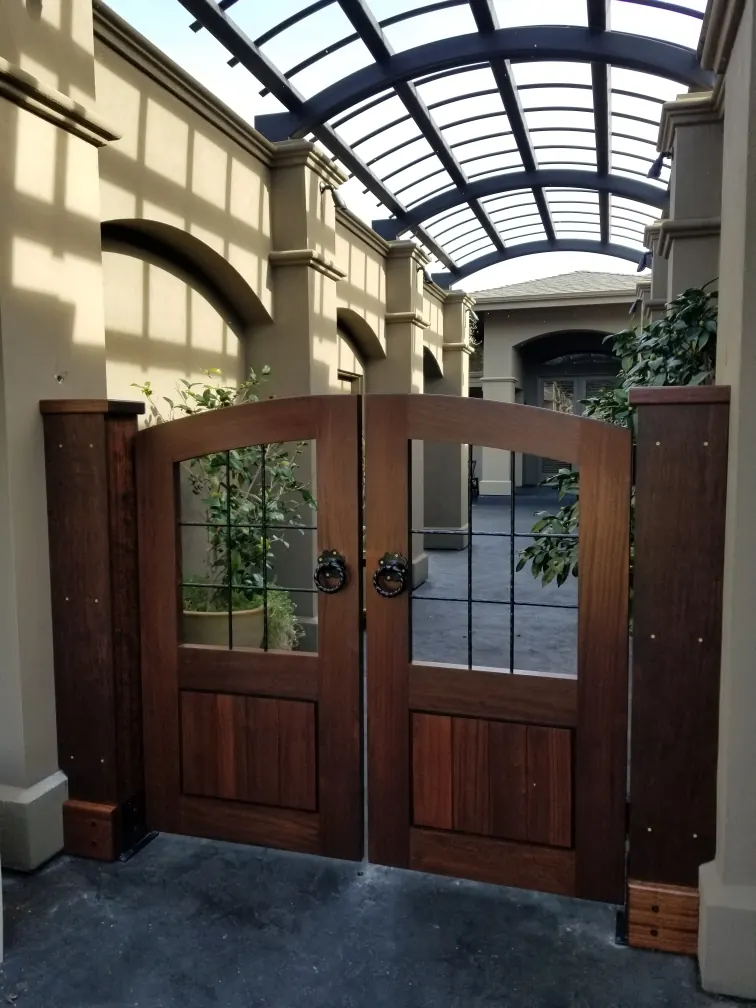
Craftsman and Greene-and-Greene-inflected homes — pure hardwood with through-tenon detailing, often white oak. Common in Piedmont, Berkeley, and the inner Bay Area craftsman neighborhoods.
Modern farmhouse — typically Sapele or white oak in horizontal slat or board-and-batten configurations. Common across the East Bay, the Lamorinda corridor, and the new estate construction in the Napa Valley.
How to think about the decision
Start with the home, not the gate. The gate should extend the architecture, not compete with it. A hardwood gate on a stone Tuscan estate or a wrought iron gate on a redwood-and-glass modern can both be wrong even when the gate itself is beautiful.
Next, weigh maintenance honestly. Hardwood requires periodic refinishing on a schedule. Steel requires periodic touch-up paint. Wrought iron requires the same, plus occasional rust spot treatment. None of these is onerous — but if you genuinely will not maintain anything, a hybrid gate with a top-coat schedule we will manage on retainer is a real option we offer.
Finally, look at security needs. Pure picketed steel and wrought iron read as security; solid hardwood reads as privacy. Both can be designed to meet either functional need, but the visual signal matters.
Working with us across Northern California
We design and build in all of the above materials — pure hardwood, hybrid, and decorative iron with hardwood — at our Concord workshop, and install across Walnut Creek, the East Bay, the Napa wine country, the Lamorinda corridor, and the Sacramento estate areas. For wrought iron specifically, we collaborate with two East Bay forges with whom we have long-standing relationships.
Start with our custom gates service overview or our automatic driveway gates page. To begin a project, request a design consultation and we will walk through the material decision in person.
The right material is the one you do not have to think about every time you drive through the gate.
The finish system, chosen per project
There is no single best finish for a custom gate — the right system depends on the wood species, microclimate, sun exposure, salt load, and the look you want. Our default is Penofin Verde Marine Oil for Sapele, white oak, and teak (penetrating, low-VOC, UV-stable). For western red cedar and redwood we prefer Armstrong Clark's non-drying conditioning oils. Cabot Australian Timber Oil gives a warmer amber tone on mahogany. Sikkens Cetol is reserved for protected coastal doors. Messmer's UV Plus is our pick for ipe and garapa. TWP 100 handles foothill mildew zones. Every spec is documented in your maintenance binder so any qualified refinisher can match it.
- PenofinPenofin Verde Marine Oil
Best for: Sapele, white oak, teak — most inland & wine-country installs
Penetrating, low-VOC, UV-stable transoxide pigment package. Never peels because there is no film.
- Armstrong ClarkArmstrong Clark Semi-Transparent Oil
Best for: Western red cedar, redwood, sun-exposed inland gates
Non-drying conditioning oils sit deep; drying oils harden at the surface — superior for cedars under intense UV.
- CabotCabot Australian Timber Oil
Best for: Mahogany and dense tropicals when a richer amber tone is preferred
Tung-oil-and-linseed blend that warms hardwood without obscuring grain. Color-matches well for restoration work.
- SikkensSikkens Cetol SRD / Cetol Door & Window
Best for: Coastal salt-spray sites and high-traffic pedestrian doors
Alkyd-modified resin with mildewcide; the only film system we will spec, and only on protected vertical surfaces.
- Messmer'sMessmer's UV Plus for Hardwoods
Best for: Ipe, garapa, and ultra-dense hardwoods that reject most finishes
Specifically engineered for oily tropicals; the trans-oxide pigments hold color on woods where Penofin can be slow to soak.
- TWPTWP 100 Series Total Wood Preservative
Best for: Sierra foothill installs with heavy winter mildew pressure
EPA-registered mildewcide and fungicide package — used when the site has shade and rain together.
About design
For more answers, see our full FAQ.
Let's design a gate that belongs to your home.
Tell us about the entrance you want to build. We respond same-day to consultations booked before 2pm, next business day after.