
Designing Waterfront-Resistant Gates for Tiburon and Belvedere
Salt air, fog, prevailing wind, and irrigation. Four problems that destroy ordinary gates within a decade — and the design choices that make a Tiburon waterfront gate last 30 years.
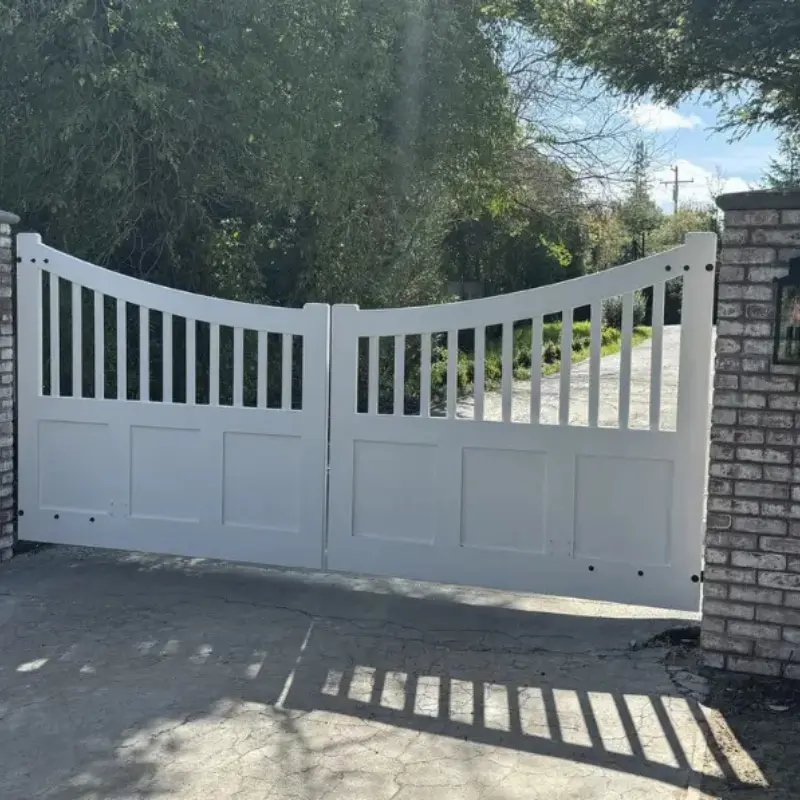
Tiburon and Belvedere waterfront installations require specific design choices: salt-resistant hardware (bronze, stainless 316), elevated bottom rail clearance, hardwood selection (Sapele or teak, never cedar or softwood), drainage details at the bottom rail, and powder-coat over zinc-rich primer on any steel. With these in place, a 30-year service life is realistic.
Key takeaways
- Tiburon and Belvedere waterfront installations require specific design choices: salt-resistant hardware (bronze, stainless 316), elevated bottom rail clearance, hardwood selection (Sapele or teak, never cedar or softwood), drainage details at the bottom rail, and powder-coat over zinc-rich primer on any steel. With these in place, a 30-year service life is realistic.
- The salt-air problem and how it attacks gates: Salt-laden marine air carries sodium chloride and other chlorides as a fine aerosol that deposits on exposed surfaces.
- Hardwood selection for the waterfront: For an unfinished, naturally weathering Tiburon waterfront gate, teak is the historical gold standard and we'll happily build in it.
- Bottom rail design: drainage and elevation: The bottom rail of any outdoor gate is the most failure-prone element.
- Steel and structural metal in marine environments: Where steel is required for a hybrid waterfront gate — and on automated driveway gates with structural sub-frames, it usually is — we use galvanized or hot-rolled steel coated with a multi-coat zinc-rich primer and finished with marine-grade powder coat.
- How long will a properly built waterfront gate last in Tiburon? 30+ years with the design details and maintenance schedule outlined above. 12 to 15 years without them.
A Tiburon waterfront gate has to survive things most gates never see. Salt-laden air carries hundreds of feet inland on every afternoon's prevailing wind. Fog wets the wood and metalwork for hours a day from June through August. The morning sun and afternoon shade cycle through dramatic temperature changes. And irrigation systems, often poorly aimed, spray the bottom of the gate weekly. Each of these alone is manageable. All four together will destroy an ordinary gate inside of a decade. Here's how we design and build for the Tiburon waterfront specifically.
The salt-air problem and how it attacks gates
Salt-laden marine air carries sodium chloride and other chlorides as a fine aerosol that deposits on exposed surfaces. On metal, those chlorides accelerate corrosion dramatically — particularly on standard carbon steel and lower-grade stainless. On wood, the salts attract and hold moisture against the surface, accelerating finish breakdown and (over years) wood fiber degradation.
Prevailing afternoon wind in Tiburon comes off the bay. Properties on the western waterfront receive the strongest salt loading; properties on the leeward (eastern) side somewhat less. A gate facing the water sees roughly 3 to 5 times the salt loading of the same gate sheltered behind the house.
Hardware selection is the single most important decision for salt-air longevity. Lower-grade stainless (304) will pit and rust within a year or two of waterfront exposure. Plated steel will fail in months. Marine-grade bronze and 316 stainless are the only metals we specify for direct salt exposure.
Hardwood selection for the waterfront
For an unfinished, naturally weathering Tiburon waterfront gate, teak is the historical gold standard and we'll happily build in it. For a finished gate with maintained color, Sapele is our preferred material — both for cost and for finish-retention reliability in the salt and fog environment.
We do not specify cedar or any softwood for direct waterfront installations. The wood is too absorbent, the salts and constant moisture together break down the natural extractives, and the finish system cannot keep up with the moisture loading. Cedar can work for waterfront-adjacent installations (a block or two inland) but not for properties directly on the water.
White oak performs respectably on the waterfront but is more susceptible to staining from any iron-containing hardware than Sapele. We use 316 stainless exclusively on white oak waterfront installations to avoid this.
Bottom rail design: drainage and elevation
The bottom rail of any outdoor gate is the most failure-prone element. It collects water from above (rain, fog drip) and from below (irrigation overspray, splashback from wet pavement). Standard construction often traps the water against the wood, where it accelerates rot.
Our waterfront detail: bottom rail elevated at least 4 inches above grade, end caps angled to shed water away from end-grain absorption points, hidden drainage channels routed into the bottom of the rail to evacuate any moisture that does accumulate, and an additional sacrificial drip-edge molding that can be replaced in 15 or 20 years without rebuilding the gate.
Irrigation review is part of every waterfront site visit we do. The most common failure mode we see on existing gates is a pop-up sprinkler that hits the bottom of the gate weekly and saturates it. We coordinate with the client's landscaper to reroute or replace any problem heads before we install.
Steel and structural metal in marine environments
Where steel is required for a hybrid waterfront gate — and on automated driveway gates with structural sub-frames, it usually is — we use galvanized or hot-rolled steel coated with a multi-coat zinc-rich primer and finished with marine-grade powder coat. The system reliably gives 20 to 25 years of waterfront service before refinishing is needed.
Steel connections to hardware get additional barrier treatment: stainless or bronze fasteners, isolation washers, and silicone sealant at all penetrations. Any cut or drilled edge of steel exposed during fabrication is touched up with zinc-rich primer before powder coating.
Aluminum is increasingly attractive for waterfront automated gate sub-frames because of its inherent corrosion resistance. We're specifying aluminum more often than we used to on Tiburon and Belvedere automated installations.
Finish system: marine oil vs. film finishes
Film-forming finishes (varnish, polyurethane, marine spar) sit on top of the wood and create a moisture barrier. They work beautifully on yacht decks where the boat is washed weekly and the finish is renewed annually. On a Tiburon gate that's exposed continuously without that intensive maintenance, film finishes break down at the edges within 2 to 3 years and start peeling.
Penetrating oil finishes (Penofin Marine Oil, our standard) soak into the wood and protect from within. They don't form a film, so they don't peel. Maintenance is straightforward: clean, light sand if needed, two coats of fresh oil every 2 to 3 years on waterfront installations.
We've experimented with hybrid systems and consistently come back to Penofin Marine Oil for Bay Area waterfront work. The maintenance burden is lower and the failure mode is graceful — the gate looks gradually drier until it's refinished, rather than abruptly peeling and looking damaged.
We're booking design consultations 4–6 weeks out. Send us your driveway photos and we'll come back with a sketch, wood spec, and finish system within five business days.
Automation considerations for waterfront installations
Standard gate operators have varying tolerance for salt exposure. We specify operators that have been validated in marine environments — primarily FAAC hydraulic and certain LiftMaster commercial models — and we install them with additional environmental sealing on any waterfront installation.
Underground operators (a popular choice on estate driveways for their concealment) are particularly vulnerable to salt-water intrusion in the operator vault. We use heavy-duty marine-grade vault liners and waterproof junction boxes on every waterfront underground install, and we install a drainage system to evacuate any moisture that does enter the vault.
For very high-exposure installations directly on the water, we'll occasionally recommend a surface-mounted operator over an underground one specifically to avoid the long-term moisture intrusion problem. The visual compromise is real but the maintenance burden is significantly lower.
Maintenance schedule for waterfront gates
Our recommended waterfront maintenance schedule: every 12 months, walk-through inspection and lubrication of hinges and operators. Every 24 to 30 months, complete oil finish refresh on the hardwood. Every 5 to 7 years, comprehensive hardware inspection and bronze/stainless polishing as desired. Every 15 to 20 years, evaluate the sacrificial drip-edge molding for replacement.
Owners who follow this schedule realistically see 30+ year service life on waterfront gates. Owners who don't typically see 12 to 15 years before significant deterioration.
We offer annual maintenance plans for Tiburon and Belvedere clients that handle the maintenance schedule on autopilot. Most of our long-term waterfront clients are on these plans.
Starting a waterfront project
We're a 35-minute drive from most of Tiburon and Belvedere. Waterfront site visits are scheduled within two weeks of first contact and typically take 60 to 90 minutes on site to review salt exposure, irrigation, drainage, and access. See our Bay Area service area for current lead times.
If you're replacing a failed waterfront gate, we'll evaluate what can be salvaged from the existing installation. Frequently the posts and operator are recoverable, but the gate and hardware are not.
Companion reading: Sapele vs. teak in Northern California and how hardwoods weather in Marin's salt air.
The finish system, chosen per project
There is no single best finish for a custom gate — the right system depends on the wood species, microclimate, sun exposure, salt load, and the look you want. Our default is Penofin Verde Marine Oil for Sapele, white oak, and teak (penetrating, low-VOC, UV-stable). For western red cedar and redwood we prefer Armstrong Clark's non-drying conditioning oils. Cabot Australian Timber Oil gives a warmer amber tone on mahogany. Sikkens Cetol is reserved for protected coastal doors. Messmer's UV Plus is our pick for ipe and garapa. TWP 100 handles foothill mildew zones. Every spec is documented in your maintenance binder so any qualified refinisher can match it.
- PenofinPenofin Verde Marine Oil
Best for: Sapele, white oak, teak — most inland & wine-country installs
Penetrating, low-VOC, UV-stable transoxide pigment package. Never peels because there is no film.
- Armstrong ClarkArmstrong Clark Semi-Transparent Oil
Best for: Western red cedar, redwood, sun-exposed inland gates
Non-drying conditioning oils sit deep; drying oils harden at the surface — superior for cedars under intense UV.
- CabotCabot Australian Timber Oil
Best for: Mahogany and dense tropicals when a richer amber tone is preferred
Tung-oil-and-linseed blend that warms hardwood without obscuring grain. Color-matches well for restoration work.
- SikkensSikkens Cetol SRD / Cetol Door & Window
Best for: Coastal salt-spray sites and high-traffic pedestrian doors
Alkyd-modified resin with mildewcide; the only film system we will spec, and only on protected vertical surfaces.
- Messmer'sMessmer's UV Plus for Hardwoods
Best for: Ipe, garapa, and ultra-dense hardwoods that reject most finishes
Specifically engineered for oily tropicals; the trans-oxide pigments hold color on woods where Penofin can be slow to soak.
- TWPTWP 100 Series Total Wood Preservative
Best for: Sierra foothill installs with heavy winter mildew pressure
EPA-registered mildewcide and fungicide package — used when the site has shade and rain together.
About design
For more answers, see our full FAQ.
Let's design a gate that belongs to your home.
Tell us about the entrance you want to build. We respond same-day to consultations booked before 2pm, next business day after.