
The Steel Sub-Frame and Sapele Cladding Method for Wide Driveway Gates
How Heartwood Gates engineers hybrid steel-and-hardwood automatic driveway gates that span 14 to 24 feet without sagging — a method we developed for estates in Alamo, Danville, and the Lamorinda corridor.
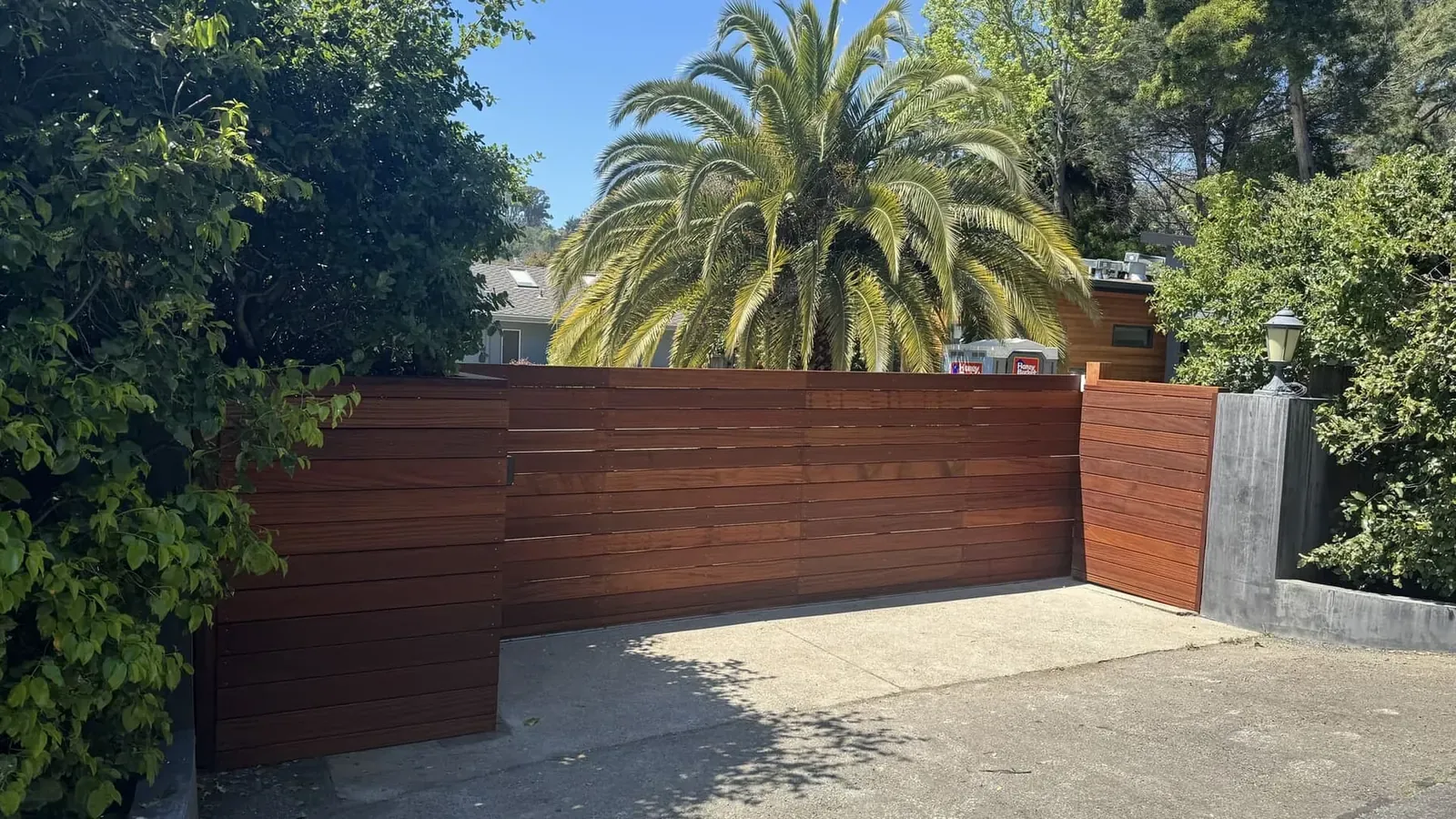
For automatic driveway gates wider than 14 feet, Heartwood Gates builds a welded steel sub-frame and clads it with mortise-and-tenon-joined Sapele mahogany. The steel handles the structural and dynamic load; the hardwood handles the appearance and the weather. The result is a gate that looks like solid millwork and engineers like a vehicle gate.
Key takeaways
- For automatic driveway gates wider than 14 feet, Heartwood Gates builds a welded steel sub-frame and clads it with mortise-and-tenon-joined Sapele mahogany. The steel handles the structural and dynamic load; the hardwood handles the appearance and the weather. The result is a gate that looks like solid millwork and engineers like a vehicle gate.
- Why all-wood frames have a span limit: An automatic swing gate is not a static object.
- How we engineer the steel sub-frame: Every Heartwood hybrid driveway gate starts with a CAD model of the steel structure.
- Why we still use real joinery in the cladding: The cladding could, in theory, be a glued-and-screwed face panel.
- Floating tenons in the cladding frame: Floating tenons (also called loose tenons or, in the small-shop world, dominoes) are slips of hardwood shop-milled to fit precision mortises cut in both joining pieces.
- Do all your driveway gates use a steel sub-frame? No. We use all-wood mortise-and-tenon construction for driveway gates up to roughly 14 feet per leaf. Wider than that, the hybrid steel-and-cladding method is the right engineering answer.
There is a point where pure wood joinery stops being the right answer for an automatic gate. Past about 14 feet in a single leaf, the cyclic torque a residential gate operator generates begins to outpace what even the best mortise-and-tenon hardwood frame can absorb season after season. For those gates — the ones that span private driveways in Alamo, Danville, Diablo, and the upper reaches of Lafayette and Orinda — we build a hybrid: a fully welded structural steel sub-frame that carries every pound of operator load, faced with a Sapele mahogany cladding shop-joined with floating tenons so the finished gate reads as solid hardwood from the street.
Why all-wood frames have a span limit
An automatic swing gate is not a static object. Every open-close cycle, the operator arm applies hundreds of pounds of starting torque, then decelerates the leaf against its own inertia at the end of travel. UL325 safety stops add additional reversal events. On a wide leaf, that translates to a cyclic racking load applied at the hinge stile thousands of times a year.
Mortise and tenon joinery resists racking magnificently up to the span where the rail itself begins to flex under its own weight. Past 14 feet, even 8/4 Sapele rails begin to deflect, the corner joints start working against themselves, and the gate develops a slight sag at the latch stile within a few seasons. We have serviced all-wood automatic gates from other builders in Alamo and Danville that show exactly this failure pattern — beautifully joined, structurally undersized.
Steel doesn't have this problem. A welded 2x4 inch HSS (hollow structural section) frame in 3/16-inch wall stock spans 24 feet with negligible deflection and laughs at operator cycling. The trade is appearance: a bare steel frame looks like a fence panel, not a piece of architecture. Cladding solves that.
How we engineer the steel sub-frame
Every Heartwood hybrid driveway gate starts with a CAD model of the steel structure. We size the perimeter members and internal bracing based on leaf width, leaf height, operator type, and wind exposure — a gate on a windy ridgeline in Diablo gets heavier members than the same gate in a sheltered Orinda canyon.
Perimeter rails are typically 2x4 inch HSS in 3/16 wall, mitered and fully welded at every corner with continuous TIG welds. Diagonal bracing in the lower triangle of each leaf prevents racking from the hinge side. A horizontal mid-rail provides a mounting surface for the cladding and breaks the leaf into two manageable panels for finishing.
All welds are ground flush, the frame is hot-dip galvanized for inland sites or two-stage epoxy-primer-plus-polyurethane top-coated for coastal sites, and the hinge points are reinforced with welded gussets sized for the specific hinge hardware. Nothing about the steel work is improvised on-site.
Why we still use real joinery in the cladding
The cladding could, in theory, be a glued-and-screwed face panel. It would look identical on day one. Within five seasons in Alamo's heat-and-cold cycling, the glue joints would begin to telegraph and the screws would loosen. We've cut apart cladding panels from other shops where this has happened — the failure mode is unmistakable.
Our cladding is built as a true mortise-and-tenon hardwood frame in 5/4 Sapele, with floating tenons connecting stiles to rails and shop-cut grooves capturing infill panels or horizontal slats. The frame is built complete in the workshop, finish-sanded, sealed, then mechanically fastened to the steel sub-frame with stainless threaded inserts on slotted holes that allow the wood to move seasonally without binding against the steel.
The result is a 24-foot driveway gate that, when you walk up to it, reads exactly like a piece of solid hardwood millwork. The steel is invisible from any angle a visitor will ever see.
Floating tenons in the cladding frame
Floating tenons (also called loose tenons or, in the small-shop world, dominoes) are slips of hardwood shop-milled to fit precision mortises cut in both joining pieces. Done correctly, they are mechanically equivalent to an integral tenon — the long grain still locks load along the wood fibers — while allowing the cladding frame to be assembled in modular sections.
We mill our own floating tenons from quartersawn Sapele off-cuts rather than buying factory beech dominoes. The reason is detailed in our companion piece on milling our own hardwood dominoes: beech moves differently from Sapele and corrodes the joint over years of outdoor exposure. Same-species tenons are the right answer for outdoor work.
Every cladding joint is drawbore-pinned with a 5/16-inch Sapele pin. Same principle as a traditional pinned mortise and tenon — the pin pulls the shoulder tight and the joint can never loosen short of catastrophic failure of the wood itself.
Operator selection for hybrid gates
A 16-foot hybrid leaf weighs in the range of 350 to 500 pounds depending on cladding species and infill. That is well within the spec of premium residential operators — FAAC 415L and 422 series, LiftMaster LA500, Viking K-2 — provided the operator is sized correctly for both weight and cycle frequency.
We default to FAAC for inland East Bay installations because the hydraulic actuators are quiet, smooth, and tolerate the 100°F-plus summer temperatures common in Alamo and Danville without thermal fade. LiftMaster is our choice when a client wants tight integration with myQ smart-home access; Viking when extreme reliability under heavy daily cycling matters.
Every hybrid gate we install includes UL325 photo-eye safety beams, a Wiegand-compatible access controller for keypad or intercom entry, and a battery backup that will run the gate for at least 12 cycles in a power outage. None of this is optional.
We're booking design consultations 4–6 weeks out. Send us your driveway photos and we'll come back with a sketch, wood spec, and finish system within five business days.
Foundations, posts, and site work
A hybrid driveway gate is only as good as what it hangs from. We pour 36-inch-diameter reinforced concrete footings to a minimum depth of 48 inches below grade for both hinge and latch posts. Posts are 4x4 inch HSS welded to anchor plates that are bolted to embedded J-bolts cast into the footing.
On clay-heavy sites — which describes most of the Alamo, Diablo, and Danville hill country — we go deeper. Bay Area clay swells and contracts dramatically through the wet and dry seasons, and a footing that is too shallow will heave the post out of plumb within two years. We've seen this failure on owner-built gates more than once.
Hinge selection matters as much as post depth. We use industrial ball-bearing hinges rated for at least 3x the leaf weight, mounted on through-bolts that pass entirely through the steel post and capture on a backing plate. Lag-bolted hinges on hardwood posts are a non-starter for an automatic gate.
Finishing the cladding for inland climates
The Sapele cladding gets a four-coat marine-grade Penofin finish before installation. We use the Penofin Verde line for its low-VOC chemistry and excellent UV stability — important for unshaded gates that get the full Alamo and Danville sun load 200 days a year.
Finish is applied in the workshop under controlled conditions, then touched up at the seams after install. We provide every client with a documented re-finish schedule: a single wipe-on top coat at year three, a full strip-and-recoat at year eight, and a strip-and-recoat every six to eight years thereafter. With that schedule, the cladding will outlast the steel.
For coastal North Bay installations where salt air is a factor, we substitute a marine-grade two-part finish over an epoxy-sealed substrate. The details are in our forthcoming piece on coastal gate finishing.
What this means for a homeowner planning a wide driveway gate
If your driveway opening is wider than 14 feet — which describes most estate driveways in Alamo, Danville, Diablo, and the upper hills of Orinda — you should expect a serious gate builder to be talking about steel sub-frame construction, not selling you a pure-wood gate that 'should be fine.' The latter is a five-year solution at a twenty-year price.
Ask any prospective builder how they will engineer the load path from the operator to the hinge, what gauge steel they will use, how the cladding will be attached, and how the wood will be allowed to move seasonally against the steel. The answers will tell you everything about the gate's likely service life.
If you'd like to see one of these gates in person, we periodically host shop visits in Concord and can arrange site visits to recent installations in Alamo and Danville. Start with our automatic driveway gates service overview or our custom gates page, then request a design consultation.
The finish system, chosen per project
There is no single best finish for a custom gate — the right system depends on the wood species, microclimate, sun exposure, salt load, and the look you want. Our default is Penofin Verde Marine Oil for Sapele, white oak, and teak (penetrating, low-VOC, UV-stable). For western red cedar and redwood we prefer Armstrong Clark's non-drying conditioning oils. Cabot Australian Timber Oil gives a warmer amber tone on mahogany. Sikkens Cetol is reserved for protected coastal doors. Messmer's UV Plus is our pick for ipe and garapa. TWP 100 handles foothill mildew zones. Every spec is documented in your maintenance binder so any qualified refinisher can match it.
- PenofinPenofin Verde Marine Oil
Best for: Sapele, white oak, teak — most inland & wine-country installs
Penetrating, low-VOC, UV-stable transoxide pigment package. Never peels because there is no film.
- Armstrong ClarkArmstrong Clark Semi-Transparent Oil
Best for: Western red cedar, redwood, sun-exposed inland gates
Non-drying conditioning oils sit deep; drying oils harden at the surface — superior for cedars under intense UV.
- CabotCabot Australian Timber Oil
Best for: Mahogany and dense tropicals when a richer amber tone is preferred
Tung-oil-and-linseed blend that warms hardwood without obscuring grain. Color-matches well for restoration work.
- SikkensSikkens Cetol SRD / Cetol Door & Window
Best for: Coastal salt-spray sites and high-traffic pedestrian doors
Alkyd-modified resin with mildewcide; the only film system we will spec, and only on protected vertical surfaces.
- Messmer'sMessmer's UV Plus for Hardwoods
Best for: Ipe, garapa, and ultra-dense hardwoods that reject most finishes
Specifically engineered for oily tropicals; the trans-oxide pigments hold color on woods where Penofin can be slow to soak.
- TWPTWP 100 Series Total Wood Preservative
Best for: Sierra foothill installs with heavy winter mildew pressure
EPA-registered mildewcide and fungicide package — used when the site has shade and rain together.
About joinery
For more answers, see our full FAQ.
Related articles
Let's design a gate that belongs to your home.
Tell us about the entrance you want to build. We respond same-day to consultations booked before 2pm, next business day after.