Decorative Iron: Forged, Cast, and CNC Steel in Modern Gate Design
Iron has been on gates for two thousand years. The question now isn't whether to use it — it's which kind, where, and at what scale. A practical guide for Alamo and Danville estate gates.
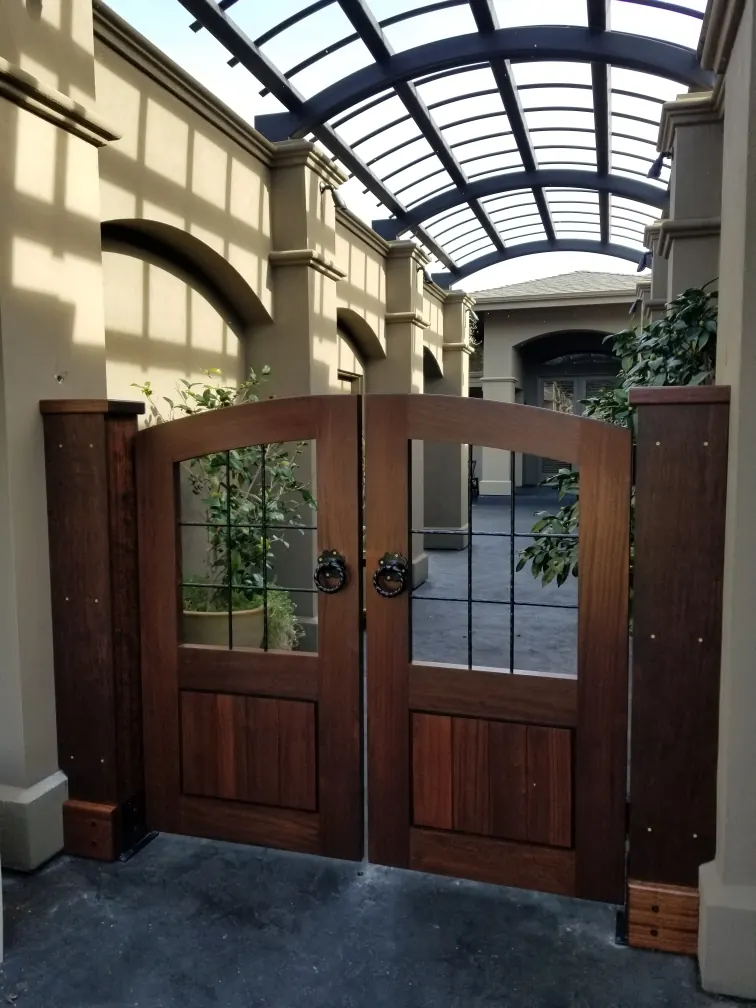
There are three practical categories of decorative iron used on modern gates: hand-forged wrought iron, cast iron, and CNC-cut steel. Each has a different cost, lead time, aesthetic, and longevity. The right choice depends on the architecture, the design intent, and how the iron will integrate with the wood frame.
Key takeaways
- There are three practical categories of decorative iron used on modern gates: hand-forged wrought iron, cast iron, and CNC-cut steel. Each has a different cost, lead time, aesthetic, and longevity. The right choice depends on the architecture, the design intent, and how the iron will integrate with the wood frame.
- True wrought iron vs. mild steel: Most metalwork sold today as "wrought iron" is actually mild steel formed to look like wrought iron.
- Cast iron: when ornament needs mass: Cast iron is iron poured into a mold rather than forged.
- CNC-cut steel: the contemporary option: CNC plasma and waterjet cutting of mild steel plate has changed what's possible in decorative metalwork over the last decade.
- Integrating iron with hardwood: the construction details: Where iron meets hardwood, two practical problems must be solved: chemical and mechanical.
- Is true wrought iron still available? Effectively no — the last commercial wrought iron mill closed long ago. What's sold today as "wrought iron" is hand-forged mild steel, which is functionally equivalent and weldable. Genuine vintage wrought iron is occasionally salvaged from demolitions, but it's not a current production material.
Walk through Alamo's Round Hill area, or up the hills above Danville's Diablo Country Club, and you'll see decorative iron everywhere — on gates, fences, balconies, and railings. Done well, it adds gravity and craft to a property. Done poorly, it adds visual noise and rust. The difference comes down to three decisions: which kind of metal, what kind of fabrication, and how it integrates with the wood and architecture around it. Here's how we think about it on every Heartwood gate that combines hardwood with iron or steel.
True wrought iron vs. mild steel
Most metalwork sold today as "wrought iron" is actually mild steel formed to look like wrought iron. True wrought iron — iron with a low carbon content and a fibrous, slag-streaked structure — is essentially out of production. The last commercial wrought iron mill in the world closed decades ago. What's available as "wrought iron" gates today is mild steel, bent and welded into traditional forms.
Mild steel is, for our purposes, an acceptable substitute. It's stronger, more readily available, weldable, and can be hot-forged to produce the hammer-marked, slightly irregular surface that gives traditional wrought iron its character. With the right blacksmith, mild steel can be made to look indistinguishable from genuine wrought iron.
We work with two regional blacksmiths for forged elements — both within a day's drive of our Concord workshop — for clients who want truly hand-forged scrolls, finials, and pickets.
Cast iron: when ornament needs mass
Cast iron is iron poured into a mold rather than forged. It allows ornament that would be prohibitively expensive to forge — complex relief patterns, sculpted finials, repeating decorative elements at scale. Cast iron is also significantly heavier than steel of the same dimensions, which gives a gate substantial visual mass.
The disadvantages are real. Cast iron is brittle and can crack under impact, it cannot be welded, and the weight can stress automated gate operators and post mounting. For an automated estate gate, we'll typically limit cast iron to decorative panel inserts and use steel for any structural element.
Where cast iron shines is in pedestrian and courtyard gates in classical, mediterranean, or Italianate styles — common in older Alamo and Danville estates from the 1960s and 70s. A cast iron rosette in the center of a Sapele gate panel can transform the gate's character.
CNC-cut steel: the contemporary option
CNC plasma and waterjet cutting of mild steel plate has changed what's possible in decorative metalwork over the last decade. Patterns that would have required weeks of hand-forging can now be cut from a single sheet of steel in hours, with absolute precision and the ability to replicate the pattern across multiple panels exactly.
For contemporary architecture — and for modern remodels of older Alamo homes — CNC-cut steel panels are increasingly our default decorative metalwork. We design the pattern in CAD, cut it from 1/4" or 3/8" mild steel, then powder-coat it in a matte black or oil-rubbed bronze finish that's nearly indistinguishable from forged ironwork at viewing distance.
CNC also allows custom patterns at no fabrication penalty. A client's family monogram, a stylized tree silhouette, a topographic map of the property — all are equally easy to cut once the design is finalized.
Integrating iron with hardwood: the construction details
Where iron meets hardwood, two practical problems must be solved: chemical and mechanical. Chemically, steel and iron react with the tannins in many hardwoods (especially white oak) to produce dark stains. We isolate every steel-wood contact with a barrier — typically a thin gasket of high-density polyethylene or a powder-coat layer on the steel — so the two materials never actually touch.
Mechanically, steel and wood move at different rates as humidity and temperature change. If you bolt a steel panel rigidly to a wood frame, the wood will eventually crack as it expands and contracts against the immobile steel. We use slotted fastener holes and rubber isolation washers to allow seasonal movement without binding.
These details are invisible on a finished gate, but they're the difference between a gate that looks beautiful for thirty years and one that develops cracks and rust streaks within five.
Finishing iron for Bay Area weather
Untreated steel rusts. The question is how much, how fast, and whether you want the look. For most clients in the East Bay, we specify a multi-coat powder-coat finish over a zinc-rich primer. Properly applied, this system gives 25 to 30 years of weather protection before any refinishing is needed.
For clients who want a more traditional look, we offer a hot-blackened patina — the steel is heated, treated with a phosphoric acid solution, then oiled to lock the color in. The result is a deep blue-black finish that develops natural variation over time and ages beautifully. It requires light oil reapplication every couple of years.
We never specify uncoated mild steel for outdoor decorative work in the Bay Area. The rust isn't structurally dangerous for a long time, but the staining on adjacent stone, stucco, and pavers becomes a maintenance problem quickly.
We're booking design consultations 4–6 weeks out. Send us your driveway photos and we'll come back with a sketch, wood spec, and finish system within five business days.
How much decoration is too much
The most common mistake we see on iron-decorated gates is too much of it. A heavily ornamented iron gate in front of a quiet contemporary home reads as a costume; a quiet hand-forged detail on the same gate reads as a signature.
Our default approach: let the wood be the gate, and let the iron be the punctuation. A pair of hand-forged hinges, a single decorative band across the upper rail, a discreet monogram cast into a panel. The iron should be noticed only after the gate has been admired as a whole.
There are absolutely projects where elaborate ironwork is the right answer — large Italianate or Spanish Colonial estates, properties where the existing architecture is itself heavily ornamented. But for the majority of high-end Alamo and Danville commissions we see, restraint is the better strategy.
Cost ranges for iron and steel work
Hand-forged wrought iron from a regional blacksmith typically runs $200 to $400 per linear foot for decorative elements, with custom forged hinges and latches running $400 to $1,200 each. Cast iron elements range from $300 to $2,500 depending on size and complexity. CNC-cut and powder-coated mild steel decorative panels typically run $90 to $180 per square foot.
On a typical $25,000 East Bay estate driveway gate, ironwork accounts for roughly $3,000 to $8,000 of the total. On a heavily decorated gate, it can exceed $15,000.
We'll always quote the metalwork as a separate line item so you can see exactly what the decoration is costing and adjust as needed.
Starting a project in Alamo or Danville
We routinely install in Round Hill, Stone Valley, and across the Alamo and Danville corridor. Most consultations are scheduled within a week of first contact. See our East Bay service area for lead times and our custom gates service for the broader process.
If you're considering a fully automated driveway gate with integrated decorative metalwork, our piece on Alamo and Danville ranch-modern gate design walks through several recent projects in detail.
For pricing context across the full project, see our pricing guide.
About hardware
For more answers, see our full FAQ.
Related articles
Let's design a gate that belongs to your home.
Tell us about the entrance you want to build. We respond same-day to consultations booked before 2pm, next business day after.