
Sapele vs. Redwood: A 25-Year Durability Comparison for Walnut Creek Gates
Redwood has been the default California outdoor wood for a century. Here's what actually happens to it over 25 years on a Walnut Creek gate — and how Sapele compares in the same climate.
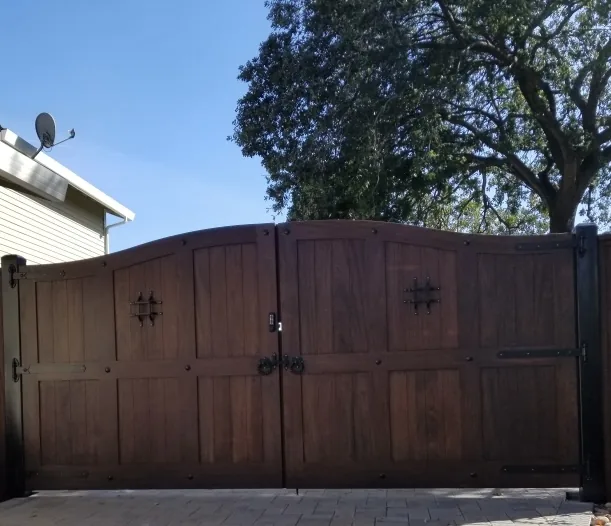
Old-growth heart redwood was an exceptional outdoor wood. The redwood available today is almost entirely second-growth with much less natural decay resistance and significantly more sapwood. For a 25-year gate in Walnut Creek, modern redwood underperforms Sapele on dimensional stability, finish retention, and decay resistance. Sapele costs more upfront but lasts roughly twice as long.
Key takeaways
- Old-growth heart redwood was an exceptional outdoor wood. The redwood available today is almost entirely second-growth with much less natural decay resistance and significantly more sapwood. For a 25-year gate in Walnut Creek, modern redwood underperforms Sapele on dimensional stability, finish retention, and decay resistance. Sapele costs more upfront but lasts roughly twice as long.
- Why old-growth redwood was the default — and why that era ended: The redwood gates and decks built in the Bay Area through the mid-20th century were built from old-growth heartwood — wood from trees often 500 to 1,000 years old at harvest.
- What modern redwood actually does over 25 years: Modern second-growth redwood is still a respectable outdoor wood — softer than Sapele or oak, lighter, and easier to work — but it does not have the longevity of the wood it replaced.
- Sapele over the same 25 years: A Sapele gate built with the same joinery and finished with Penofin Marine Oil will, in the same Walnut Creek climate, typically need light refinishing every 3 to 4 years and no structural work for 30-plus years.
- Cost over 25 years, not just at purchase: On the day of installation, a modern redwood gate of a given design costs 25 to 40% less than the Sapele equivalent.
- Is modern redwood really that different from old-growth? Yes. Old-growth redwood had 30+ growth rings per inch and almost no sapwood; modern second-growth typically has 6 to 12 rings per inch and significant sapwood. The decay resistance and dimensional stability are noticeably different.
Drive any older Walnut Creek neighborhood — Tice Valley, Saranap, Northgate — and you'll find a lot of original 1970s and 1980s redwood gates still standing. Most of them are tired. Some are excellent. The difference between the two outcomes is rarely the original wood quality and almost always the construction. After twenty-five years of weather, the wood species choice does start to matter, and the difference between old-growth redwood and modern second-growth redwood is dramatic. Here's how we think about redwood vs. Sapele for a gate that needs to look right for the next quarter-century, not just the first five years.
Why old-growth redwood was the default — and why that era ended
The redwood gates and decks built in the Bay Area through the mid-20th century were built from old-growth heartwood — wood from trees often 500 to 1,000 years old at harvest. That wood had incredibly tight grain (often 30+ rings per inch), very high concentrations of natural decay-resistant tannins, and essentially no sapwood. It was an exceptional outdoor material that aged gracefully and resisted rot for half a century or more.
Commercial old-growth redwood logging effectively ended decades ago. Modern California redwood is overwhelmingly second-growth — 40 to 80 years old at harvest — with much wider growth rings, much less heartwood concentration, and significantly more sapwood. The same species, but a fundamentally different material.
If you find a gate in Walnut Creek that has aged beautifully over 40 years, look at the end grain. If you can count 25 or more growth rings per inch and see no sapwood, it's old-growth — a material you cannot replicate today.
What modern redwood actually does over 25 years
Modern second-growth redwood is still a respectable outdoor wood — softer than Sapele or oak, lighter, and easier to work — but it does not have the longevity of the wood it replaced. In a Walnut Creek climate, with sharp summer-winter humidity swings and full sun exposure on most driveway-facing gates, modern redwood will typically need significant refinishing every 2 to 3 years and structural repair within 12 to 18 years.
The most common failure mode we see is checking and splitting at the end grain of stiles and rails, with associated rot at the bottoms of vertical members where water sits. Sapwood content accelerates both failures dramatically.
A well-built modern redwood gate with vertical-grain heart material and quality joinery can still last 25 years. The bar for the wood selection has just gotten significantly higher than it used to be.
Sapele over the same 25 years
A Sapele gate built with the same joinery and finished with Penofin Marine Oil will, in the same Walnut Creek climate, typically need light refinishing every 3 to 4 years and no structural work for 30-plus years. We've serviced Sapele gates we built 15 years ago that still have tight joints, no checking, and no significant degradation.
Sapele's higher density (about 42 pounds per cubic foot vs. redwood's 28), tighter grain, and tropical hardwood extractives all contribute to better long-term performance. Sapele also resists insect attack — particularly carpenter bees, which are an increasing problem in East Bay redwood structures.
The trade-off is weight and cost. A Sapele gate is heavier than the equivalent redwood gate (real consideration for automation) and the wood itself costs 2 to 3 times more per board foot.
Cost over 25 years, not just at purchase
On the day of installation, a modern redwood gate of a given design costs 25 to 40% less than the Sapele equivalent. Over 25 years, that math reverses. A redwood gate at year 25 has typically needed: 8 to 10 refinishings (vs. 6 to 8 for Sapele), at least one round of joint or structural repair (vs. zero for Sapele), and is at or near the end of its serviceable life — meaning replacement is on the horizon.
Total 25-year cost of ownership for a midrange Walnut Creek driveway gate: roughly $32,000 to $42,000 for the redwood path (initial $18,000, refinishing, repairs, eventual replacement) vs. roughly $28,000 to $34,000 for the Sapele path (initial $24,000, fewer refinishings, no replacement).
The Sapele gate is also the gate that's still working at year 30. The redwood gate is the gate the next homeowner replaces.
When redwood is still the right choice
There are projects where we still specify and build in redwood. Rustic and country-style gates where the lighter weight and softer aesthetic of redwood are essential to the design. Historic restoration projects where the original gate was redwood and matching matters more than maximum longevity. Projects with strict weight limits where Sapele would push the gate past what the operator can handle.
When we build in redwood, we specify vertical-grain heart material only — no sapwood, no flat-sawn flat-grain stock — and we use clear, all-heart construction. The premium for true VG heart material is significant, but it's the only modern redwood that approaches the longevity of the old-growth material it replaced.
We will not build a gate in construction-grade redwood with mixed grain and sapwood content. The result is too short-lived to be worth our shop's name on it.
We're booking design consultations 4–6 weeks out. Send us your driveway photos and we'll come back with a sketch, wood spec, and finish system within five business days.
What happens to the finish
Both Sapele and redwood weather to a silver-gray if left unfinished. The path to silver is different: redwood goes pink, then orange, then silver, with the process accelerating in full sun. Sapele goes from rich brown through a sequence of red-browns to silver, with the process being slower in full sun.
Most clients want to maintain a color rather than let the wood weather, which means a maintenance cycle. We use Penofin Marine Oil — a penetrating oil finish with UV inhibitors — on both species. On Sapele, the refinishing cycle is 3 to 4 years in full sun, 5 to 6 years in shade. On redwood, the cycle is 2 to 3 years in full sun, 4 in shade.
Refinishing is a single-day job on most gates and can be done by a competent painter or by our shop. We offer annual or biennial maintenance plans for Bay Area clients.
Sustainability considerations
Both materials can be sourced sustainably. We source FSC-certified Sapele from West African plantations and concessions with documented chain of custody. California-grown redwood from FSC-certified operations is available but expensive; lower-cost redwood is often from less rigorously managed forests.
Carbon-wise, the embodied transport energy of Sapele is higher (it ships from Africa) but the longer service life partially offsets that. Modern lifecycle analysis on both species is broadly comparable when adjusted for service life.
If sustainability is the primary driver of your material choice, we'd recommend an in-depth conversation with one of our designers rather than a default recommendation. We're happy to walk through certified options for both species.
Starting a project in Walnut Creek
We're 15 minutes from most of Walnut Creek, and Walnut Creek is one of our most active service areas. Most consultations are scheduled within a week of first contact. See our Walnut Creek service area page for current lead times.
If you're replacing a tired redwood gate, we'd start with an on-site evaluation of the existing posts, hinges, and (for automated gates) operator. Many redwood gate replacements can reuse the existing posts and automation, which keeps the project cost down significantly.
For broader material context, our companion pieces on Sapele vs. teak and cedar vs. hardwood are the next two we'd recommend.
The finish system, chosen per project
There is no single best finish for a custom gate — the right system depends on the wood species, microclimate, sun exposure, salt load, and the look you want. Our default is Penofin Verde Marine Oil for Sapele, white oak, and teak (penetrating, low-VOC, UV-stable). For western red cedar and redwood we prefer Armstrong Clark's non-drying conditioning oils. Cabot Australian Timber Oil gives a warmer amber tone on mahogany. Sikkens Cetol is reserved for protected coastal doors. Messmer's UV Plus is our pick for ipe and garapa. TWP 100 handles foothill mildew zones. Every spec is documented in your maintenance binder so any qualified refinisher can match it.
- PenofinPenofin Verde Marine Oil
Best for: Sapele, white oak, teak — most inland & wine-country installs
Penetrating, low-VOC, UV-stable transoxide pigment package. Never peels because there is no film.
- Armstrong ClarkArmstrong Clark Semi-Transparent Oil
Best for: Western red cedar, redwood, sun-exposed inland gates
Non-drying conditioning oils sit deep; drying oils harden at the surface — superior for cedars under intense UV.
- CabotCabot Australian Timber Oil
Best for: Mahogany and dense tropicals when a richer amber tone is preferred
Tung-oil-and-linseed blend that warms hardwood without obscuring grain. Color-matches well for restoration work.
- SikkensSikkens Cetol SRD / Cetol Door & Window
Best for: Coastal salt-spray sites and high-traffic pedestrian doors
Alkyd-modified resin with mildewcide; the only film system we will spec, and only on protected vertical surfaces.
- Messmer'sMessmer's UV Plus for Hardwoods
Best for: Ipe, garapa, and ultra-dense hardwoods that reject most finishes
Specifically engineered for oily tropicals; the trans-oxide pigments hold color on woods where Penofin can be slow to soak.
- TWPTWP 100 Series Total Wood Preservative
Best for: Sierra foothill installs with heavy winter mildew pressure
EPA-registered mildewcide and fungicide package — used when the site has shade and rain together.
About materials
For more answers, see our full FAQ.
Let's design a gate that belongs to your home.
Tell us about the entrance you want to build. We respond same-day to consultations booked before 2pm, next business day after.