
Western Red Cedar vs. Hardwood for Mill Valley's Fog Belt
Mill Valley's fog and humidity create a unique microclimate. Cedar is the regional vernacular, but is it the right choice for a 25-year gate? A side-by-side comparison.
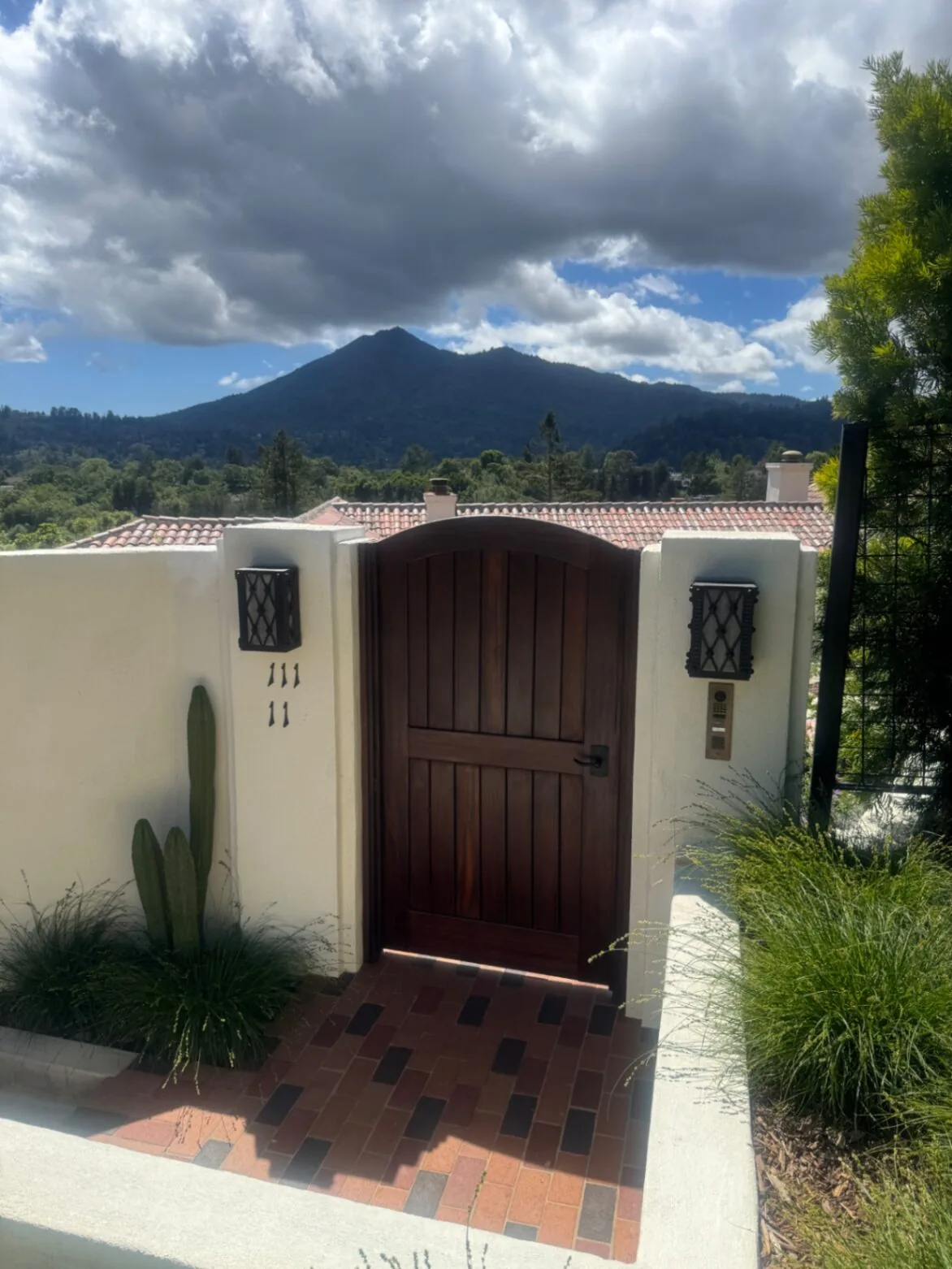
Western red cedar is light, dimensionally stable, naturally rot-resistant, and aesthetically perfect for Mill Valley's regional architecture. It's also significantly softer than hardwood and ages faster. Hardwood (Sapele or white oak) lasts longer but reads less native to the architecture. The right answer often involves both materials in the same gate.
Key takeaways
- Western red cedar is light, dimensionally stable, naturally rot-resistant, and aesthetically perfect for Mill Valley's regional architecture. It's also significantly softer than hardwood and ages faster. Hardwood (Sapele or white oak) lasts longer but reads less native to the architecture. The right answer often involves both materials in the same gate.
- Why cedar suits Mill Valley specifically: Western red cedar is a Pacific Northwest native that thrives in exactly the kind of cool, humid, foggy environment that defines Mill Valley summers.
- Where cedar struggles: Cedar is soft.
- The hybrid approach: cedar visible, hardwood structural: For most Mill Valley estate gates where the client wants the cedar aesthetic but also wants 30-year longevity, our recommended approach is a hybrid: a hardwood (Sapele or white oak) structural frame, faced with cedar cladding.
- Finishing cedar for the fog belt: Cedar finishing is more demanding than hardwood finishing in Mill Valley's climate because the constant fog means the wood is rarely fully dry.
- Will cedar last 25 years in Mill Valley? Pure cedar construction in clear vertical-grain stock with disciplined finishing can last 18 to 22 years. Hybrid cedar-and-hardwood construction can last 30+ years.
Mill Valley is one of the most architecturally specific places we work. Shingle-style and California redwood vernacular homes nestle into hillsides where fog rolls in most summer mornings and humidity rarely drops below 60%. Western red cedar is the regional wood — on shingled walls, on decks, on fences, and on most older gates. When a Mill Valley client asks whether their new gate should be cedar to match the rest of the house or hardwood for longevity, the answer is genuinely "it depends." Here's the framework we use.
Why cedar suits Mill Valley specifically
Western red cedar is a Pacific Northwest native that thrives in exactly the kind of cool, humid, foggy environment that defines Mill Valley summers. The wood's natural oils (thujaplicins) provide excellent decay resistance, and its very low density (about 23 pounds per cubic foot — lighter than redwood) means it moves remarkably little across humidity changes.
Aesthetically, cedar is the wood of the local vernacular — shingle siding, decking, exposed structural timbers. A cedar gate at a shingle-style Mill Valley home reads as continuous with the architecture in a way no other wood quite does. The smell alone tells you you're in the right place.
For projects where matching the regional architectural language is the primary goal, cedar is often the correct material despite its drawbacks.
Where cedar struggles
Cedar is soft. Janka hardness is about 350 — less than half that of redwood, a quarter of Sapele. This means cedar dents easily, doesn't hold mortise and tenon joints as cleanly under load, and is more susceptible to physical damage from impact, gates closing on rocks, kids' bikes, and the like.
Cedar is also lighter colored than most clients expect when fresh, and weathers quickly to a silver-gray (in a matter of months in unfinished conditions, much faster than redwood or Sapele). The natural color is golden-tan and beautiful but fades quickly under UV.
For automated driveway gates, cedar's softness becomes a real problem at the operator mounting points and hinge connections — the wood compresses under cyclic load and the connections loosen over years. We rarely specify pure cedar construction for automated gates over 8 feet wide.
The hybrid approach: cedar visible, hardwood structural
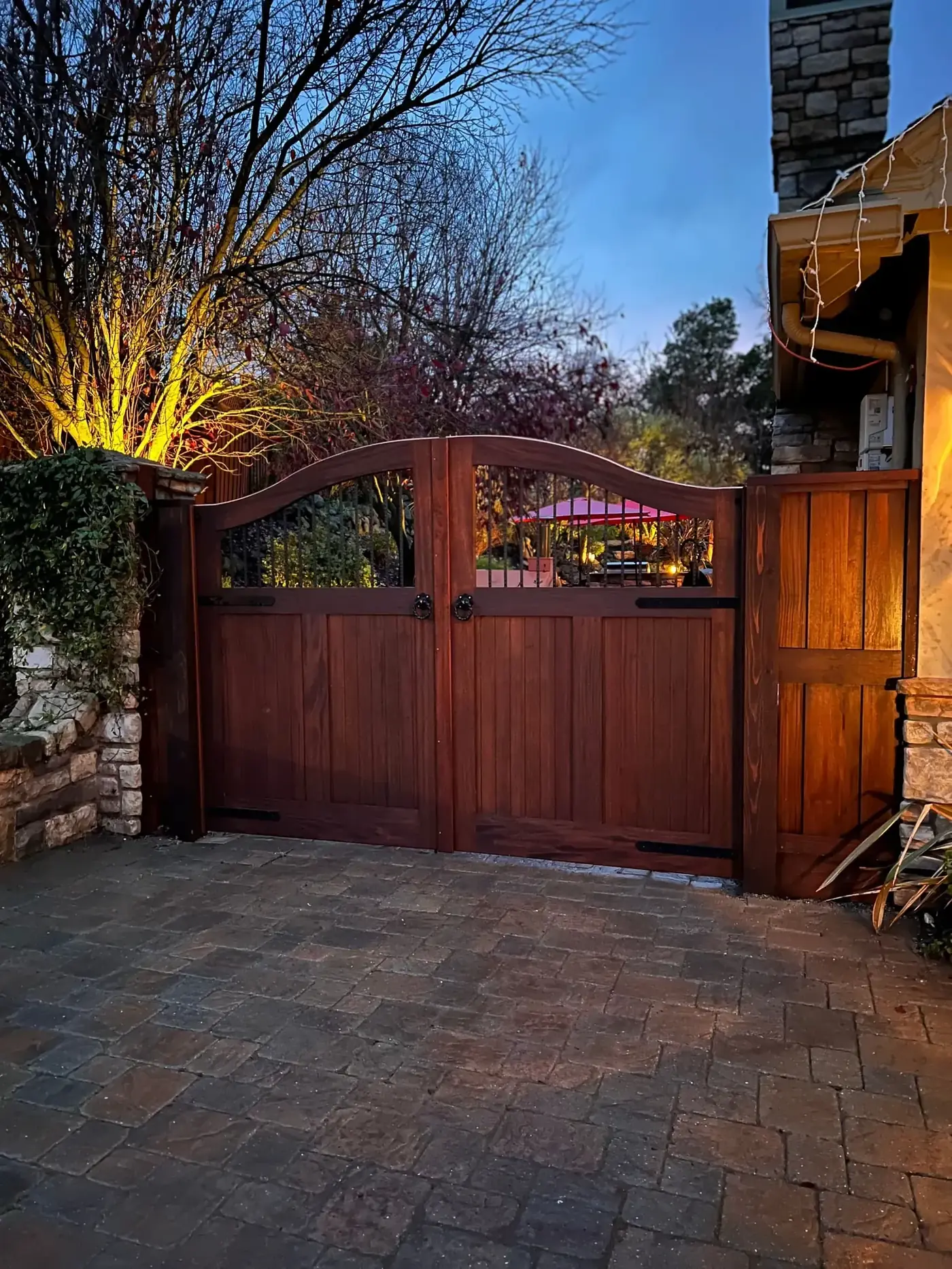
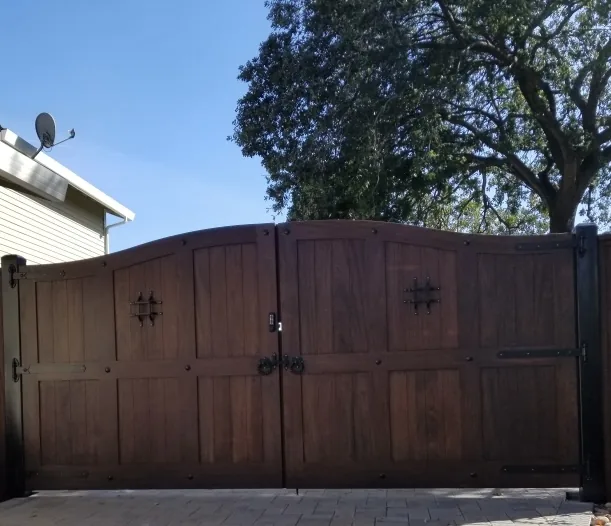
For most Mill Valley estate gates where the client wants the cedar aesthetic but also wants 30-year longevity, our recommended approach is a hybrid: a hardwood (Sapele or white oak) structural frame, faced with cedar cladding. The cedar is what you see; the hardwood is what holds the gate together.
This approach combines the strengths of both materials. The structural mortise and tenon joinery is in hardwood, where it belongs. The visible faces are in cedar, where the regional vernacular wants them. The cladding can be replaced in 15 or 20 years if it weathers heavily, without rebuilding the gate.
We've used this approach on a number of Mill Valley, Tiburon, and Marin projects. The visual result is indistinguishable from pure cedar at any normal viewing distance; the durability is closer to hardwood than to cedar.
Finishing cedar for the fog belt
Cedar finishing is more demanding than hardwood finishing in Mill Valley's climate because the constant fog means the wood is rarely fully dry. Conventional film-forming finishes (varnishes, polyurethanes) trap moisture against the wood and peel within a year or two. Penetrating oil finishes work but need more frequent reapplication than on harder, denser wood.
Our standard cedar finish in the fog belt is two coats of Penofin Marine Oil applied initially, then a maintenance coat every 18 to 24 months. Clients who want the silver-gray weathered look can skip finishing entirely; the wood gets there quickly and naturally.
We do not recommend painted cedar gates for fog-belt installations. The constant humidity and the wood's natural movement together break down paint adhesion within a few seasons.
Sustainability of cedar
Western red cedar is sustainably harvested in Washington, British Columbia, and Oregon. FSC-certified cedar is widely available; we specify FSC stock when the supply chain matters to the client.
Old-growth cedar from very large trees is becoming scarce. Most current cedar production is from managed second-growth forests, which produces good but not exceptional material. For premium gates we'll often specify clear vertical-grain cedar from western Washington mills, which represents the highest grade still in regular production.
Cedar's low density means low transport energy compared with denser hardwoods. Lifecycle analysis tends to favor cedar over imported tropical hardwoods on pure carbon grounds, though service-life adjustments narrow the gap considerably.
We're booking design consultations 4–6 weeks out. Send us your driveway photos and we'll come back with a sketch, wood spec, and finish system within five business days.
Cost comparison
Clear vertical-grain cedar in the grades suitable for premium gate work runs $8 to $14 per board foot, compared with $14 to $18 for Sapele and similar for white oak. The total wood cost differential on a typical Mill Valley driveway gate is modest — perhaps $800 to $1,500.
Lifecycle costs favor hardwood. A pure cedar gate will typically need significant repair or replacement at year 15 to 20; a hybrid cedar-and-hardwood gate or a pure hardwood gate will not. Over 25 years, the cost differential favors hardwood or hybrid construction.
For clients on a tighter budget who specifically want cedar, we'll quote pure cedar construction with clear vertical-grain material and conservative engineering. For clients who want maximum longevity and the cedar aesthetic, we'll quote the hybrid approach.
Working with the regional architecture
Mill Valley homes are not all shingle-style. The city has substantial inventories of mid-century modern, contemporary, and recent transitional architecture. For mid-century homes, cedar's golden-to-silver weathering arc fits beautifully. For modern and contemporary homes, the choice between cedar and hardwood is more about the broader material palette of the building.
We always look at the existing siding, decking, trim, and door materials before recommending a gate wood species. The goal is for the gate to read as native to the property, not as a separate object.
For broader stylistic context, see our piece on Berkeley Hills shingle-style gate design, which covers similar architectural considerations.
Working with us in Mill Valley
We're a 45-minute drive from most of Mill Valley and we routinely install across central Marin. Consultations are scheduled within two weeks of first contact. See our Bay Area service area for current lead times.
For projects on properties with steep grades or limited site access (common in the Mill Valley hills), we'll coordinate with your contractor for staging and access logistics during the site visit.
Companion reading: Sapele vs. teak, how these woods weather in Marin's salt air, and our custom gates service overview.
About materials
For more answers, see our full FAQ.
Let's design a gate that belongs to your home.
Tell us about the entrance you want to build. We respond same-day to consultations booked before 2pm, next business day after.