
Ipe vs. Sapele for Estate Driveway Gates in Danville
Ipe is the densest commercially available hardwood. Sapele is our standard. For a 14-foot Danville estate driveway gate, which is the right choice?
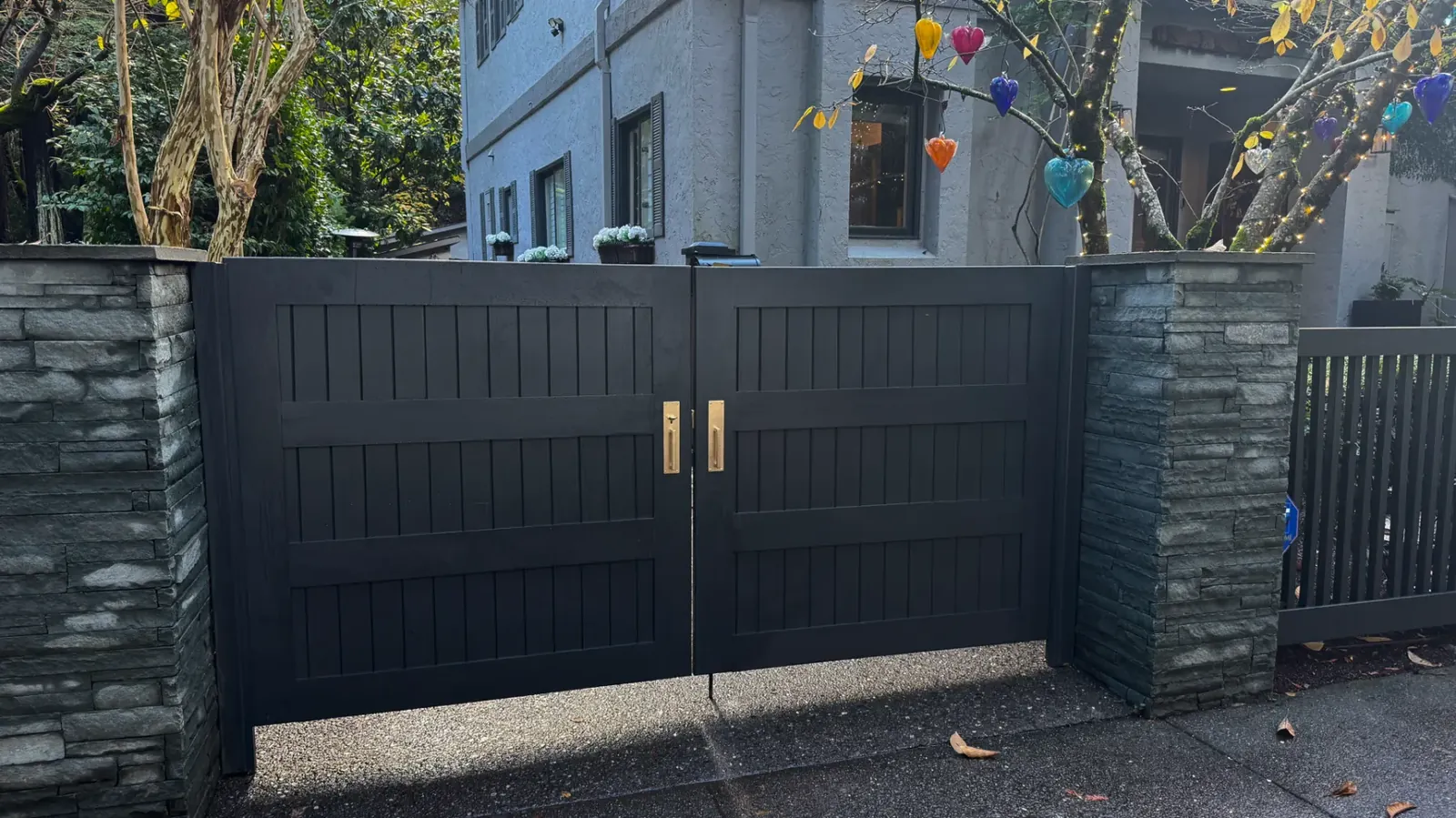
Ipe is harder, denser, and more decay-resistant than Sapele but is significantly heavier (about 75 pounds per cubic foot vs. 42 for Sapele), more difficult to machine, and harder on gate automation. For a 14-foot Danville estate driveway gate, Sapele is usually the better choice. Ipe makes sense for specific applications where its extreme density is required.
Key takeaways
- Ipe is harder, denser, and more decay-resistant than Sapele but is significantly heavier (about 75 pounds per cubic foot vs. 42 for Sapele), more difficult to machine, and harder on gate automation. For a 14-foot Danville estate driveway gate, Sapele is usually the better choice. Ipe makes sense for specific applications where its extreme density is required.
- What ipe is and where it comes from: Ipe is a tropical hardwood from South and Central America (often labeled as "Brazilian walnut," though it's not a walnut).
- Why ipe is hard to work with: Ipe's density is what makes it durable and what makes it difficult.
- The weight problem for automated gates: A 14-foot single-leaf swing gate in Sapele typically weighs 220 to 290 pounds depending on configuration.
- When ipe is the right choice: Ipe is the correct choice for a few specific applications: gates in active California wildfire zones where the Class A fire rating is required by insurance or AHJ, gates in ground-contact installations where the wood's extreme decay resistance is essential, gates with very long service life requirements where the additional upfront cost is acceptable, and pedestrian or smaller swing gates where the weight is not a problem.
- Is ipe really fireproof? Ipe carries a Class A flame spread rating but is not literally fireproof. It will char in a sustained fire but is genuinely difficult to ignite — a meaningful advantage in wildfire-zone installations.
Ipe is the wood that decking magazines won't stop writing about. It's the densest hardwood in regular commercial production, almost impervious to rot, and tests as fire-resistant as a Class A roofing material. So why don't we default to ipe for every estate driveway gate in Danville's Diablo, Blackhawk, and Westside neighborhoods? The answer is partly weight, partly workability, partly cost — and partly that Sapele is, for most projects, the better material despite ipe's spec-sheet superiority. Here's the side-by-side.
What ipe is and where it comes from
Ipe is a tropical hardwood from South and Central America (often labeled as "Brazilian walnut," though it's not a walnut). Janka hardness is approximately 3,680 — roughly two and a half times harder than Sapele. Density is about 75 pounds per cubic foot, making it one of the few woods that sinks rather than floats.
The decay resistance is remarkable. The USDA Forest Products Laboratory rates ipe as very durable, with a service life in ground contact that exceeds 50 years. Outdoor decking installations have documented 40-year service lives with no significant degradation.
Ipe is also fire-resistant, with a Class A flame spread rating that some California fire-zone clients specifically request. Properly cured ipe will char in a fire but is genuinely difficult to ignite.
Why ipe is hard to work with
Ipe's density is what makes it durable and what makes it difficult. Standard carbide tooling wears noticeably faster on ipe than on any other hardwood we use. Drill bits dull within a few holes. Saw blades require resharpening more frequently. Our shop costs are measurably higher when working in ipe.
Ipe also splits easily at the end grain unless predrilled, and the wood is interlocked enough that planing and joinery cuts can produce tear-out unless tooling is exceptionally sharp. The dust is irritating to many people and a known sensitizer.
For a shop set up to work in Sapele day-in and day-out, switching to an ipe project requires re-tooling, slower feed rates, and more careful technique. The labor cost is roughly 25 to 35% higher per board foot of finished work.
The weight problem for automated gates
A 14-foot single-leaf swing gate in Sapele typically weighs 220 to 290 pounds depending on configuration. The same gate in ipe weighs 380 to 510 pounds. For most residential FAAC and LiftMaster operators, ipe pushes the gate weight into the upper end of or beyond the operator's design envelope.
Heavier gates also place more load on hinges and posts. Where a Sapele gate can hang on standard heavy-duty residential hinges, an ipe gate of the same size typically requires commercial-grade hinges and reinforced post embedment.
For a manually operated pedestrian or courtyard gate, the weight is not a problem and ipe is a viable choice. For an automated 14-foot estate driveway gate, the weight makes ipe a more complicated specification that requires careful operator selection and engineering review.
When ipe is the right choice
Ipe is the correct choice for a few specific applications: gates in active California wildfire zones where the Class A fire rating is required by insurance or AHJ, gates in ground-contact installations where the wood's extreme decay resistance is essential, gates with very long service life requirements where the additional upfront cost is acceptable, and pedestrian or smaller swing gates where the weight is not a problem.
We've built ipe gates for clients in the Lamorinda hills where wildfire risk drives the material specification, and for clients with very specific aesthetic preferences for ipe's distinctive olive-brown color and dense, even grain.
For estate driveway gates in Danville's lower-elevation neighborhoods (Westside, Old Blackhawk, Sycamore Valley) where wildfire risk is manageable and other factors dominate, we typically recommend Sapele.
The Sapele case for most Danville projects
Sapele is roughly half the weight of ipe with comparable real-world longevity for an above-ground gate application. It machines cleanly, takes finish reliably, comes in wider widths, and costs less per board foot. The mortise and tenon joinery we use cuts cleanly in Sapele and holds reliably for the life of the gate.
For the typical Danville client commissioning a 12 to 16-foot automated driveway gate with hardwood cladding over a steel sub-frame, Sapele lands in the sweet spot of cost, weight, durability, and aesthetics.
We'll quote both materials for any project where ipe is genuinely under consideration so the cost differential is transparent.
We're booking design consultations 4–6 weeks out. Send us your driveway photos and we'll come back with a sketch, wood spec, and finish system within five business days.
Cost comparison on a typical Danville driveway gate
A complete 14-foot automated single-leaf swing gate in Sapele with steel sub-frame, premium hardware, FAAC operator, and access control typically ranges $26,000 to $34,000 installed in Danville. The same gate in ipe with the same hardware and operator typically ranges $34,000 to $44,000 installed.
The cost differential is split roughly evenly between higher material cost ($1,800 to $2,800 more for ipe), higher shop labor ($2,800 to $4,500 more), and heavier-duty hardware and operator requirements ($1,800 to $3,200 more).
If wildfire-zone insurance requirements are driving the specification, the cost premium is straightforwardly justified. If the specification is driven by an interest in maximum longevity, Sapele's 30+ year service life typically makes the ipe upcharge harder to justify on pure ROI grounds.
Sustainability and sourcing
Ipe sustainability is more complicated than Sapele. Much of the ipe in US trade has historically come from regions with weaker enforcement of forest protection. FSC-certified ipe exists but is significantly more expensive and supply is constrained.
We source ipe only from FSC-certified suppliers with documented chain of custody when we use it. We're transparent with clients about the supply chain and the cost premium that comes with certified material.
If sustainable sourcing is a primary concern, we'd typically recommend Sapele (which has more developed FSC supply chains) or white oak (which is domestically harvested) before ipe.
Starting a project in Danville
We routinely install in Diablo, Blackhawk, Sycamore Valley, Westside, and across the Danville and Alamo corridor. Most consultations happen within a week of first contact. See our East Bay service area for current lead times and our automatic driveway gates service for project details.
If wildfire zoning is part of your specification, we'll coordinate with your insurer and the local fire authority on material specifications during the design phase.
Companion reading: our pieces on decorative iron in modern gates and Alamo and Danville ranch-modern gate design.
About materials
For more answers, see our full FAQ.
Let's design a gate that belongs to your home.
Tell us about the entrance you want to build. We respond same-day to consultations booked before 2pm, next business day after.