
Cantilever Sliding Gate Engineering for Hillside Driveways in Lafayette and Orinda
Why cantilever sliding gates outperform rolling and swing gates on the steep, narrow driveways typical of Lafayette, Orinda, and the Berkeley Hills — and how we engineer them to last.
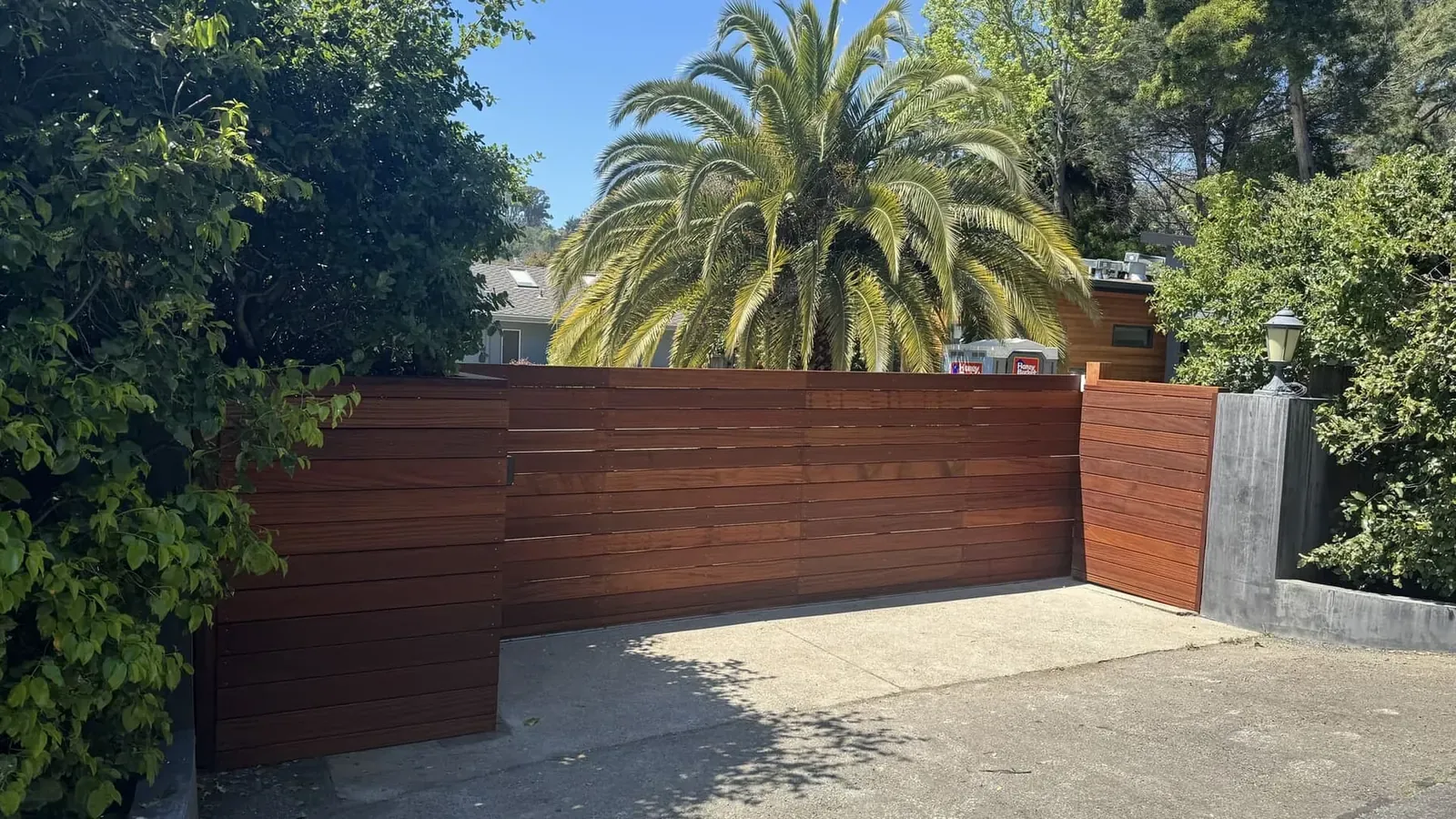
Cantilever sliding gates solve hillside driveway access where swing and rolling gates can't. Heartwood Gates engineers them with structural steel internal beams clad in Sapele or white oak, sized so the counterbalance equals 1.5x the active span, and powered by industrial-grade rack-and-pinion operators rated for the leaf weight.
Key takeaways
- Cantilever sliding gates solve hillside driveway access where swing and rolling gates can't. Heartwood Gates engineers them with structural steel internal beams clad in Sapele or white oak, sized so the counterbalance equals 1.5x the active span, and powered by industrial-grade rack-and-pinion operators rated for the leaf weight.
- Why swing gates fail on hillside lots: A swing gate needs a flat, unobstructed arc roughly equal to the leaf width.
- The counterbalance principle: A cantilever gate is structurally a lever.
- Cladding a cantilever frame in Sapele or white oak: The steel beam is the structural element; the visible gate is hardwood cladding joined with the same floating-tenon method we use on swing gates.
- Operator selection for cantilever installations: Cantilever sliding gates are driven by rack-and-pinion operators — a toothed rack bolted along the bottom of the gate and a motorized pinion gear mounted on the support post.
- How much side-yard space do I need for a cantilever gate? The counterbalance is roughly half the active span. A 16-foot opening needs about 8 feet of clear side yard for the counterbalance to retract into when the gate is open.
Hillside driveways in Lafayette, Orinda, Moraga, and the Berkeley Hills present a problem that defeats most off-the-shelf gate solutions: there is no level ground for a swing arc, no room for a v-track rolling gate, and the slope changes within the first ten feet of the driveway. The right answer is almost always a cantilever sliding gate — a gate that hangs from a beam above grade and slides horizontally across the opening without ever touching the driveway surface.
Why swing gates fail on hillside lots
A swing gate needs a flat, unobstructed arc roughly equal to the leaf width. On a Lafayette hillside where the driveway falls 6 to 12 inches across the gate opening, that arc doesn't exist. The gate either drags on the high side, gaps three inches on the low side, or — most commonly — gets installed level and immediately starts binding on its own latch the first wet season as the gate moves and the ground shifts.
Rolling v-track gates have the opposite problem. They need a continuous, level track embedded in the driveway, which means concrete cutting, grading work, and a track that fills with debris and freezes in winter on hill properties above 1,000 feet of elevation. Most Orinda and Moraga clients reject v-track for exactly these reasons.
Cantilever sliding eliminates both failure modes. The gate hangs from an overhead beam and slides on roller carriages, never touching the ground. Driveway slope is irrelevant.
The counterbalance principle
A cantilever gate is structurally a lever. The portion of the gate that crosses the opening (the active span) is balanced by a tail section that extends behind the support post, riding on rollers. For the gate to track smoothly and the operator to draw normal current, the counterbalance must be roughly 1.5 times the active span.
For a 16-foot opening, that means a 24-foot total gate length — 16 feet of active span plus 8 feet of counterbalance. Clients are sometimes surprised by this footprint until they see one in operation; the silent, effortless motion of a properly balanced cantilever gate makes the trade obvious.
We size the internal steel beam to the total length. For gates under 20 feet total, 4-inch HSS in 1/4-inch wall is sufficient. Past 24 feet, we step up to 6-inch HSS or move to a welded box-beam fabrication. Undersizing this beam is the most common failure mode on owner-built and contractor-built cantilever gates we've been called in to replace.
Cladding a cantilever frame in Sapele or white oak
The steel beam is the structural element; the visible gate is hardwood cladding joined with the same floating-tenon method we use on swing gates. See our companion piece on the steel sub-frame and Sapele cladding method for the full joinery detail.
For Lafayette and Orinda installations we typically clad in Sapele mahogany for its dimensional stability and rich color, or in rift-sawn white oak when the architecture calls for a lighter, more contemporary tone. Both species hold up beautifully under proper finish; the choice is aesthetic. Our piece on Sapele versus teak for Northern California climates covers the material trade-offs in detail.
Cladding is mortise-and-tenon joined as a continuous wood face that conceals the steel beam, with intentional shadow lines at the panel breaks to allow seasonal movement without visible cracking.
Operator selection for cantilever installations
Cantilever sliding gates are driven by rack-and-pinion operators — a toothed rack bolted along the bottom of the gate and a motorized pinion gear mounted on the support post. We default to FAAC 746 and 844 series operators for residential cantilever work; both are intermittent-duty rated and quiet enough for properties where the gate sits within 50 feet of the house.
For estates with high cycle counts — typically those with caretakers, frequent vendor traffic, or multiple household drivers — we step up to LiftMaster CSL24 or Viking I-8 industrial operators. Both are continuous-duty rated and will outlast the gate.
All installations include UL325 safety edges along the leading edge of the gate, photo-eye beams across the opening at vehicle height, and a redundant safety loop buried in the driveway approach. Cantilever gates move with significant kinetic energy; the safety package is not optional.
We're booking design consultations 4–6 weeks out. Send us your driveway photos and we'll come back with a sketch, wood spec, and finish system within five business days.
Site preparation and posts
A cantilever gate requires two support posts on the receiving side of the opening, spaced to match the gate's roller carriage geometry — typically 8 to 10 feet apart. Posts are 6x6 inch HSS welded to anchor plates, set in 48-inch-deep concrete footings reinforced with rebar cages.
On hillside sites in Orinda and the Berkeley Hills, footing depth often increases to 60 inches to reach undisturbed soil below the fill layer common on cut-and-fill homesites. Our installation crew runs soil probes at the post locations before pouring; if we hit fill deeper than 36 inches, we deepen the footings rather than gambling on the long-term plumb of the posts.
The receiving post on the opposite side of the opening is a simple catch — it carries no structural load when the gate is closed, only locates the leading edge. We typically match it visually to a perimeter fence post or pilaster.
Maintenance and service life
A properly engineered cantilever gate needs roller-carriage lubrication once a year, a rack inspection every three years, and the same hardwood finish schedule as our swing gates — wipe-on top coat at year three, full strip-and-recoat at year eight. We offer service plans for all Lafayette, Orinda, and Moraga installations.
Mechanical service life of the steel and rollers is 25+ years. Finish-cycle service life of the hardwood cladding, with proper maintenance, matches.
About joinery
For more answers, see our full FAQ.
Related articles
Let's design a gate that belongs to your home.
Tell us about the entrance you want to build. We respond same-day to consultations booked before 2pm, next business day after.