
White Oak Deep-Dive: Quartersawn Grain, Rift-Sawn Stability, and the Right Finish for a Bay Area Gate
A technical guide to white oak selection for estate gates — why quartersawn matters, how rift-sawn compares, and which finish systems bring out the grain without trapping moisture.
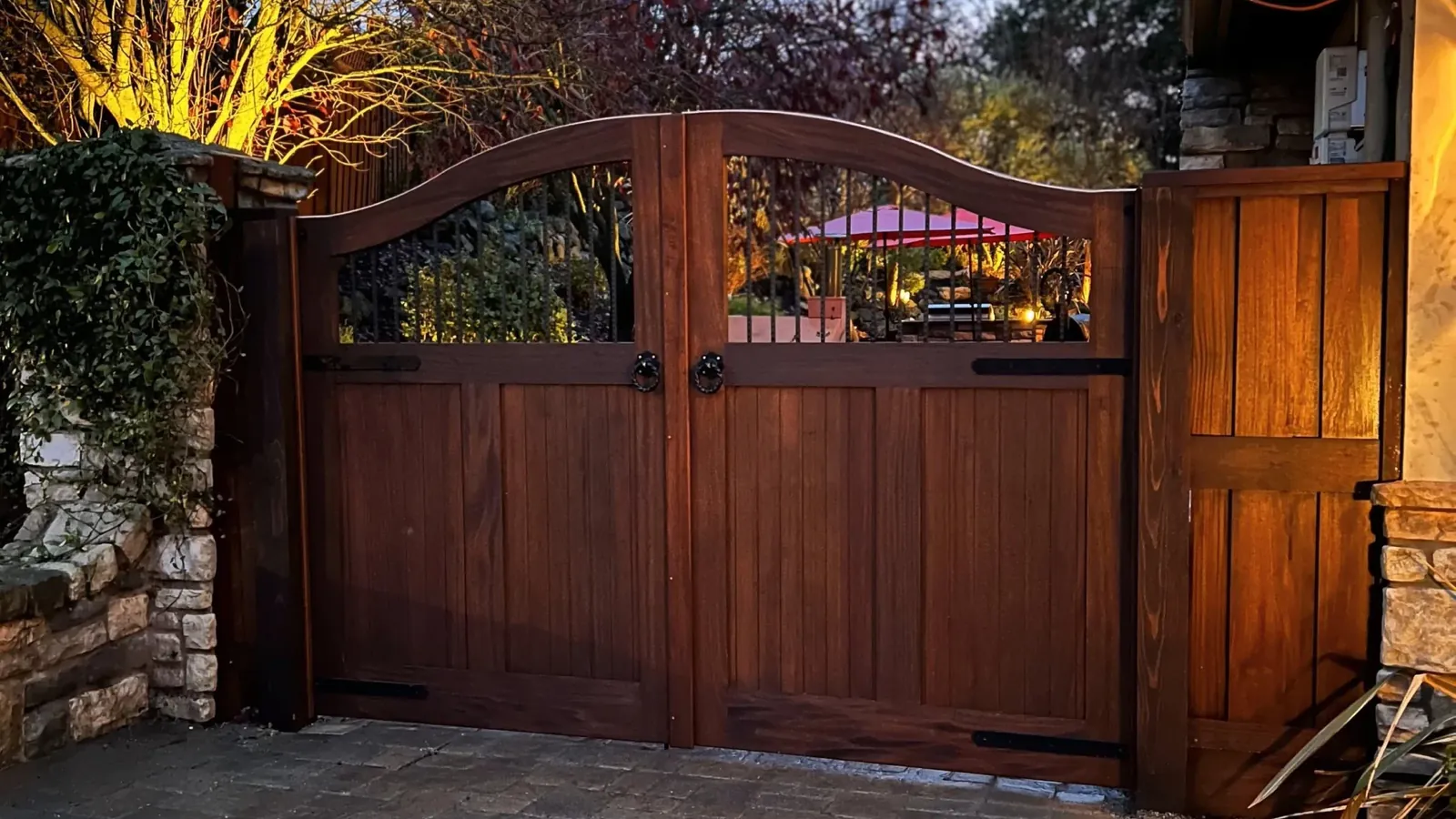
Quartersawn white oak offers the best combination of dimensional stability and visual drama for Bay Area gates. Rift-sawn oak is even more stable and reads as more modern. Both species take penetrating oil finishes beautifully and resist moisture better than redwood or cedar, but they require finish systems that breathe — never film-forming varnishes or polyurethanes outdoors.
Key takeaways
- Quartersawn white oak offers the best combination of dimensional stability and visual drama for Bay Area gates. Rift-sawn oak is even more stable and reads as more modern. Both species take penetrating oil finishes beautifully and resist moisture better than redwood or cedar, but they require finish systems that breathe — never film-forming varnishes or polyurethanes outdoors.
- What white oak actually is: Quercus alba, the American white oak, is a hardwood native to the eastern and central United States.
- Quartersawn vs. rift-sawn vs. plain-sawn: The way a log is sawn determines the grain pattern, the dimensional stability, and the cost of the resulting boards.
- Why stability matters on a gate: A gate is not a table.
- The medullary ray and the 'ray flake': The medullary rays in white oak are not a cosmetic feature — they are structural.
- Is white oak more expensive than Sapele? Yes — quartersawn white oak runs 20 to 40% more per board foot than Sapele. The upcharge on a typical gate is $1,500 to $3,000, depending on size.
White oak is the most technically interesting wood we work with. It is harder than Sapele, more stable than redwood, and possesses a grain figure that ranges from subtle and linear to wildly dramatic depending on how the log is sawn. For clients in Berkeley, Piedmont, and the East Bay who want a gate that reads as contemporary, restrained, and unmistakably high-end, white oak is often the right species. This piece is a deep dive into what makes white oak different from every other hardwood in our rack: the anatomy of the grain, the stability of quartersawn and rift-sawn stock, and the finishing systems that protect it without hiding it.
What white oak actually is
Quercus alba, the American white oak, is a hardwood native to the eastern and central United States. It is not the same species as European oak (Quercus robur) or live oak (Quercus virginiana), though all three are in the same genus and share many characteristics. American white oak averages 1,360 on the Janka hardness scale — harder than Sapele (about 1,500), much harder than redwood (450 to 500), and dense enough to hold crisp mortise and tenon joinery for decades.
The defining feature of white oak is its cellular structure. The wood contains large medullary rays — radial structures that run from the center of the tree to the bark — and tyloses, cellular plugs that block the vessels and make the wood highly resistant to water penetration. This is why white oak is the traditional wood for whiskey barrels and ship planking: it is essentially waterproof along the grain. For an outdoor gate, that water resistance is a significant advantage.
Quartersawn vs. rift-sawn vs. plain-sawn
The way a log is sawn determines the grain pattern, the dimensional stability, and the cost of the resulting boards. Plain-sawn (also called flat-sawn) is the most common and cheapest method: the log is sliced parallel to the bark, producing boards with a cathedral grain pattern that is beautiful but unstable. Plain-sawn oak moves significantly across humidity changes and is prone to cupping and warping outdoors.
Quartersawn oak is produced by slicing the log so that the growth rings are perpendicular to the face of the board. This exposes the medullary rays as dramatic flecks — the 'ray flake' pattern that makes quartersawn oak instantly recognizable. More importantly, quartersawn stock is roughly twice as stable as plain-sawn, because the wood moves primarily along the thickness rather than across the face.
Rift-sawn oak is sawn at a 30- to 60-degree angle to the growth rings, splitting the difference between quartersawn and plain-sawn. It produces a straight, linear grain with minimal ray fleck and is the most dimensionally stable cut of all. Rift-sawn reads as more modern and less rustic than quartersawn, and it is the default for contemporary gates in Berkeley and the Piedmont hills.
Why stability matters on a gate
A gate is not a table. It hangs on two hinges, carries its own weight across a span, and lives through 40°F winter nights and 100°F summer afternoons. Every time the wood swells or shrinks, the joints move, the finish stretches, and the hardware loosens a fraction. Over years, those fractions add up to sag, rack, and failure.
Quartersawn and rift-sawn white oak minimize this problem by moving less. A plain-sawn oak stile might grow or shrink 3/16 of an inch across its width through a season in the East Bay. A quartersawn stile of the same dimension moves less than 1/16 inch. That difference is the difference between a gate that stays tight for 30 years and one that needs joint repair at year 12.
We specify quartersawn or rift-sawn stock for every white oak gate we build. The upcharge over plain-sawn is 30 to 50 percent, but on a gate that will outlast a mortgage, the cost is negligible compared to the service life.
The medullary ray and the 'ray flake'
The medullary rays in white oak are not a cosmetic feature — they are structural. In a living tree, they transport nutrients radially. In lumber, they appear as light-colored streaks that reflect light differently from the surrounding wood. Quartersawn cutting exposes these rays on the face of the board, producing the characteristic ray flake.
Some clients love the flake and choose quartersawn specifically for it. Others find it too busy for a contemporary gate and prefer rift-sawn, which suppresses the flake while preserving the stability. There is no right answer; the choice is aesthetic. We show clients sample boards of both cuts before specifying the material.
The ray flake also affects how the wood takes finish. The rays are denser than the surrounding wood and absorb less penetrating oil, which means they finish slightly lighter and create a natural two-tone effect. On a dark oil-rubbed finish, the flake reads as highlights. On a natural oil finish, it reads as subtle texture.
We're booking design consultations 4–6 weeks out. Send us your driveway photos and we'll come back with a sketch, wood spec, and finish system within five business days.
Finishing white oak for outdoor life
White oak's natural water resistance means it does not need the heavy film-forming finishes that softer woods require. In fact, film-forming finishes — varnishes, polyurethanes, and spar varnishes — are the wrong choice for white oak outdoors because they trap moisture at the surface and peel as the wood breathes underneath.
Our most common white oak finish is Penofin Marine Oil — though we also specify Armstrong Clark or Cabot Australian Timber Oil when a richer amber tone or a hotter inland microclimate calls for it. The standard package is, applied in four thin coats with light sanding between coats. The oil penetrates the wood, the UV inhibitors slow silvering, and the finish never peels because there is no film to fail. Maintenance is a single wipe-on coat every three to four years.
For clients who want the weathered silver look, we skip the UV-inhibited oil and use a plain penetrating oil for the initial coat, then let the gate silver naturally. White oak silvers more evenly and attractively than redwood or cedar, producing a soft gray that architects often specify for contemporary homes in the Berkeley Hills.
White oak in joinery: the mortise and tenon test
White oak's density makes it the most demanding wood in our shop to join — and the most rewarding. Mortises cut cleanly but require sharp tooling; dull chisels crush the fibers rather than slicing them. Tenons must be fit with precision, because the wood does not compress the way cedar or even redwood does.
The payoff is a joint that is still tight after 20 years. We've disassembled white oak gates we built for Berkeley clients in the early 2000s and found mortise and tenon joints that were as tight as the day they were drawbore-pinned. The wood simply does not move enough to loosen the joint.
For very wide automated driveway gates, white oak's weight becomes a consideration. A white oak gate leaf is roughly 15% heavier than the equivalent Sapele leaf, which affects operator sizing and post engineering. We account for this in our structural calculations and specify heavier hinges and operators when needed.
Cost and sourcing for Bay Area projects
Quartersawn and rift-sawn white oak in 8/4 and 12/4 thicknesses suitable for gate construction runs $18 to $26 per board foot in the current market, compared with $14 to $18 for Sapele. The premium is for the sawing method, not the species — plain-sawn white oak is cheaper but unsuitable for outdoor gates.
We source our white oak from Appalachian mills with documented chain of custody. FSC-certified stock is available at a 10 to 15 percent premium. Lead time for thick quartersawn stock is typically 3 to 4 weeks, which we build into our project schedule.
For clients comparing white oak to Sapele, our general guidance is: choose white oak when the architecture is contemporary, transitional, or farmhouse-modern, and when dimensional stability is the highest priority. Choose Sapele when the architecture is traditional, Mediterranean, or Craftsman, and when a richer, warmer tone is desired. Both are excellent woods that will outlast any softwood by decades.
The finish system, chosen per project
There is no single best finish for a custom gate — the right system depends on the wood species, microclimate, sun exposure, salt load, and the look you want. Our default is Penofin Verde Marine Oil for Sapele, white oak, and teak (penetrating, low-VOC, UV-stable). For western red cedar and redwood we prefer Armstrong Clark's non-drying conditioning oils. Cabot Australian Timber Oil gives a warmer amber tone on mahogany. Sikkens Cetol is reserved for protected coastal doors. Messmer's UV Plus is our pick for ipe and garapa. TWP 100 handles foothill mildew zones. Every spec is documented in your maintenance binder so any qualified refinisher can match it.
- PenofinPenofin Verde Marine Oil
Best for: Sapele, white oak, teak — most inland & wine-country installs
Penetrating, low-VOC, UV-stable transoxide pigment package. Never peels because there is no film.
- Armstrong ClarkArmstrong Clark Semi-Transparent Oil
Best for: Western red cedar, redwood, sun-exposed inland gates
Non-drying conditioning oils sit deep; drying oils harden at the surface — superior for cedars under intense UV.
- CabotCabot Australian Timber Oil
Best for: Mahogany and dense tropicals when a richer amber tone is preferred
Tung-oil-and-linseed blend that warms hardwood without obscuring grain. Color-matches well for restoration work.
- SikkensSikkens Cetol SRD / Cetol Door & Window
Best for: Coastal salt-spray sites and high-traffic pedestrian doors
Alkyd-modified resin with mildewcide; the only film system we will spec, and only on protected vertical surfaces.
- Messmer'sMessmer's UV Plus for Hardwoods
Best for: Ipe, garapa, and ultra-dense hardwoods that reject most finishes
Specifically engineered for oily tropicals; the trans-oxide pigments hold color on woods where Penofin can be slow to soak.
- TWPTWP 100 Series Total Wood Preservative
Best for: Sierra foothill installs with heavy winter mildew pressure
EPA-registered mildewcide and fungicide package — used when the site has shade and rain together.
About materials
For more answers, see our full FAQ.
Let's design a gate that belongs to your home.
Tell us about the entrance you want to build. We respond same-day to consultations booked before 2pm, next business day after.