
Why White Oak Belongs on Bay Area Estate Gates
Quarter-sawn white oak has held up wine barrels, ship hulls, and Stickley furniture for centuries. Here's why we increasingly specify it for high-end Piedmont and Berkeley Hills estate gates.
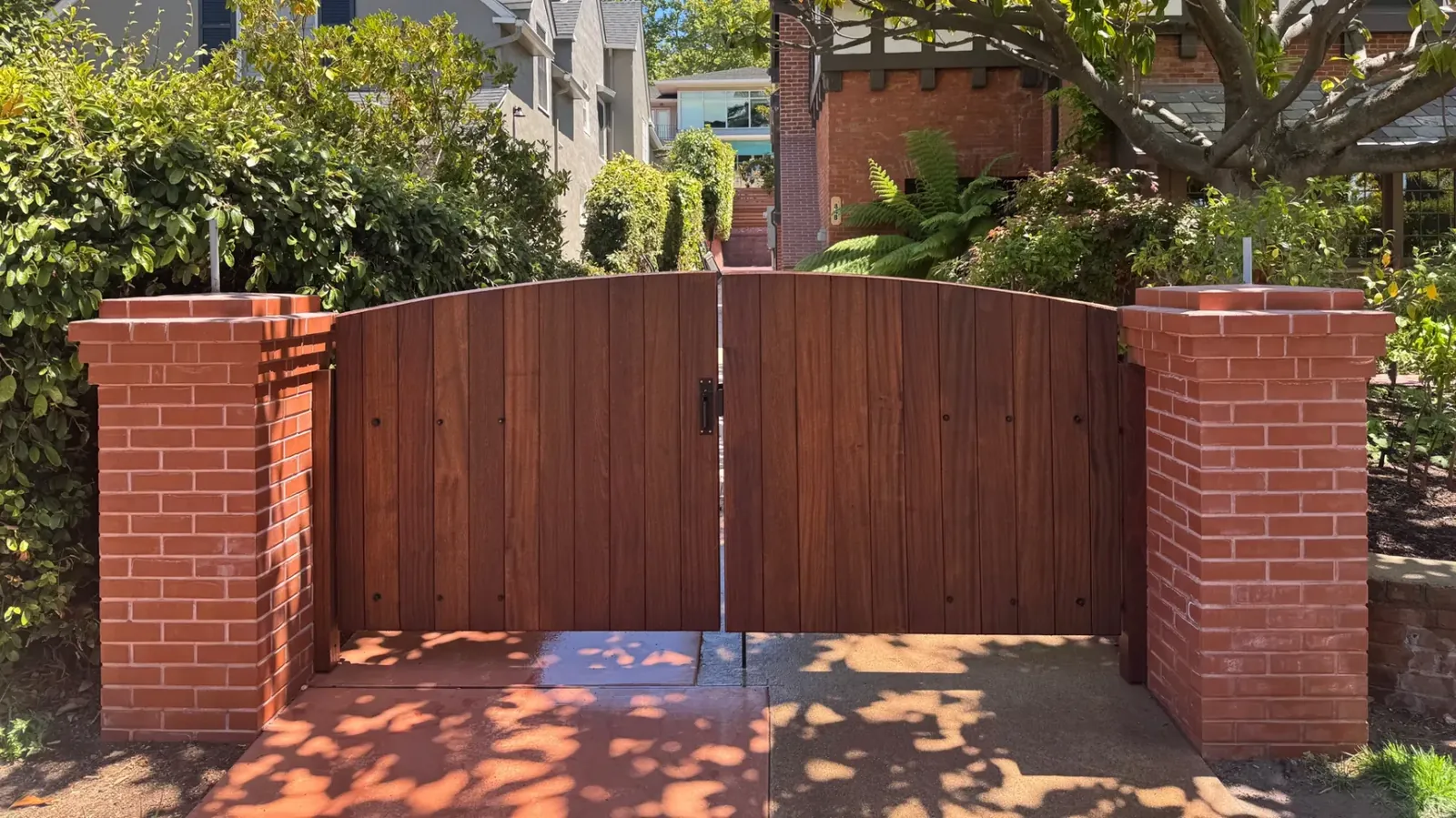
Quarter-sawn white oak is a domestically harvested, durable hardwood with closed-cell ray structure that makes it nearly waterproof and naturally rot-resistant. For Bay Area estate gates where the architecture leans craftsman, prairie, transitional, or modern American, white oak is often a better stylistic and structural choice than imported tropical hardwoods.
Key takeaways
- Quarter-sawn white oak is a domestically harvested, durable hardwood with closed-cell ray structure that makes it nearly waterproof and naturally rot-resistant. For Bay Area estate gates where the architecture leans craftsman, prairie, transitional, or modern American, white oak is often a better stylistic and structural choice than imported tropical hardwoods.
- What makes white oak different from red oak: The defining difference is at the cellular level.
- Why white oak suits Piedmont and Berkeley architecture: Piedmont, the Berkeley Hills, and the older neighborhoods of Oakland are dense with craftsman, shingle-style, prairie, and tudor homes from the 1900s through 1930s.
- Performance compared to Sapele: On pure performance metrics, Sapele and quarter-sawn white oak are nearly identical for our application.
- The fumed white oak finish: One thing white oak does that no tropical hardwood can: respond beautifully to ammonia fuming.
- Why quarter-sawn instead of flat-sawn? Quarter-sawn white oak moves about half as much across humidity changes, has the distinctive ray-fleck figure, and is less prone to cupping. The premium is worth it for a gate that will last 30 years.
White oak is having a moment in American architecture, and the moment is deserved. The same wood that built American naval frigates and survives in 19th-century barn timbers is the wood specified on more high-end Piedmont and Berkeley Hills remodels than any other domestic hardwood we see right now. When a client wants a gate that ties into a Greene-and-Greene-inflected craftsman home or a contemporary Piedmont prairie remodel, white oak is increasingly the right answer — and not just for stylistic reasons.
What makes white oak different from red oak
The defining difference is at the cellular level. White oak's growth rings contain tyloses — bubble-like structures that block the wood's vascular pathways and make the heartwood almost waterproof. This is why white oak is used for wine barrels: liquids stay in. Red oak, despite looking similar, has open vascular pathways and is unsuitable for outdoor use. A red oak gate will absorb water at the end grain like a straw.
White oak is also harder than red oak (Janka 1,360 vs. 1,290), denser, and more dimensionally stable. Quarter-sawn white oak — cut so the grain runs nearly perpendicular to the board face — moves about half as much as flat-sawn material across humidity changes.
For a gate, quarter-sawn white oak is functionally equivalent to Sapele in stability and outperforms most other temperate hardwoods. It also has the distinctive ray-fleck figure that Stickley made famous and that pairs perfectly with arts-and-crafts and prairie-style architecture.
Why white oak suits Piedmont and Berkeley architecture
Piedmont, the Berkeley Hills, and the older neighborhoods of Oakland are dense with craftsman, shingle-style, prairie, and tudor homes from the 1900s through 1930s. The original millwork on these houses was overwhelmingly oak — usually quarter-sawn white oak for the higher-end builds and red oak for the more modest ones. When we're building a gate for one of these homes, matching that material vocabulary matters.
Quarter-sawn white oak's ray-fleck figure ties into the architecture in a way no tropical hardwood can. Sapele is beautiful, but Sapele on a Greene-and-Greene-inspired Piedmont gate reads as a foreign element. White oak reads as if the gate has been there since 1912.
For contemporary remodels of these houses — which we see often in Piedmont — we'll specify white oak with a fumed or rift-sawn finish. The wood still ties to the architectural lineage, but the visual treatment is fully modern.
Performance compared to Sapele
On pure performance metrics, Sapele and quarter-sawn white oak are nearly identical for our application. Both move minimally across humidity swings. Both have excellent decay resistance. Both take Penofin and other penetrating oil finishes well. Both last 30-plus years in a properly built outdoor frame.
Where Sapele edges ahead: marginally better dimensional stability in extreme humidity cycling (inland summer-winter swings), more consistent supply in very wide widths, slightly easier to machine cleanly because the grain is more uniform.
Where white oak edges ahead: domestic supply chain (US Appalachian and Midwest forests), more period-appropriate aesthetics for older Bay Area architecture, takes fuming and reactive finishes that Sapele can't, and the ray fleck is unmistakable.
The fumed white oak finish
One thing white oak does that no tropical hardwood can: respond beautifully to ammonia fuming. The tannins in white oak react with ammonia vapor to produce a deep, even, brownish-gray color that penetrates the entire wood rather than sitting on the surface. Fumed white oak was the Stickley signature, and it remains one of the most beautiful finishes available on any wood.
On a gate, we typically fume the wood before assembly in a sealed chamber, then finish with Penofin Marine Oil for weather protection. The result is a color that won't fade or scratch off — because it's not a stain, it's a chemical change in the wood itself.
Clients in Piedmont and the Berkeley Hills tend to gravitate toward fumed white oak for craftsman-leaning gates. We've also built modern slatted gates in unfumed, naturally finished white oak that read very differently — pale, golden, and contemporary.
Sourcing and sustainability
We source white oak from the Appalachian region — primarily Pennsylvania, Kentucky, and Tennessee — through FSC-certified mills. The American hardwood industry is one of the most sustainably managed in the world; net standing volume of US hardwoods has been increasing for decades.
Lead times on quarter-sawn white oak in the widths we need for gate stiles (8 to 12 inches) can be longer than for flat-sawn material. We typically allow 2 to 3 weeks for delivery on premium quartered stock, which is worth building into the project timeline.
For estate gates where the project specifies a single board's run of grain across the entire gate, we'll source a single log and have it custom-milled. The cost premium is significant, but the visual result is unmatched.
We're booking design consultations 4–6 weeks out. Send us your driveway photos and we'll come back with a sketch, wood spec, and finish system within five business days.
When white oak isn't the right choice
White oak is heavy. A 14-foot driveway gate in quarter-sawn white oak with a steel sub-frame can push 700 pounds, which puts real demands on the gate operator and hinges. For some automated installations we'll specify Sapele instead simply to keep the gate weight within the operator's design envelope.
White oak is also more susceptible to staining from iron and steel hardware than Sapele. The tannins in white oak react with iron to produce blue-black stains that are difficult to remove. We use stainless or bronze hardware exclusively on white oak gates, and we test every hardware contact point before final assembly.
For very humid coastal Tiburon and Belvedere installations, Sapele's tropical-hardwood oil content gives it a small but real advantage over white oak. We'd specify white oak inland and Sapele on the water.
Pricing and lead time
Quarter-sawn white oak gate material runs comparable to Sapele — roughly $14 to $20 per board foot for the grades we use. A typical 8-foot estate driveway gate in white oak with hand joinery and bronze hardware ranges from $22,000 to $34,000, depending on automation and access control.
Lead times are typically 8 to 12 weeks from approved design. For fumed finishes, add roughly one week for the fuming chamber cycle and post-fuming oxidation period.
We'll quote white oak and Sapele side by side on any estate project so you can see the cost and lead-time difference directly.
Working with us on a white oak gate
If you're remodeling a Piedmont craftsman, a Berkeley Hills shingle-style, or any older Bay Area home where the original millwork was oak, we'd start the conversation with quarter-sawn white oak. Send photos of your existing trim and door hardware through our contact page and we'll match the wood, finish, and metalwork.
For new construction or contemporary remodels, our recommendation depends on the broader material palette of the home. White oak pairs beautifully with limestone, blackened steel, and warm bronze. Sapele pairs more naturally with stucco, terra cotta, and traditional iron.
See our companion pieces on Piedmont craftsman gates and Berkeley Hills shingle-style gate design for stylistic context.
About materials
For more answers, see our full FAQ.
Related articles
Let's design a gate that belongs to your home.
Tell us about the entrance you want to build. We respond same-day to consultations booked before 2pm, next business day after.