
Pergola-Topped Driveway Gates for Napa and Yountville Wine Country Estates
Why an integrated overhead pergola transforms an automatic driveway gate into an estate entrance — and how we design and engineer them for the Napa Valley wine country.
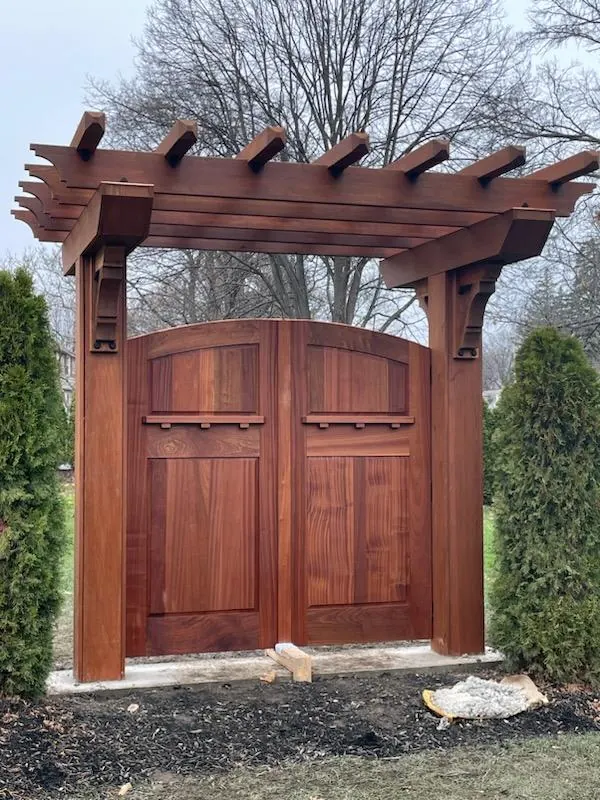
A pergola-topped driveway gate combines a custom hardwood or hybrid driveway gate with an overhead beam-and-rafter structure that visually completes the entrance. Done correctly, the pergola becomes the signature element of the property's exterior and dramatically increases curb value. The structural engineering, however, is materially different from a stand-alone gate.
Key takeaways
- A pergola-topped driveway gate combines a custom hardwood or hybrid driveway gate with an overhead beam-and-rafter structure that visually completes the entrance. Done correctly, the pergola becomes the signature element of the property's exterior and dramatically increases curb value. The structural engineering, however, is materially different from a stand-alone gate.
- What a pergola-topped gate is: The basic configuration is a stand-alone or bi-parting automatic driveway gate, hung between two heavy posts or stone columns, with a horizontal beam spanning the driveway opening at the top of the columns.
- Why the pergola changes the engineering: Adding a pergola to a driveway gate fundamentally changes the post engineering.
- Material choices for the pergola itself: Sapele mahogany is our default for pergola work in the Napa Valley.
- Integration with stone and stuccoed columns: Most Napa Valley pergola gates are built around masonry columns rather than freestanding wood posts.
- Can you build the pergola without the gate? Yes — we do free-standing entry pergolas for clients who want the structure without an automatic gate. The engineering is similar; the operator and access control simply aren't part of the scope.
Drive into any of the legendary estates of Yountville, Oakville, Rutherford, or St. Helena and you will notice the same design move repeated up the valley: the driveway gate is not a stand-alone object but the lower element of an integrated overhead pergola or arbor structure that frames the entire approach. The pergola tops a hardwood gate, often supported on stone or stuccoed columns, and the combination establishes the architectural language of the property before the visitor is fully on the driveway. This piece is about how we design and build those gates.
What a pergola-topped gate is
The basic configuration is a stand-alone or bi-parting automatic driveway gate, hung between two heavy posts or stone columns, with a horizontal beam spanning the driveway opening at the top of the columns. Rafters or a more elaborate trellis structure sit on the beam, sometimes infilled with climbing vine framework, sometimes left as exposed rafters.
On Napa Valley estates the pergola is often built in the same Sapele mahogany or white oak as the gate below it, with hand-forged iron strap details at the column-to-beam connections. The result is a unified piece of architecture that reads as a single composition rather than a gate plus an unrelated trellis.
On larger estate entries the pergola can extend several feet on either side of the driveway, supported on additional columns, creating a covered approach that reads as an actual gateway. We have built these as long as 22 feet across the driveway with 8 feet of overhang on each side.
Why the pergola changes the engineering
Adding a pergola to a driveway gate fundamentally changes the post engineering. A stand-alone gate post carries the gate's weight as a vertical load and resists racking from operator cycling. A pergola post adds dead load from the beam and rafters, plus wind loading on the overhead structure, plus seasonal expansion-and-contraction of the heavy timber beam.
We size pergola posts as a separate structural calculation from the gate. Typical pergola posts are 8x8 inch HSS steel inside a 12x12 inch stucco-clad column or stone veneer column, with the steel post extending into a 5-foot-deep concrete footing reinforced with rebar cages. The gate hardware bolts to the steel post; the pergola beam bolts to the same steel with a separate connection plate.
On windy ridgeline sites in the upper Napa Valley or the Mayacamas foothills, we add lateral bracing in the pergola beam to control sway. Untensioned cable cross-bracing or knee braces from the column to the beam are both acceptable solutions depending on the architectural language.
Material choices for the pergola itself
Sapele mahogany is our default for pergola work in the Napa Valley. It is dimensionally stable through the strong summer-to-winter moisture swing, takes finish well, and weathers to a deep mahogany red that complements both stone and stucco architecture. Large Sapele timbers are available up to 12x12 inches in the lengths we need.
White oak is the alternative for craftsman-style or modern farmhouse estates where a lighter, more amber tone is appropriate. White oak weathers grey if left unfinished and warm gold if maintained on a Penofin schedule. We choose white oak for clients building in the prairie-modern or craftsman traditions, common in the newer estate construction in Oakville and Rutherford.
Western red cedar is a budget alternative for the pergola structure if hardwood is used only for the gate itself. Cedar weathers beautifully and is dimensionally stable, but is significantly lower in long-term durability than hardwood. We will recommend it for clients who want to control cost on a large overhead structure.
Integration with stone and stuccoed columns
Most Napa Valley pergola gates are built around masonry columns rather than freestanding wood posts. The masonry establishes the Tuscan or Mediterranean architectural language; the wood gate and pergola sit inside the masonry openings as the warm, crafted element.
We coordinate with the masonry contractor at design stage to embed the structural steel post inside the column during the masonry build. The steel must be plumb to within 1/8 inch over the full height for the hardware to align — masonry tolerances are typically looser than gate-hardware tolerances, so the embedded steel is what we hang the gate on, not the masonry itself.
Pergola beam connections to the columns use hand-forged iron straps that pass around the beam and bolt to the embedded steel inside the column. The strap detail is both structural and decorative, picking up the iron language used elsewhere on the property.
Vine integration and the living pergola
Many Napa Valley clients want the pergola to host climbing vines — wisteria, jasmine, or grape vines for the wine-country reference. We design the rafter spacing and rafter geometry with vine integration in mind: closer rafter spacing for vines that need horizontal support, wider spacing for vines that climb on cable or wire trellis added between rafters.
A fully matured wisteria on a 20-foot pergola adds significant load — wet wisteria can run 30 pounds per square foot of canopy. We size the beam for the eventual mature load, not the bare-pergola load, so the structure does not need to be reinforced ten years after planting.
Vines also require maintenance access. We build pergola rafters with concealed stainless cleats every 8 to 10 feet that accept a temporary maintenance ladder hook without damaging the wood finish.
We're booking design consultations 4–6 weeks out. Send us your driveway photos and we'll come back with a sketch, wood spec, and finish system within five business days.
Lighting integration
An entry pergola is the right place for the property's primary entry lighting. We rough-in low-voltage wiring during the pergola build for downlights mounted on the underside of the beam, uplights at the base of the columns, and accent lighting on the gate itself. The wire runs through hollow channels routed into the back of the beam and exit at concealed junction points.
Lighting design is typically a separate scope of work coordinated with a lighting designer or landscape architect, but we will accommodate any specified fixture package by providing the appropriate wire chases at build time. Retrofitting lighting after the fact requires either surface-mount wire (which compromises the appearance) or invasive routing.
For Napa Valley properties governed by the county's outdoor lighting ordinance, all fixture selections must be full-cutoff, warm color temperature, and on appropriate dimmers. We coordinate compliance with the lighting designer.
Project timeline and coordination
A pergola-topped driveway gate is a significantly more complex project than a stand-alone gate. Typical timeline from signed design to final install is 14 to 20 weeks, depending on the masonry coordination and the complexity of the pergola structure.
We coordinate with the general contractor, mason, landscape designer, and lighting designer throughout. On a typical new-construction Napa estate, the gate and pergola design begins at the same time as the architectural drawings, with our scope locked in well before site work starts.
For an existing property where the gate and pergola are being added to a completed home, the schedule depends primarily on masonry lead time. Stone column work in the Napa Valley can carry 8-to-12 week lead times in the busy summer season; planning a winter or spring installation often shortens the overall timeline.
Working with us in Napa, Yountville, and St. Helena
Wine-country estate work is a core specialty for our shop. We have built pergola-topped driveway gates from the south end of the valley in Napa proper through Yountville, Oakville, Rutherford, St. Helena, and into Calistoga. Every project is a custom design coordinated with the property's architect, mason, and landscape designer.
If you are planning a new estate or a major renovation, start the gate and pergola conversation at architectural design stage rather than waiting until landscape phase. The earlier we are in the conversation, the better the integration with the rest of the project.
Begin with our custom gates service overview, the automatic driveway gates page, or our Bay Area service areas page. To start a project conversation, request a design consultation.
About design
For more answers, see our full FAQ.
Let's design a gate that belongs to your home.
Tell us about the entrance you want to build. We respond same-day to consultations booked before 2pm, next business day after.