
Bi-Parting Double Gate Engineering: When Two Leaves Are Better Than One
Why estate driveways wider than 18 feet almost always get a bi-parting design — and how Heartwood Gates engineers the center meeting stile, dual operators, and safety synchronization for properties in Alamo, Danville, and the Wine Country.
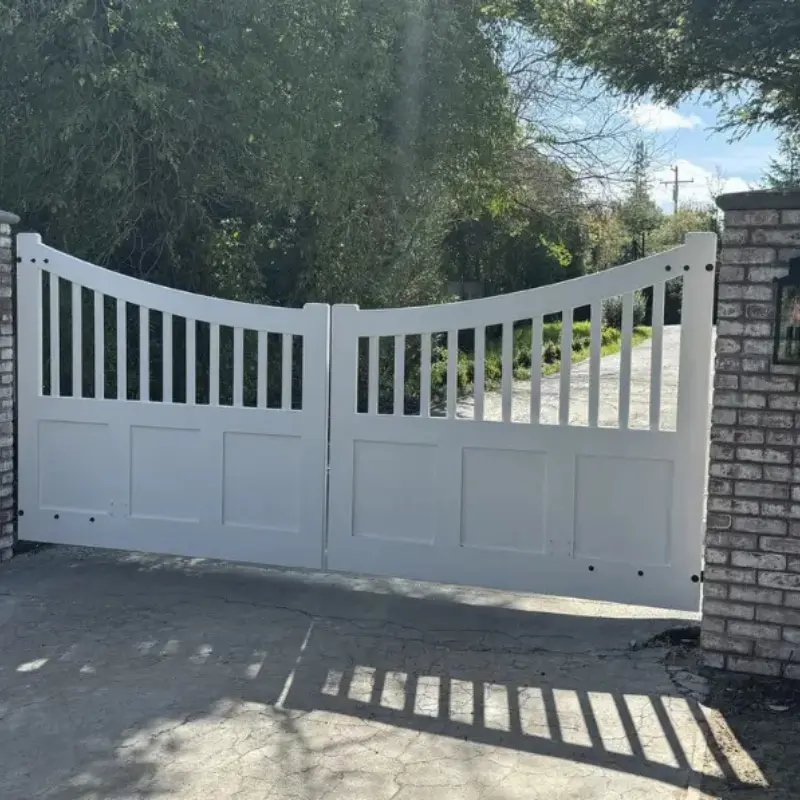
Bi-parting double gates are the right answer for driveway openings wider than 18 feet. Heartwood Gates engineers them with a steel-reinforced center meeting stile, dual operators synchronized via a master-slave control board, and UL325 safety edges on both leaves. The result is a wide gate that opens and closes with the same smooth motion as a single 10-foot leaf.
Key takeaways
- Bi-parting double gates are the right answer for driveway openings wider than 18 feet. Heartwood Gates engineers them with a steel-reinforced center meeting stile, dual operators synchronized via a master-slave control board, and UL325 safety edges on both leaves. The result is a wide gate that opens and closes with the same smooth motion as a single 10-foot leaf.
- The 18-foot threshold: An 18-foot single-leaf hardwood gate in Sapele weighs roughly 350 to 450 pounds depending on height and infill.
- The center meeting stile: The center meeting stile — the edge where the two leaves come together — is the most engineered detail on a bi-parting gate.
- Dual operator synchronization: Two operators on two leaves will not move at exactly the same speed unless they are actively synchronized.
- Safety requirements for bi-parting gates: UL325 applies to bi-parting gates with additional requirements beyond single-leaf installations.
- How wide can a bi-parting gate go? Our largest bi-parting installations are 32 feet total opening — two 16-foot leaves. Past that, we recommend a sliding gate or a rolling gate system.
There is a threshold in driveway gate design, and it sits at about 18 feet of total opening width. Below that, a single-leaf swing gate or a single sliding gate is almost always the right answer — simpler, cheaper, and more reliable. Above it, the physics change. The leaf weight grows past what a single residential operator can handle comfortably. The wind load on a single panel becomes significant. And the sag potential across a 20-foot span in hardwood becomes a real engineering problem. The solution is a bi-parting double gate: two leaves that meet in the center, each operated by its own actuator, synchronized so they move as one. This piece covers when bi-parting is the right choice and how we engineer the details that make it work.
The 18-foot threshold
An 18-foot single-leaf hardwood gate in Sapele weighs roughly 350 to 450 pounds depending on height and infill. That is at the upper limit of what a premium residential operator — a FAAC 422, LiftMaster LA500, or Viking K-2 — can open and close smoothly. At 20 feet, the weight crosses 500 pounds, and the operator is working at the edge of its duty cycle. At 22 feet, you're into industrial operator territory, with significantly higher cost, more noise, and less refined motion.
The wind load is equally important. A single 20-foot leaf presents 120 square feet of surface area to the wind. In the canyon gusts common to Alamo, Diablo, and the Berkeley Hills, that is enough surface area to stall an undersized operator or bend a hardwood frame. Splitting the opening into two 10-foot leaves cuts the wind load per leaf in half and allows each operator to work well within its comfort zone.
Sag is the third factor. Even with a welded steel sub-frame, a 20-foot single leaf will deflect measurably under its own weight over time. Two 10-foot leaves, each with its own structural frame and hinge post, eliminate the long-span deflection problem entirely.
The center meeting stile
The center meeting stile — the edge where the two leaves come together — is the most engineered detail on a bi-parting gate. It must seal visually, align precisely, carry the electric strike or magnetic lock, and tolerate minor settling or seasonal movement without binding.
Our standard meeting stile is a 3-inch-wide hardwood tongue on the active leaf (typically the right leaf from the street) that overlaps a matching groove on the passive leaf. The overlap is 1-1/2 inches, which prevents direct sightlines through the gate when closed and provides a weather seal against wind-driven rain. Both stiles are backed with steel flat bar to prevent the hardwood from compressing at the latch point over time.
For estates where security is paramount, we integrate a mortise-mount electric strike into the passive leaf stile and a matching deadbolt into the active leaf. The strike is wired through the passive leaf frame and controlled by the same access system as the operators. When the gate opens, the strike releases a half-second before the operators engage, preventing the bolt from dragging.
Dual operator synchronization
Two operators on two leaves will not move at exactly the same speed unless they are actively synchronized. Even identical operators from the same production batch have small variations in motor torque and gearbox friction. Left alone, one leaf will consistently arrive at the open or closed position before the other, causing the meeting stile to bang or the overlap tongue to wedge.
We solve this with a master-slave control board. The active leaf's operator is the master; its control board sends a timed signal to the passive leaf's operator, telling it when to start, stop, and reverse. The board also monitors current draw on both motors. If one leaf hits an obstruction and stalls, the board stops both operators immediately — a UL325 requirement for dual-leaf gates.
The synchronization can be adjusted in the field. During commissioning, we run the gate through 20 open-close cycles and fine-tune the timing until both leaves arrive at the fully open and fully closed positions simultaneously within a tolerance of 1 inch.
Safety requirements for bi-parting gates
UL325 applies to bi-parting gates with additional requirements beyond single-leaf installations. Each leaf must have its own entrapment protection: photo-eye beams across the opening at vehicle height, safety edges along the leading edge of each leaf, and a safety loop in the driveway approach.
The center meeting stile also needs protection. We install a pressure-sensitive safety edge along the full height of both meeting stiles. If the leaves close on an object — a vehicle bumper, a bicycle, a pet — the edge triggers an immediate reversal of both operators.
All safety devices are wired in series to a single safety circuit. A failure in any device disables the entire gate until the fault is cleared. This is more conservative than the minimum UL325 requirement, but it prevents the dangerous scenario where one leaf's safety is compromised and the other continues to operate.
We're booking design consultations 4–6 weeks out. Send us your driveway photos and we'll come back with a sketch, wood spec, and finish system within five business days.
Post and foundation engineering
A bi-parting gate has four structural posts instead of two: a hinge post and a latch post for each leaf. The hinge posts carry the full weight of their respective leaves plus the dynamic load of the operator. The latch posts carry only the latch mechanism and the passive leaf's overlap when the gate is closed.
Hinge posts for bi-parting gates are typically 6x6 inch HSS (hollow structural section) in 1/4-inch wall, set in 48-inch-deep concrete footings with rebar cages. On hillside sites in Alamo and Danville, we go to 60 inches to reach undisturbed soil. The posts are plumb within 1/8 inch over their full height — any twist or lean translates directly into binding at the meeting stile.
The passive leaf's latch post can be lighter — 4x4 inch HSS in 3/16 wall — because it carries no leaf weight. It still needs a full-depth footing because any settlement will misalign the electric strike and cause latch failure.
When a single sliding gate is the better alternative
Bi-parting swing gates are not the only solution for wide openings. A single cantilever sliding gate can span 20 to 24 feet without the complexity of dual operators, synchronization, and four posts. For properties with adequate side yard for the counterbalance, a sliding gate is often simpler and more reliable.
We evaluate every wide-opening project for both solutions. If the driveway is flat, the side yard is available, and the client values simplicity over classical symmetry, we typically recommend a cantilever sliding gate. If the driveway is curved, the architecture demands a symmetrical swing design, or the side yard is constrained, bi-parting is the right answer.
See our piece on cantilever sliding gate engineering for the full comparison.
Designing a bi-parting gate with Heartwood
Every bi-parting gate we build starts with a site survey and an architectural conversation. We measure the opening, evaluate the driveway geometry, assess wind exposure, and discuss the client's preferences for symmetry, automation, and security. Then we produce a CAD model showing both leaves, the meeting stile detail, the operator locations, and the foundation plan.
Production takes 10 to 14 weeks. Installation is typically two days: one day for post setting and concrete cure, one day for gate hang, operator mount, and safety commissioning. We schedule a follow-up visit at 30 days to check synchronization and make any timing adjustments.
To start a bi-parting gate project, request a design consultation or visit our automatic driveway gates service page.
About design
For more answers, see our full FAQ.
Related articles
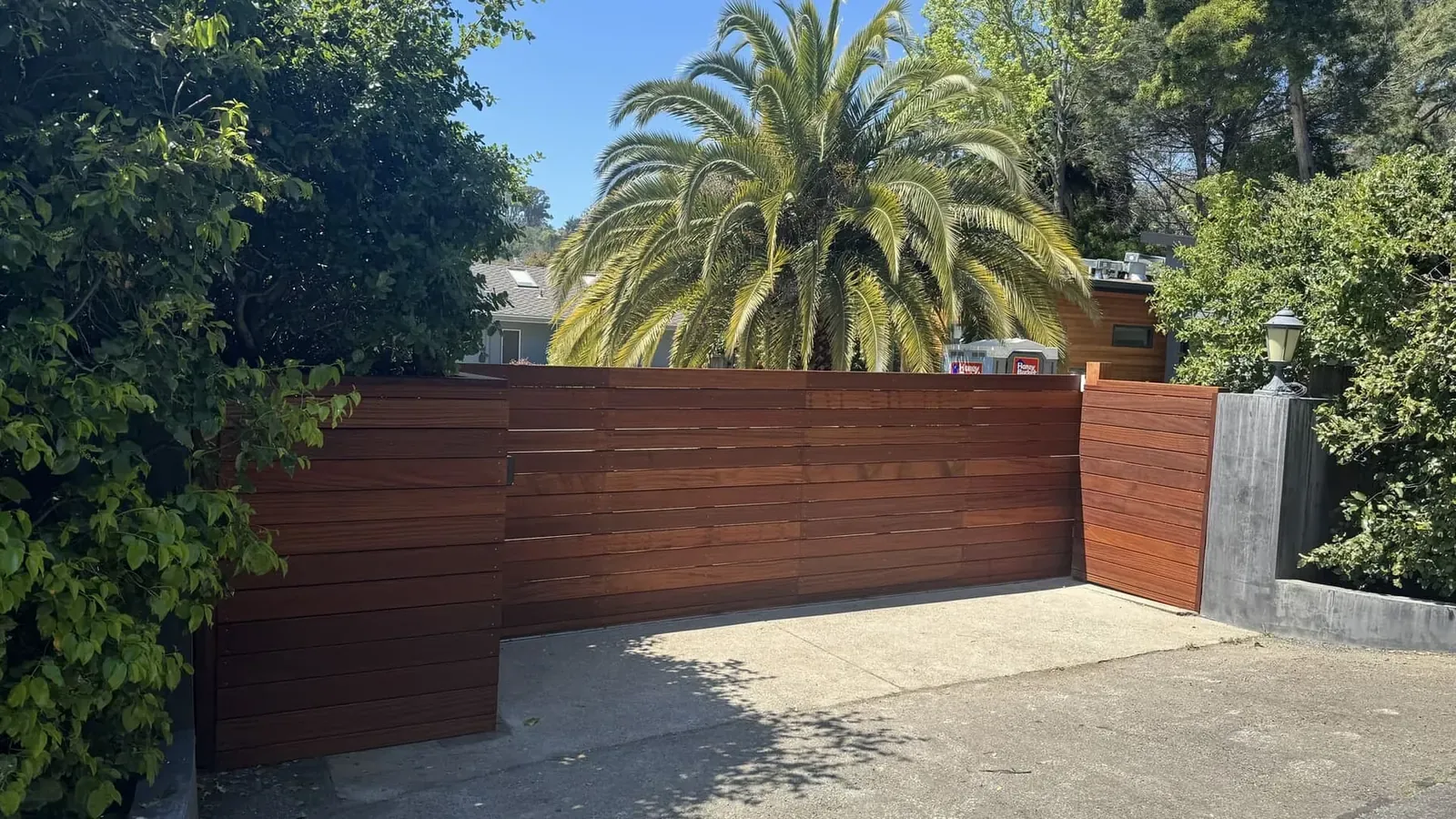
Cantilever Sliding Gate Engineering for Hillside Driveways in Lafayette and Orinda
The Steel Sub-Frame and Sapele Cladding Method for Wide Driveway Gates
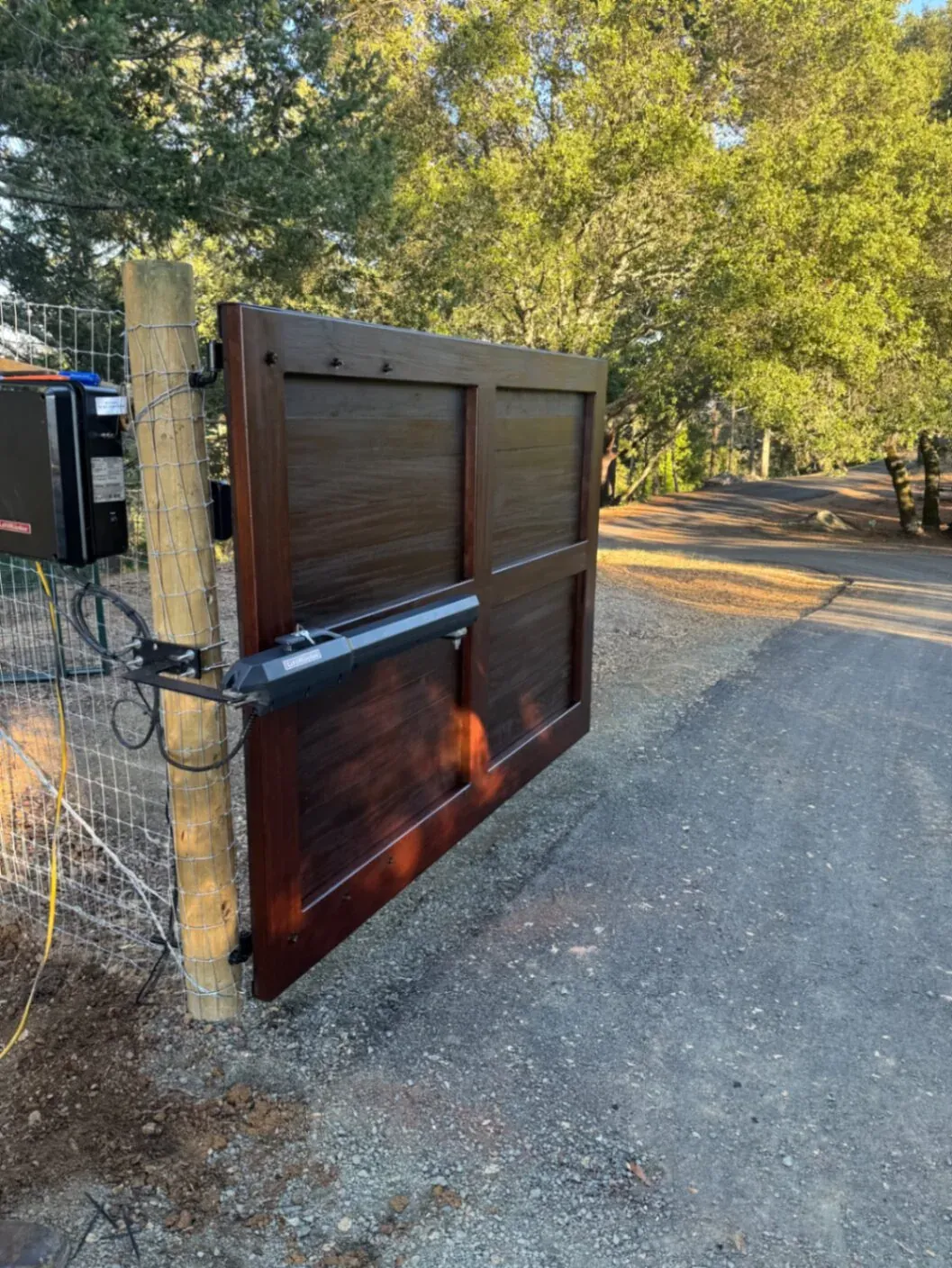
FAAC vs LiftMaster vs Viking: Choosing the Right Gate Operator for a Northern California Estate
Let's design a gate that belongs to your home.
Tell us about the entrance you want to build. We respond same-day to consultations booked before 2pm, next business day after.