Heartwood GatesHeartwood GatesCalifornia · Est. 2016
Call (925) 570-3688
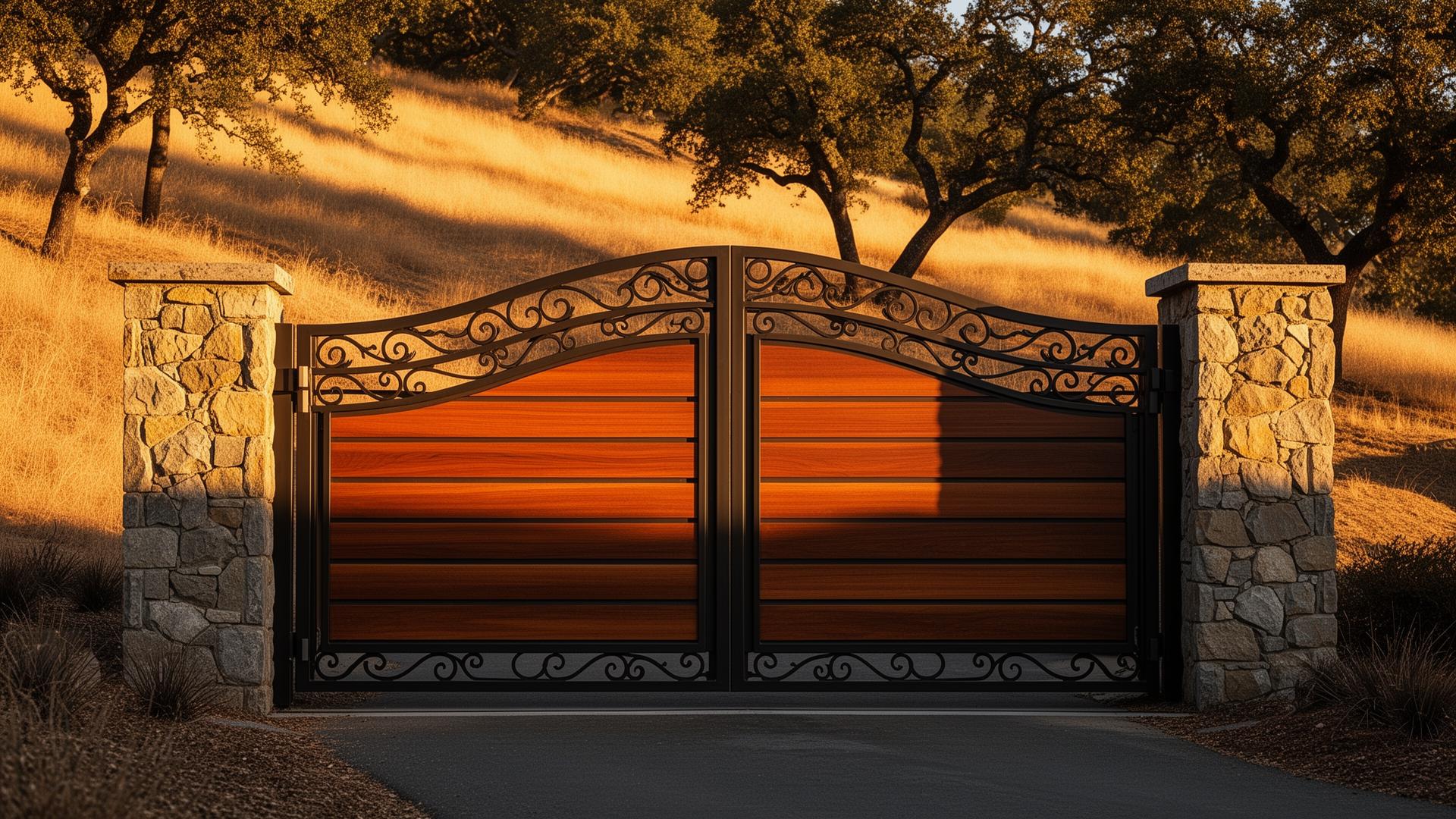
Custom wrought iron driveway gate with aluminum infill panels, WUI-compliant design for California fire zone
Services

Custom Metal Driveway Gates for California Homes & Estates

Iron, aluminum, and steel — engineered for fire zones, coastal salt, and seismic loads. Fabricated in the Bay Area. Installed statewide.

What's Included

Every custom metal driveway gates for california homes & estates commission carries.

  • 01WUI / Chapter 7A / Zone 0 fire-zone compliant designs across iron, aluminum, and steel
  • 02Wrought iron, aluminum, and steel — plus wood-and-steel and wood-and-iron hybrids
  • 03Seismic-rated hinges, latches, and operator mounts as a California standard
  • 04Coastal corrosion spec: marine-grade anodizing, hot-dip galvanizing, Kynar 500, 316 stainless fasteners
  • 05Heavy-duty automation rated for the gate's actual weight — not the operator catalog cover photo
  • 06Smart-home integration: DoorBird, Ring Elite, Control4, Savant, Crestron, HID
  • 07Battery and solar backup standard on heavy iron and estate-scale gates
  • 08Permit-ready CAD, structural engineering, and Chapter 7A compliance documentation
  • 09Bay Area fabrication — waterjet, CNC, hand-forging, welding, finishing — never outsourced overseas
  • 1010-year structural warranty, annual inspection plans, post-earthquake check-ins
Request a quote

Quote a custom metal driveway gates for california homes & estates.

Three fields. We'll call you back today or the next business day.

(925) 570-3688No spam · One business day
Chapter

Iron, aluminum, or steel — choosing the right metal

Wrought iron is the traditional choice for estate gates and luxury entry gates — hand- or machine-forged, heavy (150–400 lb per leaf), and sculptural. It's fully WUI-compliant as a non-combustible material, but needs a re-coat every 3–5 years and faster than that in coastal air. Aluminum is the practical choice for modern driveway gates, coastal properties, and large automated spans where weight matters — 40% lighter than steel and 60% lighter than iron, easier on operators and piers, and a marine-grade anodized or Kynar 500 powder-coated finish lasts 15–20 years even in salt air. We fabricate aluminum gates with wood-grain powder coat, CNC-cut decorative panels, and mixed-material designs that read as custom, not catalog. Steel is the engineer's choice — strong, versatile, and cost-effective at scale. It's the backbone of wood-and-steel hybrid gates and modern horizontal-slat designs. Hot-dip galvanize plus powder coat is our standard. All three are non-combustible and WUI-compliant; the choice between them is about look, weight, and maintenance cadence.
Chapter

California fire-zone compliance — VHFHSZ, WUI, Chapter 7A, Zone 0

California's wildfire risk isn't uniform — the state maps Fire Hazard Severity Zones, and your gate's material, placement, and design may be regulated by where you live. In a Very High Fire Hazard Severity Zone (VHFHSZ) — much of the East Bay hills, Santa Monica Mountains, and Sierra foothills — non-combustible materials are strongly preferred and metal simplifies permitting and insurance. In a Wildland-Urban Interface (WUI) zone, Chapter 7A of the California Building Code applies: exterior attachments including gates must use ignition-resistant or non-combustible materials. Zone 0 — the 0-to-5-foot 'ember-resistant' band around your home — is the most critical. A wood gate within 5 feet of the structure can ignite from wind-blown embers and radiate heat directly to the wall. A metal gate in Zone 0 may deform under extreme radiant heat, but it can't become a fuel source. Insurance carriers in VHFHSZ are increasingly requiring Zone 0 compliance for coverage. Our process: verify your WUI status using Cal Fire maps and local GIS, design to Chapter 7A and any local amendments (Atherton, Woodside, Marin, Santa Barbara County all add their own), provide compliance documentation for permit submittal, and coordinate with your insurance underwriter if they want spec sheets.
Chapter

California engineering — seismic, coastal, thermal

California gates shake, corrode, and bake — usually all on the same property. Our seismic standard: ball-bearing or thrust-bearing hinges that maintain alignment after lateral load, operator mounts with flex elements that absorb seismic movement without shearing, reinforced concrete piers with engineered rebar cages sized to your soil report, and a post-earthquake inspection clause in every maintenance plan. Coastal spec changes by material: aluminum gets marine-grade anodizing or Kynar 500 fluoropolymer, steel gets hot-dip galvanizing (ASTM A123) plus epoxy primer plus polyurethane topcoat, wrought iron gets a zinc-rich primer system with two-year inspection cycles. Every fastener, hinge, and latch within five miles of salt water is 316 stainless — full stop. Thermal spec matters too: California's 40°F–110°F swings stress welded steel frames, so we build expansion joints into anything over 12 feet and use slotted mounts on aluminum frames so they can expand without binding. In desert climates (Palm Springs, El Dorado County) we caution clients away from dark powder coats — they absorb heat and overheat operators — and recommend lighter colors or heat-reflective coatings.
Chapter

Wood-and-metal hybrid gates — design flexibility with fire-zone compliance

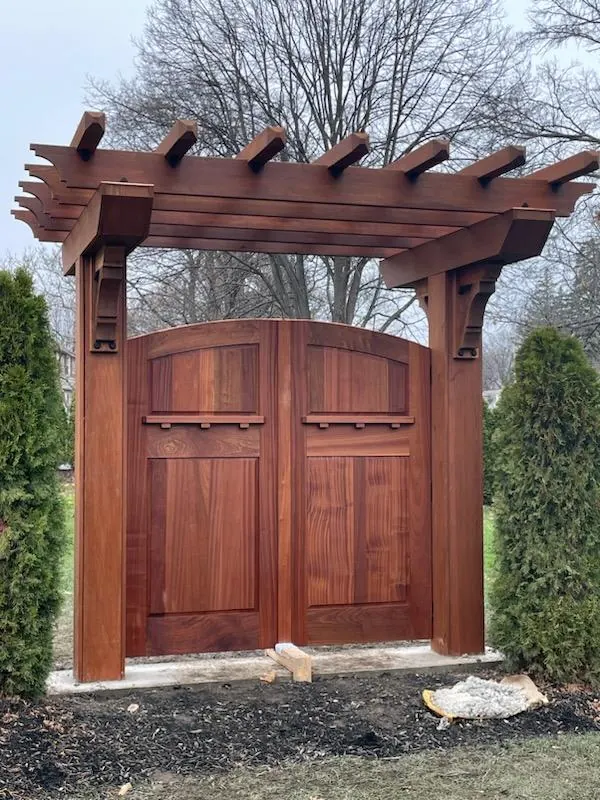
Many of our most successful luxury driveway gates combine a metal frame with hardwood infill. The metal frame and structural elements are non-combustible, the hardwood brings the warmth and texture metal alone can't produce, and the look ranges from modern horizontal-slat steel-and-Sapele to Mediterranean wrought-iron with Ipe panels. Fire-zone rules still apply to the wood portion: infill must be ignition-resistant — either treated to Chapter 7A standards or a naturally ignition-resistant species like Ipe or Teak — wood percentage of total surface area may be capped by local amendment, and ember-resistant mesh or backing may be required behind wood panels. We document the ignition-resistant material specification for permit and insurance. Popular hybrid configurations: steel tube frame with Sapele horizontal slats (modern, compliant with ignition-resistant treatment), wrought iron with Ipe vertical panels (Mediterranean, naturally compliant), aluminum with Teak slats (contemporary coastal, maximum corrosion resistance), and steel with perforated aluminum panels (industrial-modern, fully non-combustible).
Chapter

Automation built for metal — matched to the gate's actual weight

Metal gates span a huge weight range. A lightweight aluminum modern driveway gate (150–250 lb per leaf) runs cleanly on a linear or articulated-arm operator. An oversized aluminum gate (250–400 lb) needs heavy-duty linear with high cycle rating and battery backup. Standard steel gates (200–350 lb) work with articulated arm or underground operators on seismic-rated mounts. Heavy or security-grade steel (350–600 lb) calls for heavy-duty articulated or slide operators, dual motors, and a full UL 325 safety suite. Wrought iron at 300–500+ lb per leaf demands heavy-duty articulated or slide operators with custom mount engineering, battery backup, and thermal management on the operator enclosure. Access control we integrate routinely: DoorBird, Control4 DS2, or Ring Elite for video intercom; HID prox, Bluetooth, or biometric readers for high-end custom gates; Control4, Savant, Crestron, and Lutron for full smart-home; vehicle loops and RFID for hands-free entry. Battery backup is standard on every heavy iron gate we install — a 400-pound gate stuck open during a power outage is a real risk in a fire evacuation.
Materials

What we build with.

  • Wrought iron — hand- or machine-forged, fully non-combustible, WUI-compliant
  • Aluminum — marine-grade extrusion, anodized or Kynar 500 fluoropolymer powder coat
  • Steel — hot-rolled, hot-dip galvanized (ASTM A123) plus epoxy primer plus polyurethane topcoat
  • Hardwood infill (hybrids) — Ipe and Teak (naturally ignition-resistant), Sapele with Chapter 7A treatment
  • 316 stainless fasteners, hinges, and latches within five miles of salt water
  • Seismic-rated ball-bearing / thrust-bearing hinges and flex-mount operator brackets
  • Reinforced concrete piers, soil-report-sized rebar cages, crowned tops for drainage
  • Heavy-duty FAAC, BFT, LiftMaster, and HySecurity operators sized to actual gate weight
  • Battery and solar backup on every heavy iron and estate-scale automated gate
  • Permit-ready CAD, structural engineering letters, and Chapter 7A ignition-resistant material certifications
Timeline

How long it takes.

Standard metal driveway gates ship in 8–10 weeks from approved design. Custom wrought iron, hybrid, and estate-scale projects run 10–14 weeks. Fire-zone permit and Chapter 7A documentation typically adds 2–4 weeks on the front end depending on jurisdiction. Install is usually 2–4 days on-site, plus a commissioning visit on automated gates to tune photo eyes, force, slowdown, and battery backup.

Pitfalls

Common mistakes.

  • Treating a wood gate in Zone 0 as cosmetic — a wood gate within 5 ft of the house is an ember pathway and increasingly a coverage problem with insurers.
  • Specifying a residential-grade operator on a 400-lb wrought iron gate — burns out inside 12–18 months.
  • Aluminum gate spec'd without 316 stainless fasteners on a coastal site — galvanic corrosion eats the hinges in two seasons.
  • Skipping seismic-rated hinges and flex mounts — California gates fall out of alignment after a moderate event.
  • Dark powder coat on a desert gate — operator overheating and thermal warp on welded frames.
  • No expansion joints on a welded steel frame over 12 ft — wavy gate by the second summer.
  • Submitting a Chapter 7A jurisdiction without ignition-resistant material certifications — the permit doesn't move.
Northern California

Where we build metal gates in California

Bay Area first: Atherton, Woodside, Hillsborough, and Portola Valley for wrought iron and hybrid estate gates with strict design-review compliance; Menlo Park and the Peninsula for modern aluminum on tech-home integration; Marin County (Tiburon, Mill Valley, Ross, San Rafael) for coastal aluminum and Kynar-spec corrosion protection; Walnut Creek, Lafayette, Orinda, and Piedmont for WUI fire-zone compliance and Zone 0 gates; Napa Valley for vineyard estate aesthetics in iron and hybrid; Silicon Valley for estate gates with Control4 / Savant integration. Extended California: Santa Barbara and Montecito for coastal wrought iron in Spanish Colonial designs; Los Angeles and Malibu for modern aluminum with privacy and security focus; San Diego and Rancho Santa Fe for Mediterranean iron and coastal aluminum; Lake Tahoe and Truckee for heavy snow- and ice-rated operators on WUI-compliant gates; Palm Springs and the desert communities for thermal management and light-color spec. Fabricated in Concord. Installed statewide.
Compare

Wrought iron vs. aluminum vs. steel — at a glance

FactorWrought IronAluminumSteel
Weight per leafHeavy (150–400 lb)Light (40% < steel)Medium
Coastal corrosionPoor — frequent re-coatExcellentGood w/ galvanizing
WUI / Zone 0 complianceYes — non-combustibleYes — non-combustibleYes — non-combustible
Design flexibilityForged scrollwork & detailCNC, extrusion, panel artWelded, plasma-cut, slats
Maintenance interval3–5 yrs (2 yrs coastal)15–20 yrs7–10 yrs
Typical cost range$22K–$75K+$18K–$55K+$20K–$65K+
Best matchTraditional estatesCoastal & modernHybrid & security
Case Study
Custom Metal Driveway Gates for California Homes & Estates case study by Heartwood Gates — Hand-forged wrought iron frame, Ipe horizontal infill (naturally ignition-resistant), ember-resistant stainless mesh backing, FAAC 760 underground operators with battery backup, 316 stainless fasteners, Kynar 500 finish on iron.
Plate · A recent commission

A recent custom metal driveway gates for california homes & estates project.

Problem
A Lafayette family in a VHFHSZ / WUI overlay needed to replace a wood entry gate inside Zone 0 of their home. Their insurance carrier had flagged the existing gate as a coverage risk and the county planning department required Chapter 7A documentation for any replacement within the WUI mapping.
Solution
We designed a wrought-iron-frame gate with ignition-resistant Ipe horizontal infill — non-combustible structure, naturally ignition-resistant infill, ember-resistant mesh behind the wood panels. Engineering documented to Chapter 7A. Seismic-rated thrust-bearing hinges, flex-mounted FAAC 760 underground operators with battery backup, and 316 stainless fasteners throughout. Compliance package submitted with the permit; matching spec sheet sent to the insurance underwriter.
Materials
Hand-forged wrought iron frame, Ipe horizontal infill (naturally ignition-resistant), ember-resistant stainless mesh backing, FAAC 760 underground operators with battery backup, 316 stainless fasteners, Kynar 500 finish on iron.
Timeline
12 weeks from approved design, including 3 weeks of permit and Chapter 7A documentation.
Result
Permit issued on first submittal. Insurance carrier reinstated full coverage and removed the gate flag. Owners report the gate now reads as the front door of the property — the spec hides inside a design they describe as the best architectural decision they've made since the remodel.
Frequently Asked

About custom metal driveway gates for california homes & estates.

In WUI and Zone 0 areas, yes. Metal is non-combustible and satisfies Chapter 7A requirements without treatment. Wood gates can be compliant but require ignition-resistant materials, additional documentation, and may face insurance challenges. For peace of mind and simpler permitting in a VHFHSZ, metal is the safer choice.
Continue Reading
Begin a commission

Ready to design your custom metal driveway gates for california homes & estates?

Book a free design consultation. We'll review your site, talk through materials and automation, and follow up with a tailored quote.

Request a design consultation Call (925) 570-3688Mon–Fri
Free design call · No-pressure quote · Bay Area · Napa · Sacramento
CallGet a quote