
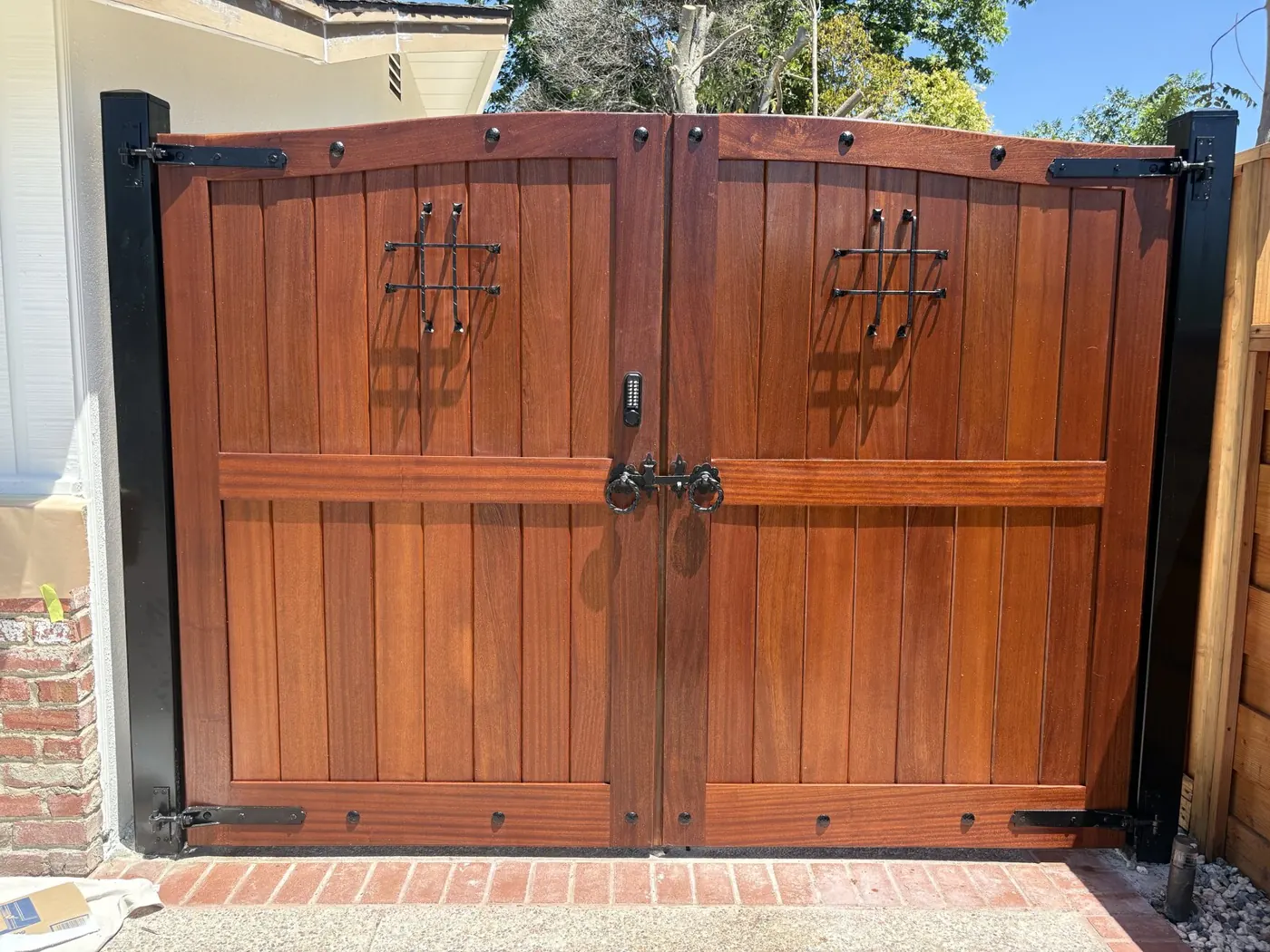
Custom Double Swing Gates — Automated & Handcrafted for Bay Area Estates
Two leaves, one statement. From classic Sapele estate gates to modern automated aluminum designs, built with mortise-and-tenon precision and engineered for decades of smooth, reliable operation.
Every custom double swing gates — automated & handcrafted for bay area estates commission carries.
- 01Two synchronized leaves — 60 inches up to 24+ feet of total opening
- 02Full automation: linear, articulated, underground, or hydraulic operators
- 03Mortise-and-tenon joinery standard on every hardwood gate
- 04Sapele hardwood — our signature wood, proven in every Bay Area microclimate
- 05White Oak, aluminum, steel, wrought iron, Ipe, and Teak available
- 06We do not build with Redwood or Cedar — softwoods that fail in Northern California's climate
- 07UL 325 photo eyes, edge sensors, manual release, and battery backup standard
- 08Smart access: keypad, app, intercom, RFID, Control4 / Savant integration
- 09WUI / Chapter 7A fire-zone compliant configurations with failsafe closure
- 10Seismic-rated hinge piers and engineered concrete foundations as a California standard
- 11Bay Area fabrication, nationwide shipping on custom-built double swing gates
- 1210-year structural warranty and annual operator service plans
Double swing vs. single swing — the 60-inch rule
Sapele — our signature wood
White Oak — the American Craftsman alternative
Metal options — aluminum, steel, and wrought iron
Why we don't build with Redwood or Cedar
Automating a double swing gate
Premium hardwood options — Ipe and Teak
Design archetypes that work as double swings
Sizing, engineering, and California fire-zone compliance
What we build with.
- —Sapele hardwood — quartersawn, 1,500 Janka, naturally rot-resistant (our signature material)
- —White Oak — domestic, closed-grain, high-tannin, dramatic quartersawn ray fleck
- —Aluminum — marine-grade extrusion, anodized or Kynar 500 fluoropolymer powder coat
- —Steel — hot-rolled, hot-dip galvanized (ASTM A123), epoxy primer plus polyurethane topcoat
- —Wrought iron — hand- or machine-forged, fully non-combustible, WUI-compliant
- —Ipe (premium) — naturally Class A fire-rated, virtually impervious to rot, 1.5–2× Sapele cost
- —Teak (legacy) — plantation, natural oils, coastal gold standard, 2–3× Sapele cost
- —Hidden welded hot-rolled steel sub-frame inside every automated hardwood gate
- —FAAC 770 underground hydraulic, FAAC 415 articulated, or linear-arm operators
- —UL 325 photo eyes, edge sensors, manual release, and battery backup standard
- —Stainless or hot-dipped hinges sized 2× actual gate weight; 316 stainless within five miles of salt water
- —Engineered 24"–30" concrete piers, seismic-rated hinge mounts, 4,000 PSI concrete with rebar cage
- —We do not build with Redwood or Cedar — softwoods that fail in Northern California's climate
How long it takes.
Custom double swing gates ship in 10–14 weeks total: 2–3 weeks for design and engineering approval, 5–7 weeks fabrication (both leaves built as a matched pair), 2 weeks finishing and curing, 1–2 weeks installation and automation commissioning. Fire-zone permit and Chapter 7A documentation typically adds 2–4 weeks on the front end where required. Install is usually 2–3 days on-site, plus a commissioning visit to tune photo eyes, force settings, synchronization, and battery backup.
Common mistakes.
- —Treating a double swing as 'two single swings' — they have to be engineered as one synchronized parallel-motion system or they bind at the center.
- —Skipping the hidden welded-steel sub-frame on automated hardwood gates — operator torque tears the joinery apart inside two years.
- —Hinges sized to gate weight rather than 2× weight — sag inside the first wet season.
- —Outward-swinging gates onto a public-street approach — almost always a code violation and a serious liability.
- —Posts set in undersized footings — first wet winter heaves them out of plumb and the leaves stop meeting.
- —Specifying Redwood or Cedar — softwoods that swell, bind at center, and force expensive operator recalibration every season.
- —Mounting articulated or linear operators on a gate the manufacturer doesn't rate for that weight or width.
- —Skipping battery backup on a fire-evacuation route — gate fails closed during a power outage when you need it open.
- —Submitting a Chapter 7A jurisdiction without ignition-resistant material certifications — the permit doesn't move.
Where we build double swing gates
Double swing materials and operators at a glance
| Material | Weight / Leaf (8–12 ft) | Cost Range (installed w/ automation) | Fire Zone | Notes |
|---|---|---|---|---|
| Sapele | 80–150 lbs | $18,000–$45,000 | Treated wood | Our signature. Best value. |
| White Oak | 120–200 lbs | $22,000–$55,000 | Treated wood | Domestic Craftsman alternative |
| Aluminum | 40–80 lbs | $18,000–$42,000 | Non-combustible | Lightest, easiest to automate |
| Steel | 100–180 lbs | $20,000–$48,000 | Non-combustible | Security, mixed-material |
| Wrought Iron | 150–300 lbs | $24,000–$65,000 | Non-combustible | Heaviest, most ornamental |
| Ipe | 150–250 lbs | $28,000–$65,000 | Naturally resistant | Premium, 1.5–2× Sapele |
| Teak | 120–200 lbs | $35,000–$85,000 | Naturally resistant | Legacy, 2–3× Sapele |
| Redwood / Cedar | — | We do not build | — | Softwoods fail in NorCal climate |

A recent custom double swing gates — automated & handcrafted for bay area estates project.
- Problem
- A Tiburon estate had an 18-foot double-swing gate binding against the driveway slope at full open and the two leaves no longer meeting cleanly at center. The owners loved the look but the gate had become unusable inside two winters, and a power outage during a fire warning had left it stuck closed.
- Solution
- We re-engineered the gate as a matched pair with raised 316-stainless hinges, a 4-inch ground-clearance arc to clear the slope through full travel, custom Sapele panels with vertical pickets to match adjacent fencing, a hidden welded-steel sub-frame in each leaf, and FAAC 770 underground hydraulic operators commissioned with dual photo eyes, edge sensors, vehicle loop, and a 72-hour battery backup. The hinge piers were re-poured at 48 inches with crowned tops for drainage and seismic-rated hinge mounts.
- Materials
- Quartersawn Sapele hardwood, hidden welded steel sub-frames, raised 316-stainless hinges sized to 2× leaf weight, FAAC 770 underground hydraulic operators, dual through-beam photo eyes, leading-edge sensors, vehicle loop, 72-hour battery backup, 24" × 48" engineered concrete piers with rebar cage.
- Timeline
- 12 weeks from approved design; 3 days on-site plus a half-day commissioning visit.
- Result
- Gate clears the driveway through full travel and the two leaves meet precisely at center. Zero binding and zero service calls across two wet seasons; the underground operators are invisible from the street; battery backup tested successfully through a 14-hour PG&E outage during last summer's fire warning. Owners report the gate is the most-photographed feature of the property.
About custom double swing gates — automated & handcrafted for bay area estates.
One-of-a-kind hardwood and metal gates designed around your home.
Motorized entrance gates with secure access control and premium hardware.
Space-saving rolling gates for tight or contemporary driveways.
Ready to design your custom double swing gates — automated & handcrafted for bay area estates?
Book a free design consultation. We'll review your site, talk through materials and automation, and follow up with a tailored quote.
