
Redwood vs. Western Red Cedar: Which Softwood Wins for a California Custom Gate?
Two iconic Pacific Coast softwoods go head-to-head on dimensional stability, decay resistance, and finish retention for gates in Concord, Walnut Creek, and the North Bay.
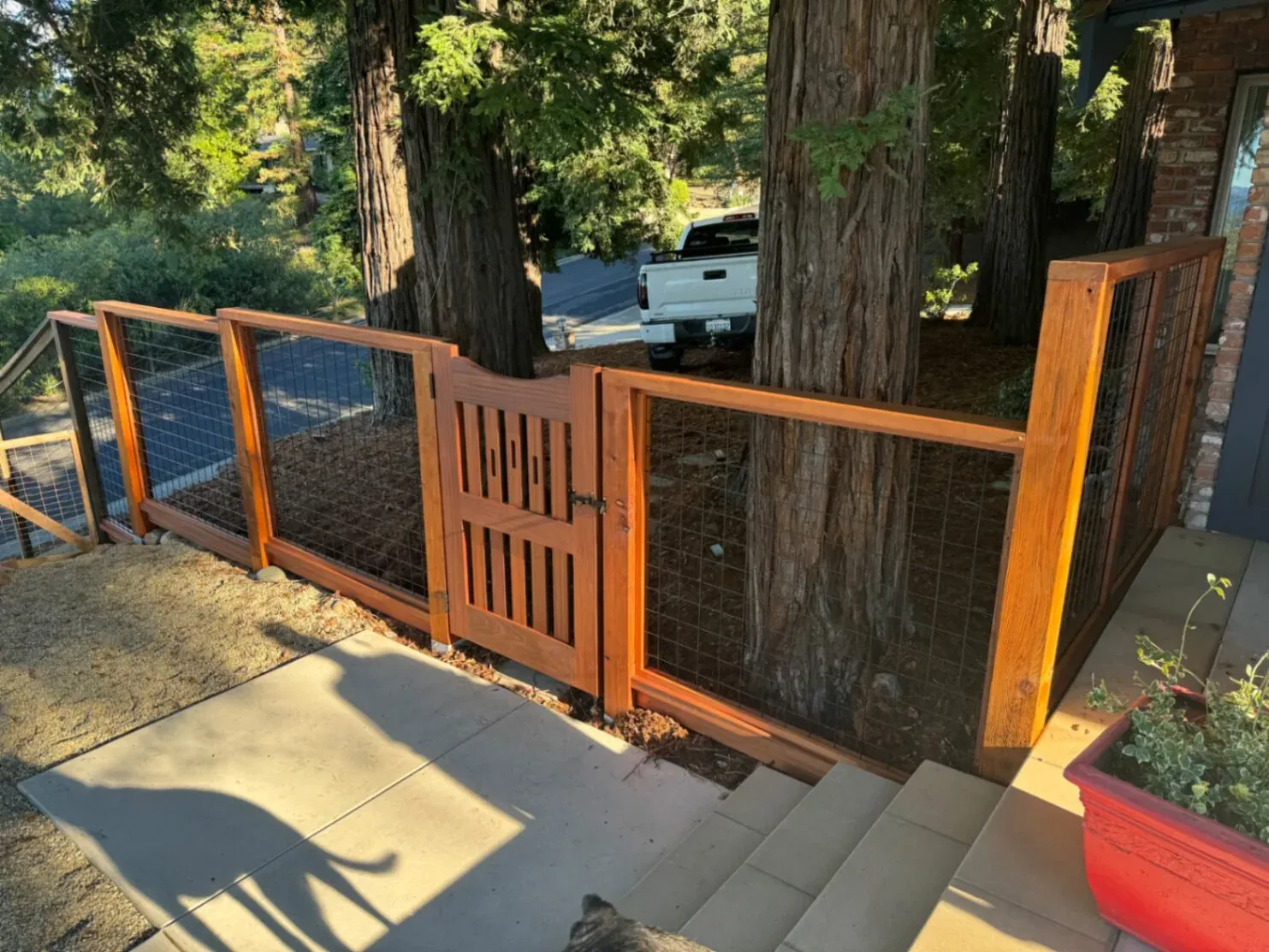
Western red cedar is lighter, more dimensionally stable, and more rot-resistant than modern second-growth redwood, but it is significantly softer and dents more easily. Redwood has more structural heft and holds joinery better, but only when true vertical-grain heartwood is specified. For a gate that must last 25 years, cedar wins on longevity in humid climates; redwood wins on structural integrity in dry inland heat.
Key takeaways
- Western red cedar is lighter, more dimensionally stable, and more rot-resistant than modern second-growth redwood, but it is significantly softer and dents more easily. Redwood has more structural heft and holds joinery better, but only when true vertical-grain heartwood is specified. For a gate that must last 25 years, cedar wins on longevity in humid climates; redwood wins on structural integrity in dry inland heat.
- The species and the wood: Redwood (Sequoia sempervirens) and western red cedar (Thuja plicata) are both conifers native to the Pacific Northwest and coastal California.
- Decay resistance: cedar's hidden advantage: Cedar contains thujaplicins — natural extractives that are among the most effective decay-resistant compounds found in any North American softwood.
- Dimensional stability and the fog belt: Cedar is one of the most dimensionally stable softwoods in North America.
- Joinery and structural integrity: Gate joinery is where redwood's extra density pays back.
- Is cedar really softer than redwood? Yes — significantly. Cedar's Janka hardness is about 350; redwood's is about 450 to 500 depending on grade. That difference is noticeable in how the wood dents, holds screws, and performs in mortise and tenon joints.
Ask any Bay Area homeowner what wood their gate should be built from and you'll hear two names first: redwood and western red cedar. Both are Pacific Coast natives, both are celebrated for outdoor durability, and both have been the regional standard for fences, decks, and gates for more than a century. But they are not the same wood. Density, decay resistance, dimensional stability, and how they accept finish all differ in ways that matter over a 25-year gate life. This piece is a direct comparison from a shop that has built, finished, and repaired gates in both species across Concord, Walnut Creek, Lafayette, and the North Bay.
The species and the wood
Redwood (Sequoia sempervirens) and western red cedar (Thuja plicata) are both conifers native to the Pacific Northwest and coastal California. Old-growth redwood was one of the most durable woods on Earth. Old-growth cedar was similarly exceptional. Both species are now harvested almost exclusively from second-growth plantations, and the material available today is softer, lighter, and less decay-resistant than the wood that built California's reputation for outdoor construction.
The critical difference for gate builders is density. Western red cedar averages 23 pounds per cubic foot. Modern second-growth redwood averages 28 pounds per cubic foot, with old-growth heart redwood reaching 32 to 35. That 20 to 50 percent density difference translates directly to how well each wood holds a mortise, resists denting, and absorbs operator load on an automated gate.
Decay resistance: cedar's hidden advantage
Cedar contains thujaplicins — natural extractives that are among the most effective decay-resistant compounds found in any North American softwood. Even second-growth cedar retains enough of these compounds to earn a USDA rating of 'resistant' to rot. Redwood contains tannins that are also effective, but modern second-growth redwood has significantly lower tannin concentration than old-growth material, and the sapwood content is higher.
In the humid fog belt of Mill Valley, Tiburon, and the Santa Cruz Mountains, cedar's decay resistance shows up in service life. We've seen cedar gates in those microclimates outlast redwood gates by five to eight years when both were built with the same joinery and finish schedule. In dry inland heat — Concord, Walnut Creek, Pleasanton — the gap narrows, and redwood's structural advantages become more important.
Dimensional stability and the fog belt
Cedar is one of the most dimensionally stable softwoods in North America. It moves very little across humidity swings, which means joints stay tight and finishes don't crack as the wood breathes. This is why cedar is the default for sauna construction, boat building, and any application where moisture cycling is extreme.
Redwood is also stable — more stable than most domestic softwoods — but it moves roughly 30% more than cedar across the same humidity range. In Concord's dry-summer, wet-winter climate, that difference is small enough to ignore. In fog-belt Marin, where humidity sits above 70% year-round and swings are damp-to-wetter rather than dry-to-wet, cedar's extra stability prevents the checking and seam-opening that redwood can develop.
Joinery and structural integrity
Gate joinery is where redwood's extra density pays back. A mortise cut into cedar is clean and precise, but the wood is soft enough that the tenon shoulders can compress under load over time. On a heavy automated driveway gate, that compression eventually shows up as a slight rack or sag at the latch stile.
Redwood holds mortise and tenon joints more firmly. The extra density means the tenon shoulders bear against the stile cheeks with less compression, and the drawbore pin seats more securely. For automated gates over 8 feet wide in dry inland climates, we typically specify redwood over cedar for exactly this reason — the structural behavior is measurably better.
For pedestrian gates, garden gates, and any gate under 6 feet wide where the structural loads are modest, cedar's joinery performance is perfectly adequate. The choice then becomes aesthetic and climatic rather than structural.
We're booking design consultations 4–6 weeks out. Send us your driveway photos and we'll come back with a sketch, wood spec, and finish system within five business days.
Finishing behavior over time
Both species weather to silver-gray if left unfinished. Cedar gets there faster — often within a single summer in full sun. Redwood holds its color longer, passing through a longer orange-pink phase before silvering. Clients who want to maintain a warm tone will need to refinish cedar more frequently.
Penetrating oil finishes (we specify Penofin Marine Oil, Armstrong Clark, or Messmer's UV Plus depending on the site) perform well on both species, but cedar's lower density means it absorbs more finish per coat and may need an extra coat to achieve the same surface saturation. Film-forming finishes (varnish, polyurethane) are a poor choice on both species outdoors, but especially on cedar in humid climates, where trapped moisture causes peeling within two years.
Cost, availability, and sustainability
Clear vertical-grain western red cedar and clear all-heart redwood are priced within 10% of each other in the Bay Area market — typically $8 to $14 per board foot for either species in gate-grade material. Construction-grade versions of both are cheaper but unsuitable for a gate that is meant to last.
FSC-certified cedar is more readily available than FSC-certified redwood in the current market. Both species can be sourced sustainably; we specify FSC stock when the client requests it. Transport energy is lower for redwood (it grows in California and Oregon) than for cedar (primarily Washington and British Columbia), though the difference is modest.
Our recommendation by microclimate
For fog-belt and coastal North Bay properties — Mill Valley, Tiburon, coastal Sonoma — we recommend western red cedar. The decay resistance and dimensional stability are worth the softness penalty, and the regional architectural vernacular expects cedar anyway.
For inland East Bay and Sacramento Valley properties — Concord, Walnut Creek, Pleasanton, El Dorado Hills — we recommend clear all-heart vertical-grain redwood. The drier climate reduces cedar's rot-resistance advantage, and the structural demands of wide automated gates favor redwood's extra density.
For clients who want the best of both worlds, we offer hybrid gates: a redwood or hardwood structural frame with cedar cladding on the visible faces. This is especially popular in transitional microclimates like Berkeley and Oakland, where the fog rolls in some mornings but the afternoons are hot and dry.
The finish system, chosen per project
There is no single best finish for a custom gate — the right system depends on the wood species, microclimate, sun exposure, salt load, and the look you want. Our default is Penofin Verde Marine Oil for Sapele, white oak, and teak (penetrating, low-VOC, UV-stable). For western red cedar and redwood we prefer Armstrong Clark's non-drying conditioning oils. Cabot Australian Timber Oil gives a warmer amber tone on mahogany. Sikkens Cetol is reserved for protected coastal doors. Messmer's UV Plus is our pick for ipe and garapa. TWP 100 handles foothill mildew zones. Every spec is documented in your maintenance binder so any qualified refinisher can match it.
- PenofinPenofin Verde Marine Oil
Best for: Sapele, white oak, teak — most inland & wine-country installs
Penetrating, low-VOC, UV-stable transoxide pigment package. Never peels because there is no film.
- Armstrong ClarkArmstrong Clark Semi-Transparent Oil
Best for: Western red cedar, redwood, sun-exposed inland gates
Non-drying conditioning oils sit deep; drying oils harden at the surface — superior for cedars under intense UV.
- CabotCabot Australian Timber Oil
Best for: Mahogany and dense tropicals when a richer amber tone is preferred
Tung-oil-and-linseed blend that warms hardwood without obscuring grain. Color-matches well for restoration work.
- SikkensSikkens Cetol SRD / Cetol Door & Window
Best for: Coastal salt-spray sites and high-traffic pedestrian doors
Alkyd-modified resin with mildewcide; the only film system we will spec, and only on protected vertical surfaces.
- Messmer'sMessmer's UV Plus for Hardwoods
Best for: Ipe, garapa, and ultra-dense hardwoods that reject most finishes
Specifically engineered for oily tropicals; the trans-oxide pigments hold color on woods where Penofin can be slow to soak.
- TWPTWP 100 Series Total Wood Preservative
Best for: Sierra foothill installs with heavy winter mildew pressure
EPA-registered mildewcide and fungicide package — used when the site has shade and rain together.
About materials
For more answers, see our full FAQ.
Let's design a gate that belongs to your home.
Tell us about the entrance you want to build. We respond same-day to consultations booked before 2pm, next business day after.